
Connecticut gardeners can drop carrot seed in the ground weeks before the last spring frost, since the crop tolerates cool soil and shrugs off a light freeze once it sprouts. But counting back from frost only answers half the question here. The soil that USDA treats as representative of the state runs sandy, strongly acid, and excessively drained, and that combination changes how deep you sow, how often you water, and whether the bed needs help before a single seed goes in.
The short answer
The soil USDA lists as representative of Connecticut is the Windsor series, an Entisol, a young soil with almost no layered profile to speak of. Its surface horizon runs about 82 percent sand, 2 percent clay, and 16 percent silt, with a pH near 5.1, strongly acid, and a drainage class described as excessively drained. That combination puts Windsor soil about as far from heavy clay as garden ground gets.
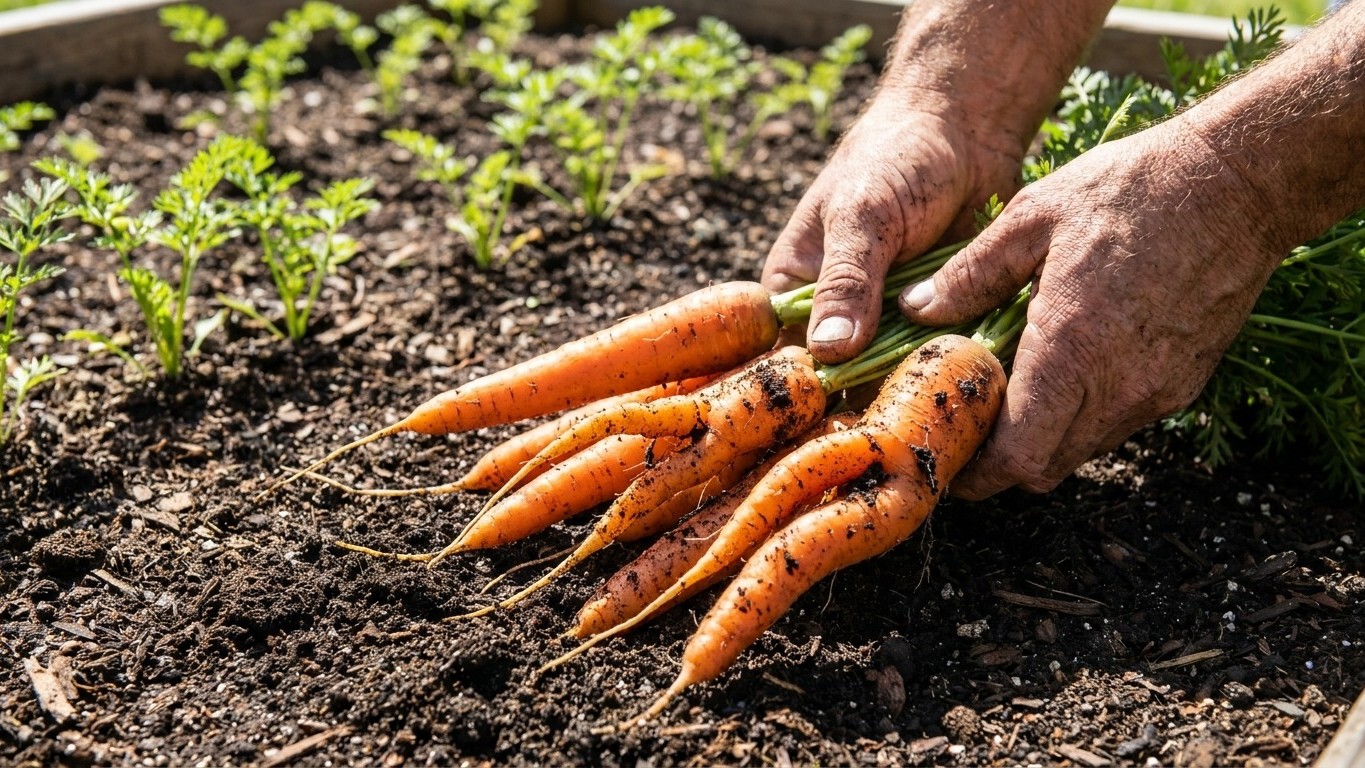
That matters directly for carrots, because Utah State University Extension is blunt about what causes a root to fork: heavy or rocky soil that resists the taproot as it grows down. With clay sitting at just 2 percent, the Windsor series carries almost none of the density that pushes a carrot sideways or splits it around an obstruction. Sown into ground built like this, a carrot is unlikely to fork from soil weight alone.
The catch is that excessively drained soil cuts both ways. Water moves through ground that is 82 percent sand fast, faster than a shallow-rooted seedling can always keep pace with, so a bed built on Windsor-type soil dries between waterings unless organic matter is worked in to slow that drainage. The survey’s organic matter reading for this series runs close to 95 percent at the surface, but that figure reflects an undisturbed layer of forest litter measured where the soil was mapped, not a tilled vegetable row. Turn that same ground into a garden bed and the organic matter content drops close to zero almost immediately, which is exactly why compost belongs in the plan from the first season rather than as a fix applied later.
Utah State’s remedy for problem ground is compost worked in generously, plus double digging to loosen depth so the root can run straight, or a raised bed built above the native soil entirely. On Windsor-type ground, that same compost does double duty: it adds the organic matter the surface lacks once tilled, and it slows the drainage that would otherwise leave young carrot seedlings gasping between rains.
None of this describes any single backyard. Connecticut is mapped across hundreds of distinct soil series, and a garden a few miles from where Windsor soil dominates can sit on heavier, wetter, or rockier ground entirely, especially near river bottoms or on land a builder has cut, filled, or compacted. Treat these numbers as a regional starting point, a guess about which direction the soil probably leans, not a reading of the dirt under your own rake.
The test that settles it in your own garden
Soil surveys describe the county. They don’t describe the raised bed by the garage or the row along the back fence. The only way to know what a carrot will actually meet underground is to check the soil directly, and none of the following steps require a lab.
- Dig a test hole about a foot deep with a spade in the spot you plan to sow, and look at what comes up. Does the color or texture change partway down, or is it the same dirt the whole way? A hard, pale layer partway down often signals compacted subsoil or hardpan, either of which will stop a carrot root cold.
- Sift the dug soil through your hands and check for stones. Frequent stones, even small ones, are enough to deflect a growing taproot and cause the same forking that heavy clay causes. Note how deep the workable, stone-free layer runs before you hit rock or dense subsoil.
- Take a moist handful and try the ribbon test: squeeze it between thumb and finger and see if it holds a shape. Sandy soil falls apart and won’t ribbon at all. Silty soil forms a short, crumbly ribbon. Clay-heavy soil forms a long, slick ribbon that holds together. This one test tells you more about which direction your own ground leans than any regional average can.
- Dig a hole roughly a foot deep, fill it with water, let it drain once, then fill it again and time how long the second fill takes to disappear. Water that vanishes almost immediately points to sandy, fast-draining ground that will need organic matter to hold moisture. Water that sits for hours points to heavier, slower-draining soil where a raised bed helps more than compost alone.
What goes wrong here
Connecticut’s climate and soil tendencies combine to cause a short, recurring list of carrot failures, each one traceable back to how the ground handles water and density.
- Forking in heavy ground: where a garden sits on denser or rockier soil than the sandy Windsor series that represents the state, roots meet resistance and split or curl around obstructions as they grow down. Utah State University Extension’s fix is straightforward: work in generous compost and double dig the bed a full spade’s depth to loosen it, or skip the native soil problem entirely by building a raised bed filled with a looser mix.
- Poor germination in a hot spell: carrot seed is tiny and sits close to the surface, and fast-draining, sandy ground dries out within hours during a warm stretch, well before the seed has taken up enough moisture to sprout. A row lightly mulched, or covered with a board until the first seedlings show, keeps the surface from crusting and drying out between waterings.
- Splitting from uneven water: excessively drained soil swings between dry and saturated fast, since water passes straight through rather than being held near the root. A stretch of dry weather followed by a heavy soak makes the root swell suddenly and crack along its length. Watering on a consistent schedule, backed by mulch to slow evaporation between waterings, keeps that swing narrower and the root intact.
Common questions
Do I need to test my soil, or can I just go by the state average?
Go by your own soil. The Windsor series describes what USDA treats as representative of Connecticut, but the state is mapped across hundreds of distinct soil series, and gardens even a short distance apart can differ completely. The dig-and-feel test in this article settles the question for your own bed in a few minutes, with no state figure needed.
Is Connecticut’s soil naturally too acidic for carrots?
The representative Windsor series runs strongly acid, with a surface pH near 5.1, but that figure describes the mapped soil series, not any individual garden’s own reading. A home soil test is the only way to know the actual pH of a specific bed before deciding whether it needs adjusting.
If my soil is sandy like the Windsor series, do I still need compost?
Yes. Sandy, excessively drained soil resists forking because it lacks the density that heavy clay carries, but it also drains too fast to hold moisture near a carrot root. Compost worked into sandy ground slows that drainage and adds organic matter that a tilled sandy bed otherwise lacks.
Since carrots are sown directly outdoors, does the 70- to 100-day maturity window start at seeding or later?
It starts at seeding. Carrots are sown in place and never transplanted, so the 70- to 100-day window Utah State University Extension describes for the crop counts from the day the seed goes into the ground, not from any later stage of growth.