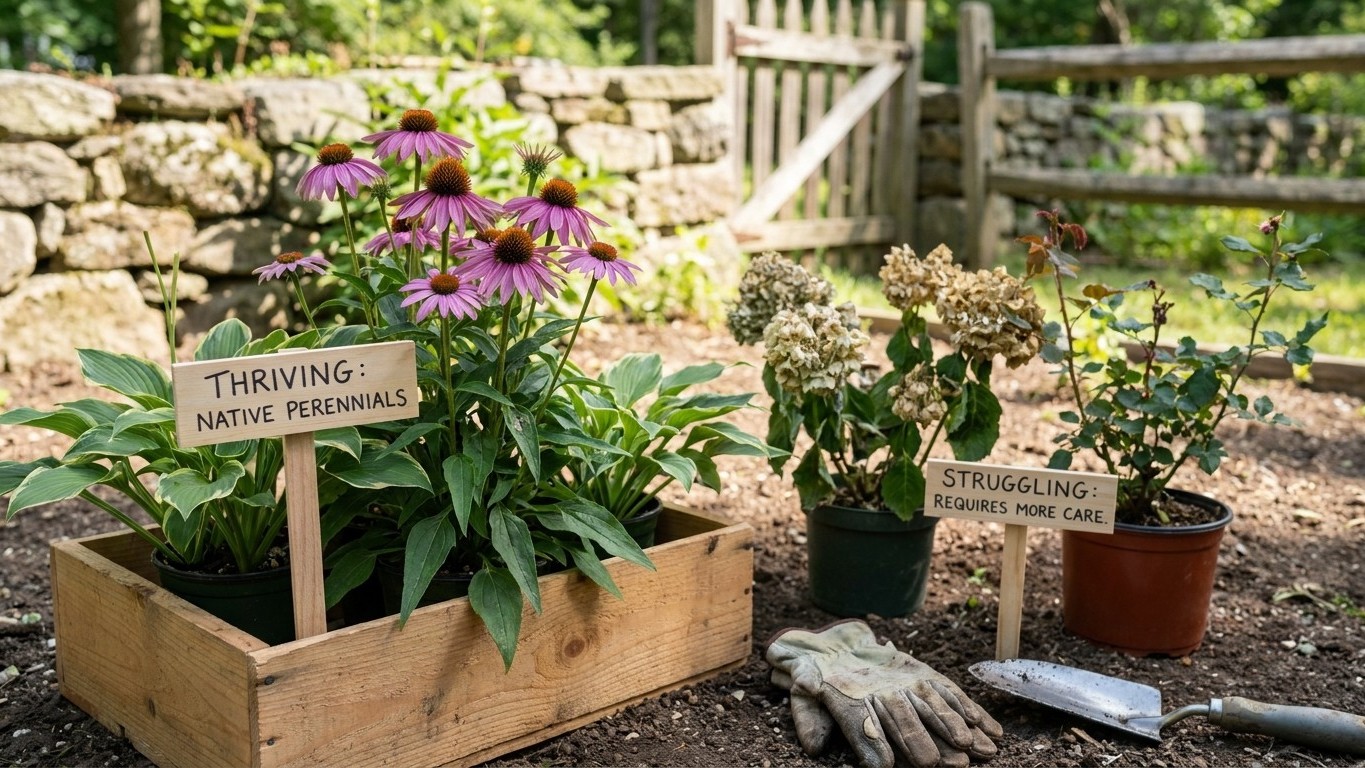

Flowers that thrive in Connecticut are the ones built for the state’s USDA zones 6a to 7b (USDA Plant Hardiness Zone Map, 2023 normals), and for a growing season that runs, at the Bridgeport reference station, from a last spring frost of April 2 to April 12 to a first fall frost of October 28 to November 10 (NOAA’s 1991-2020 climate normals). Check the hardiness zone printed on a plant tag against your own town, not just the state-wide range, before you buy it.
What thrives in Connecticut

Cold hardiness first
Some flowers will limp along in a Connecticut yard for a year or two and quietly die, and others will still be blooming there when you’re old — the difference almost always comes down to whether the plant was ever built to survive a real winter in this state. Zone matters more than anything else you’ll read on a plant tag. Before you buy anything, find your zone on the label, then check it against your own town rather than trusting a general “Connecticut-friendly” sticker at the garden center, because the coast and the hills here are not the same winter at all.
Summer heat and humidity
Summer heat load here is moderate by national standards. Bridgeport averages just 6.2 days a year at 90F or hotter (NOAA’s NCEI 1991-2020 normals), which is not the punishing stretch gardeners in the Mid-Atlantic or the South deal with. What causes more trouble is humidity sitting on foliage through July and August. Powdery mildew shows up on garden phlox and bee balm, and black spot works through roses that were bred for drier air. Choosing disease-resistant cultivars matters more here than choosing drought-tolerant ones, since water is rarely the limiting factor.
Families that combine winter hardiness with tolerance for a humid summer include peonies (Paeonia lactiflora hybrids), daylilies (Hemerocallis), purple coneflower (Echinacea purpurea), black-eyed Susan (Rudbeckia fulgida), and garden phlox cultivars bred specifically for mildew resistance, such as ‘David’ and ‘Jeana’. Ornamental grasses like little bluestem (Schizachyrium scoparium) and switchgrass (Panicum virgatum) shrug off both the cold and the humidity without much fuss. Space plants for airflow rather than packing them tight, since damp, still air between leaves does more damage over a Connecticut summer than any single heat wave.
Native plants worth the space
Why natives establish faster
Plants native to the wider Northeast are already matched to this rainfall pattern, this soil chemistry, and this freeze-thaw cycle, so they spend less time sulking after transplant and less time needing supplemental water once their roots are down. The first full season is the only one where a native perennial needs regular watering, after that most survive on rainfall alone in an average year. That is not true of many popular garden imports, which keep needing help indefinitely.
The pollinator case is separate from the maintenance case. Native bees, and the moths and butterflies that evolved alongside these plant families, often need a specific host plant to complete their life cycle rather than just any flower for nectar. Milkweed species like butterfly weed (Asclepias tuberosa) are the textbook example, since monarch caterpillars eat almost nothing else. A border built entirely from non-native ornamentals can look full and still support very little insect life.
Plants to look for
- New England aster (Symphyotrichum novae-angliae) – tall, purple, blooms into fall
- Wild bergamot (Monarda fistulosa) – lavender flowers, draws bees and hummingbirds
- Butterfly weed (Asclepias tuberosa) – orange clusters, drought-tolerant once rooted
- Cardinal flower (Lobelia cardinalis) – deep red spikes, likes damp ground
- Wild columbine (Aquilegia canadensis) – early spring bloomer, tolerates part shade
- Joe Pye weed (Eutrochium purpureum) – large, pink-mauve, works at the back of a border
These same species carry the wider Northeast region, which is why the same native list works its way into flowers that actually thrive in Maine just as it does here, even though the two states differ in their frost windows and zone ranges. Rather than claim a precise native range for any one species down to the county, treat this as a starting list and confirm locally before buying, since nursery tags are not always accurate on origin.
Perennials that come back

What returns reliably here
At zones 6a to 7b, a solid list of perennials comes back without protection most winters: peonies, daylilies, hostas, garden phlox, coneflowers, black-eyed Susans, catmint (Nepeta), and most true geraniums (the hardy cranesbill type, not the tender bedding kind sold as Pelargonium). These are the backbone plants worth putting real budget into, since a well-sited clump only grows larger and more floriferous with each passing year rather than needing replacement.
What gets grown as an annual here
Plenty of plants sold in the same nursery aisle are perennial only in warmer states. Lantana, tender salvias like Salvia guaranitica, and most Pelargonium geraniums are reliably perennial in places like Maryland, where the winter low sits well above Connecticut’s, but they will not survive a Connecticut winter outdoors and are grown here as one-season annuals or overwintered indoors. The zone number on the tag is the number to check, not the plant’s common name or its price, since two plants that look nearly identical on the shelf can have completely different cold limits.
Reading the tag against your zone
A tag that reads “hardy zones 4-9” is unambiguous here, that plant will winter over in every part of Connecticut. A tag reading “hardy zones 7-10” is a coin flip near the Sound and a near-certain loss inland, given USDA’s 2023 map puts most of the state’s interior at the colder end of the 6a-7b range. When the range printed on the tag straddles the line, buy it expecting to treat it as an annual, and treat any perennial performance as a bonus rather than a plan.
Putting a border together
Layering by height
A border reads as intentional when height steps down from back to front rather than jumping around at random. Put tall bloomers like Joe Pye weed or garden phlox at the back or center of an island bed, mid-height plants like coneflower and black-eyed Susan in the middle band, and low edging plants like catmint or creeping phlox at the front.
| Position | Height range | Example plants |
|---|---|---|
| Back | 4-6 ft | Joe Pye weed, tall garden phlox |
| Middle | 2-3 ft | Coneflower, black-eyed Susan, daylily |
| Front | under 12 in | Catmint, creeping phlox, dwarf aster |
Bloom succession across the season
The growing season at the Bridgeport reference station runs from a last spring frost of April 2 to April 12 to a first fall frost of October 28 to November 10 (NOAA’s 1991-2020 climate normals), and inland gardens should expect that window to open later and close earlier. Plan for something in bloom at each stage of it: columbine and peony for the first weeks after the frost date clears, coneflower and phlox through the humid middle of summer, and asters and Joe Pye weed carrying color into the shortening days of fall. A border planted for one big June show and nothing else looks empty for the other five months.
Repeating color and leaving room
Repeat the same two or three colors at intervals through the bed rather than treating every plant as its own isolated statement. A border where purple coneflower and purple aster echo each other at both ends reads as designed, even with dozens of different species in between. Leave real space between new perennials at planting time, since a one-gallon pot of daylily or phlox will be three times its current width in two seasons, and crowding invites the very humidity problems covered above.
Local help
UConn Extension keeps regional plant lists and disease bulletins specific to Connecticut conditions, and its extension service is the first stop for a soil test or a question about a plant not covered here. The UConn Master Gardener program trains volunteers county by county who staff plant clinics and answer exactly this kind of question in person. For other projects around the property, the broader set of Connecticut guides covers vegetables, lawns, and seasonal tasks on the same climate basis used here.
Common questions
Will hydrangeas turn blue in my Connecticut soil?
It depends on your soil’s pH rather than anything about the state as a whole, since bigleaf hydrangea (Hydrangea macrophylla) blooms blue in acidic soil and pink in alkaline soil, with purple in between. Get a soil test through UConn Extension before adding aluminum sulfate or garden lime, since guessing in either direction can stress the plant without changing the color you wanted.
Do I need to deadhead perennials to get them to bloom again next year?
Not for next year’s survival, no. Deadheading mostly encourages a second flush of bloom in the same season on repeat-bloomers like coneflower and catmint, and tidies up spent flowers on plants like peony that only bloom once. Leaving seed heads on black-eyed Susan and coneflower through fall and winter also feeds birds, so it is worth skipping the deadheading on those specifically.
What does “hardy to zone 6” actually mean if I’m buying at a zone 7 nursery?
It means the plant is rated to survive winter lows typical of zone 6, which is colder than zone 7, so a zone 6 rating is safe to plant anywhere in Connecticut’s 6a-7b range. The risk runs the other way: a plant rated only to zone 7 is not guaranteed to survive a zone 6a winter, which describes most of inland Connecticut.
Can I direct-sow flower seeds outside instead of starting them indoors?
Many annuals and hardy perennials do fine direct-sown once the danger of frost has passed, and at the Bridgeport reference station that means after the April 2 to April 12 window, later inland. Slower-germinating perennials and anything you want blooming its first summer generally do better started indoors six to eight weeks before that date, then transplanted out once the soil has warmed.
Related guides
- Flowers That Actually Thrive in New York, and the Ones That Struggle
- Flowers That Actually Thrive in Massachusetts, and the Ones That Struggle
- Flowers That Actually Thrive in Maine, and the Ones That Struggle