
Maryland covers a real spread of growing conditions, but the state as a whole sits at USDA hardiness zone 5b-8a, and Baltimore averages 24.6 days a year at 90F or hotter according to NOAA’s 1991-2020 climate normals. That combination of cold winters and muggy summers rules out plants that want a dry heat or a mild one. Before you buy anything, match the hardiness zone on the plant tag to your own county rather than to the state range as a whole.
What thrives in Maryland

Three traits decide whether a flower earns its space here: winter cold hardiness, tolerance for heat layered with humidity, and the ability to shrug off a dry August once established. NOAA’s 1991-2020 climate normals for Baltimore put the coldest month’s average low at 25.4F, which is the number that actually determines whether a marginal perennial survives the winter rather than just looking cold on paper. A plant that is rated hardy to 20F on the tag has room to spare here. One rated only to 30F is gambling every year it stays in the ground.
Heat and humidity change the calculus too
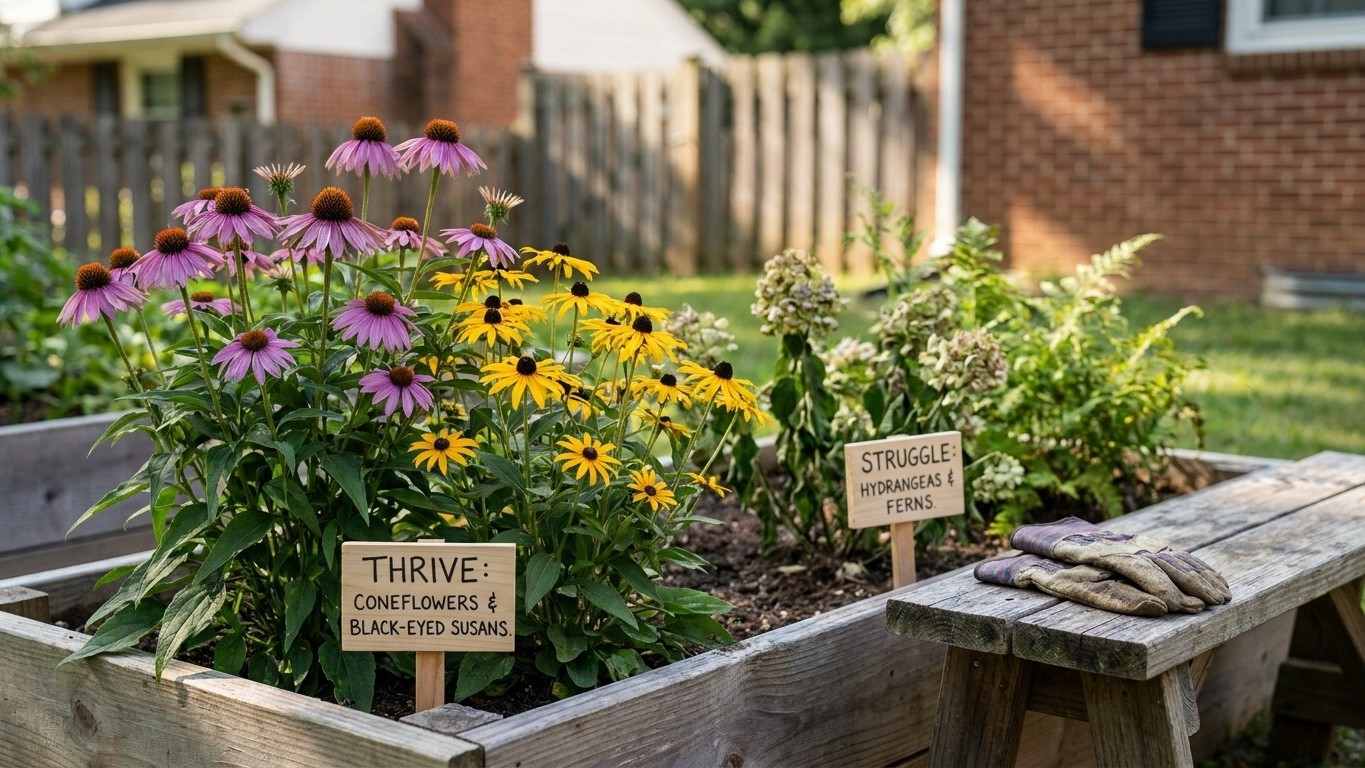
Baltimore’s 24.6 days a year above 90F, per NOAA’s normals, means humidity-sensitive flowers rot at the base or develop powdery mildew before they ever get to bloom well. This is why lavender and delphinium, which perform beautifully in a drier climate, tend to sulk or die out in a Maryland border within a year or two. Heat-and-humidity-tolerant genera do the heavy lifting instead: daylilies (Hemerocallis), coneflowers (Echinacea), black-eyed Susans (Rudbeckia), garden phlox (Phlox paniculata) bred for mildew resistance, and Russian sage (Perovskia, now often sold as Salvia yangii). These hold their form through a wet, sticky July without extra intervention.
Drought resistance matters less for survival and more for how much you’ll be watering in August. Sedum (Hylotelephium), catmint (Nepeta), and yarrow (Achillea) all root deep and coast through dry spells once they’ve had a full season to establish. The families that carry all three traits together, cold hardiness, heat tolerance, and drought resistance, are the ones worth building a border around, rather than fighting the climate with a plant that wants conditions Maryland doesn’t offer. Compare that to a state like Mississippi, where the growing challenge runs almost entirely the other direction: our guide to flowers that actually thrive in Mississippi, and the ones that struggle covers a climate with far more extreme heat and a much shorter or nonexistent real winter.
Native plants worth the space
Plants native to the wider mid-Atlantic and eastern United States have already solved the local puzzle: they’ve spent thousands of years adapting to this exact rhythm of cold winters, humid summers, and the freeze-thaw cycles in between. That history is why they need less babying once they’re in the ground. A native coneflower or black-eyed Susan planted in decent soil rarely needs supplemental water past its first year, and it won’t need winter protection the way a borderline-hardy import might.
What to plant and why it matters for pollinators
Purple coneflower (Echinacea purpurea), black-eyed Susan (Rudbeckia hirta), butterfly weed (Asclepias tuberosa), wild bergamot (Monarda fistulosa), and blue false indigo (Baptisia australis) are all native across a broad swath of the eastern U.S. and perform reliably in Maryland gardens. These aren’t just decorative. Native plants support the insects that evolved alongside them, and that support chain runs deeper than a flower that simply offers nectar. Butterfly weed is a host plant for monarch caterpillars specifically, not just an adult nectar source, which is a distinction that matters if the goal is more than a pretty border.
A few practical notes on using natives well:
- Wild bergamot spreads by rhizome and can take over a small bed if not divided every few years.
- Blue false indigo is slow to establish, sometimes taking two or three seasons to bloom heavily, but it lives for decades once settled.
- Butterfly weed resents being moved once its taproot is established, so plant it where you want it to stay.
- Black-eyed Susan reseeds freely and will fill gaps in a border on its own within a couple of years.
None of this means avoiding cultivated varieties. A native species crossed into a garden cultivar, like Echinacea ‘Magnus’ or Rudbeckia ‘Goldsturm’, usually keeps most of the straight species’ toughness while offering more uniform bloom size or color. The tradeoff is worth it for most home borders, and it’s a reasonable middle ground between a wild look and a curated one.
Perennials that come back

At Maryland’s zone range of 5b to 8a, a wide band of perennials return reliably year after year, but the honest answer depends on which end of that range you garden in. A plant hardy to zone 6 comes back without effort in Baltimore or on the Eastern Shore. The same plant is a coin flip in the colder pockets of Western Maryland, where the growing conditions run closer to zone 5b.
Reading a plant tag against your own zone
Every reliable plant tag lists a hardiness range, something like “zones 6-9.” The rule that matters is simple: if your zone falls inside that range, the plant should overwinter outdoors without protection. If your zone falls just outside it, on the cold side, treat the plant as a gamble at best and an annual at worst. This is the exact issue behind plants like lantana and tender salvias (Salvia guaranitica, for instance), which are true perennials in the Deep South but get grown as annuals across most of Maryland because winter kills them back to the roots, and the roots themselves often don’t survive either.
Compare that to a colder state like Wisconsin, where the entire hardiness conversation shifts several zones colder and rules out plants that Maryland gardeners take for granted. Our guide to flowers that actually thrive in Wisconsin, and the ones that struggle walks through what that colder baseline does to plant choice.
Perennials that hold up well across most of the state
Daylilies, garden phlox, coneflower, black-eyed Susan, sedum, catmint, and Russian sage all sit comfortably within Maryland’s zone range and return without fuss in most counties. Peonies do especially well here because they actually benefit from a real winter chill, something Maryland provides reliably even in its milder eastern counties. Hardy hibiscus (Hibiscus moscheutos), a native perennial with dinner-plate-sized blooms, dies back completely each fall and looks dead well into late spring, which catches a lot of new gardeners off guard before it comes roaring back in June.
Putting a border together
A border that looks good all season is built in layers, not planted all at once and left to sort itself out. Put the tallest plants, like Russian sage or hardy hibiscus, at the back or center of an island bed. Mid-height plants, coneflower, phlox, black-eyed Susan, fill the middle. Low, spreading plants like catmint or creeping sedum edge the front and hide the bare stems of everything behind them.
Succession of bloom matters more than any single showy plant
The most common beginner mistake is buying only what’s blooming at the garden center in May, which front-loads a border with spring color and leaves it flat by August. Plan for at least three overlapping bloom windows: something spring-flowering like peony or catmint, something for the long summer stretch like coneflower, phlox, or daylily, and something that carries into fall, like sedum or aster. Repeating the same two or three colors through those windows, rather than treating each bloom period as its own separate palette, is what makes a border read as designed rather than accidental.
Timing your annual planting around frost matters here too. NOAA’s 1991-2020 climate normals put Baltimore’s last spring freeze window at April 3 to April 16, and the first fall freeze at October 26 to November 5. Tender annuals like zinnias or lantana shouldn’t go in the ground until that spring window has passed, and Western Maryland’s mountain counties run noticeably later than that, sometimes by several weeks, while the Eastern Shore tends to run milder. Leave real space between transplants at planting time. A border that looks sparse in May because plants are spaced for their mature width will look crowded and thriving by July, and that’s the correct order to get it wrong in.
Local help
The University of Maryland Extension runs the state’s Master Gardener program, which trains volunteers county by county and is one of the best free resources for plant lists suited to your specific soil and microclimate rather than the state as a whole. Reach the extension service directly at extension.umd.edu for county-level contacts, and for more on gardening elsewhere in the state, our Maryland guides hub covers vegetables, soil, and seasonal timing beyond flowers.
Common questions
Can I grow hydrangeas in Maryland?
Yes, and they’re one of the most reliable shrubs across the state’s zone range. Bigleaf hydrangea (Hydrangea macrophylla) can struggle to bloom some years if a late spring freeze damages buds that formed the previous fall, so panicle hydrangea (Hydrangea paniculata), which blooms on new wood, is a safer bet if reliable yearly flowering matters more to you than a specific bloom color.
Why did my perennials from a warmer climate die over winter?
Most likely the plant’s hardiness rating didn’t actually match your zone, even if the tag said “perennial.” Many big-box garden centers stock plants grown for a national market, and a plant labeled hardy to zone 7 will often die back in the colder pockets of Western Maryland even though it survives fine near Baltimore or on the Eastern Shore.
Do I need to deadhead everything to keep flowers blooming?
No, but it depends on the plant. Coneflower and black-eyed Susan will rebloom faster if spent flowers are removed, but leaving some seed heads standing into fall feeds birds and lets the plant reseed itself, which is worth doing at least on part of a native planting.
Is it too late to plant flowers if I missed the spring window?
Not necessarily. Many perennials establish just as well planted in late summer or early fall, as long as they go in with enough time to root before the ground freezes, and container-grown perennials can technically go in anytime the soil isn’t frozen or waterlogged. Annuals are the exception, since they need the full frost-free stretch to bloom and produce, so a late start there really does cost you flowering time.
Related guides
- Flowers That Actually Thrive in Delaware, and the Ones That Struggle
- Flowers That Actually Thrive in Pennsylvania, and the Ones That Struggle
- Flowers That Actually Thrive in Mississippi, and the Ones That Struggle