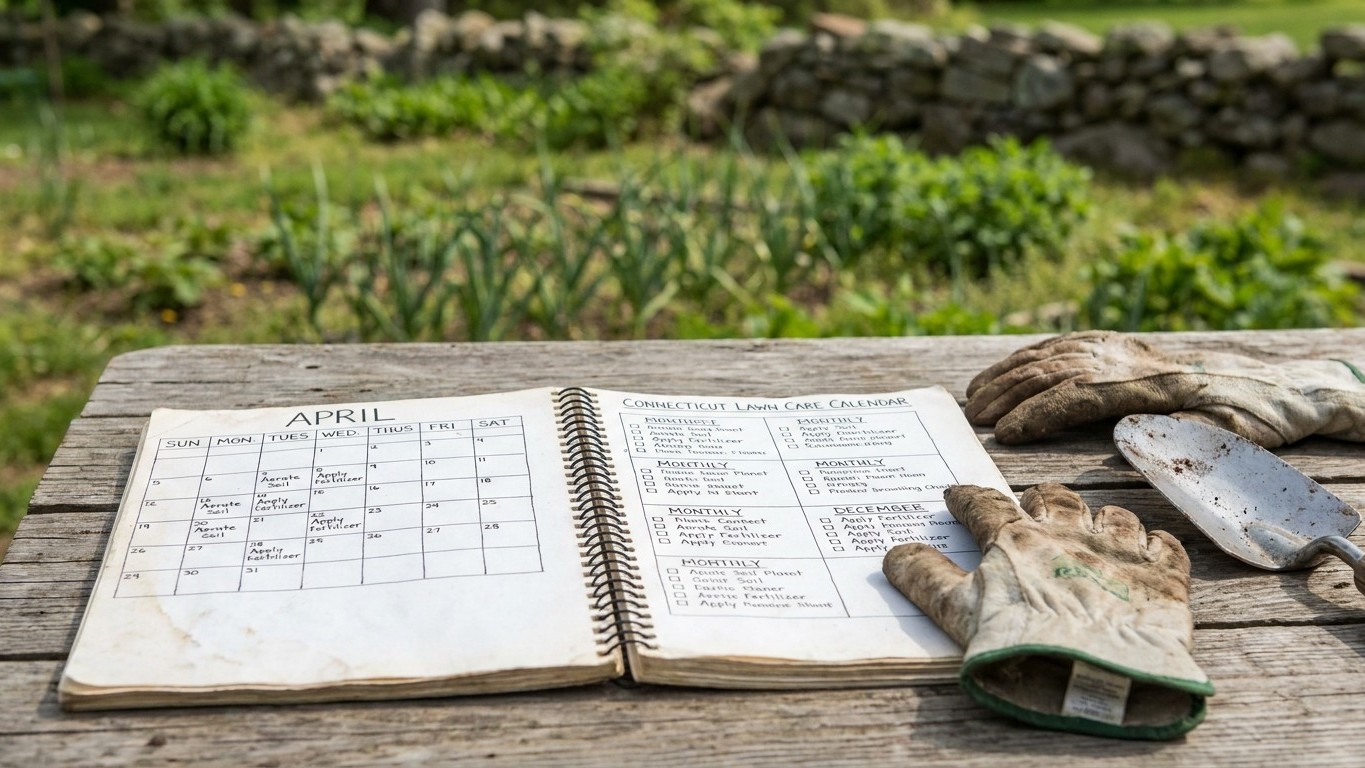

Connecticut lawns run on a fall-first calendar, not a spring one. The Homestead Post’s zone reading places the state in the cool-season turf zone, and NOAA’s 1991-2020 climate normals put Bridgeport’s first fall freeze at October 28 to November 10. The action that follows: plan your last fall feeding and any overseeding to land before that freeze window, not after it, and pick your grass from the cool-season list rather than anything bred for southern lawns.
The short answer for Connecticut
Labor Day weekend does more for a Connecticut lawn than any April ritual ever will. Most lawn advice opens in spring, pushing seed and fertilizer the moment the ground thaws — but here, that early rush mostly feeds crabgrass. Connecticut soil doesn’t cool and settle until September, and that’s when roots actually take hold instead of just leaves. Get the fall stretch right, and the months that follow mostly take care of themselves.
Which of the five you choose, and how you treat it, depends on light, foot traffic and how much watering you’re willing to do. Tall Fescue‘s deep roots ride out dry spells with little irrigation. Kentucky Bluegrass spreads by rhizome and fills in bare patches on its own, but wants more water and nitrogen to do it. Fine Fescues need almost no fertilizer and hold up in shade where the others thin. Perennial Ryegrass germinates fast enough to nurse a new lawn through its first weeks. Rough Bluegrass tolerates wet, shaded ground the rest would rot in, but fades once summer heat sets in.
| Grass | Drought tolerance | Shade tolerance | Wear tolerance |
|---|---|---|---|
| Tall Fescue | High | Moderate | High |
| Kentucky Bluegrass | Moderate | Low | High, self-repairing |
| Perennial Ryegrass | Low | Moderate | Moderate |
| Fine Fescues | Moderate | High | Low |
| Rough Bluegrass | Low | High | Low |
For a closer look at how these five stack up on soil and sun before you commit, see The Best Grass Seed for Connecticut Lawns. Fall is the season that decides most of what follows, and NOAA’s normals put Bridgeport’s first freeze at October 28 to November 10. Bridgeport is a Long Island Sound coastal station and reads the mildest end of the state’s range: further inland or north, that freeze usually arrives earlier.
Working through the year

Tall Fescue is the one cool-season species with a published month-by-month calendar behind it, Clemson Cooperative Extension’s HGIC 1219 Tall Fescue Maintenance Calendar, and since Tall Fescue is one of the five grasses that actually holds up in Connecticut, its rates and timing are the closest thing the state has to a script. Kentucky Bluegrass, Perennial Ryegrass, Fine Fescues and Rough Bluegrass follow the same shape of year, spring growth, summer stress, fall recovery, but each wants its own nitrogen rate and mowing height, so treat the figures below as the Tall Fescue baseline and adjust down for the others. If you’re still choosing which of the five to plant, that comes first, and once the lawn is established, per Connecticut Lawn Care, this calendar picks up from there.
Spring: March through May
Mow as soon as growth restarts, keeping the deck at 2.5 to 3.5 inches per HGIC 1219, and never take off more than a third of the blade in one pass. Skip a heavy nitrogen feeding here. Clemson’s calendar puts most of a Tall Fescue lawn’s yearly nitrogen budget, roughly 3 to 4 pounds per 1,000 square feet, into fall, because spring nitrogen pushes leaf growth at the expense of root growth right before summer heat arrives. A pre-emergent crabgrass application, if you use one, goes down once soil temperatures warm consistently, not on a fixed calendar date, since a cold spring pushes that window later regardless of the month on the wall.
Summer: June through August
Raise the mower to the top of that 2.5 to 3.5 inch range, or slightly above it, once heat sets in. A taller blade shades the crown and roots and slows moisture loss. Irrigation is optional, but if you do water, HGIC 1219 puts the figure at about 1 inch per week, applied in one or two soakings rather than daily sprinkling that only wets the surface. Nitrogen stays light to none this quarter. A humid Connecticut summer paired with a heavy feeding is exactly the combination that invites brown patch fungus in Tall Fescue, and the damage shows up as ragged brown rings within days of the conditions that caused it, not weeks later.
Fall: September through November
This is the working season. Core aerate and overseed in September, while soil is still warm enough for germination but air temperatures have cooled enough to slow weed competition. HGIC 1219 schedules the bulk of the year’s nitrogen here too, split across two applications roughly a month apart, to rebuild roots before dormancy. The last feeding of the year needs to land before, not after, the ground freezes. At Bridgeport, NOAA’s 1991-2020 normals put that freeze at October 28 to November 10, so a Bridgeport-area lawn’s final application should be down and watered in ahead of that window. Inland and northwest Connecticut lawns should move that deadline earlier, sometimes by two weeks or more.
Winter: December through February
Cool-season turf goes dormant, not dead, once real cold sets in, and there’s nothing to feed or mow. Stay off frozen or frost-covered grass. Foot traffic on frozen blades bruises the tissue and leaves thin, discolored patches once growth resumes in spring.
What changes across Connecticut
Every figure in the calendar above is read at or near Bridgeport, a coastal station on Long Island Sound, and NOAA credits it with the mildest freeze window in the state. Move away from the coast and the season compresses from both ends.
The Litchfield Hills and the rest of northwest Connecticut sit at higher elevation and further from the Sound’s moderating water, so frost arrives earlier in fall and lingers later in spring than the Bridgeport figures suggest. A calendar timed to Bridgeport’s window risks putting the last fall feeding down too late for a Litchfield Hills lawn, and pushing the first spring mowing too early for the same ground.
Shoreline towns along Long Island Sound, from Greenwich east through New London, run closest to the Bridgeport numbers, since the same body of water moderating Bridgeport moderates them too. The Connecticut River valley and the rest of the state’s interior fall in between, warmer than the northwest hills but cooler than the coast, without a station in the record precise enough to give them their own date range.
None of this changes which grasses grow. Fine Fescues, Kentucky Bluegrass, Perennial Ryegrass, Rough Bluegrass and Tall Fescue remain the cool-season standard from the shoreline to the Massachusetts line. It changes only when you do each task, and the safest adjustment for inland and northwest lawns is to treat Bridgeport’s window as the late end of the range and work backward from there.
The mistakes this climate punishes
Seeding a cool-season lawn in late spring or early summer is the most common mistake, and it fails for a simple reason: new grass needs weeks of mild, moist weather to root before it faces real stress, and a Connecticut summer starts pushing into the 90s within weeks of a May sowing. The damage doesn’t show as bare ground right away. It shows in July and August, when thin, shallow-rooted seedlings brown out under the first real dry stretch and never recover the way an established fall-seeded lawn would.
Mowing too short in summer heat is the second. Scalping a cool-season lawn below about 2.5 inches in July removes the leaf area the plant uses to shade its own crown and roots, and the result is a lawn that goes drought-stressed weeks earlier than a neighbor’s cut at 3.5 inches, even with identical rainfall. The damage reads first as a dull, grayish cast to the blades, then as widening brown patches through August.
Heavy nitrogen in July and August is the third, and it’s usually borrowed from a spring-lawn habit that doesn’t transfer to summer. Pushing leaf growth during the hottest, most humid stretch of the year feeds the fungal diseases, brown patch and dollar spot among them, that thrive in exactly those conditions, and the ragged, irregular brown rings they leave behind get blamed on drought when fertilizer was the actual cause.
The fourth is mistaking summer dormancy for a dead lawn and reacting with a full reseed. A cool-season lawn that browns uniformly across the whole yard during a dry August is usually dormant, not dead, and it typically greens back up on its own once fall rain and cooler nights return. Reseeding into it in August wastes both seed and money, since the same heat that pushed the existing turf dormant will do the same to any new seedlings before they root.
Checking this against your county
Every figure above comes from a single Bridgeport reading or from a species calendar written for the whole cool-season region, not from a source specific to any one Connecticut county, and conditions vary enough that it’s worth a second check before you commit a whole lawn to one date. UConn Extension is the state’s land-grant service and the right first call for a soil test, a local frost read, or a second opinion on timing before you put down seed or the year’s last round of nitrogen.
A soil test in particular is worth running before following any nitrogen rate in this calendar to the letter, since HGIC 1219’s figures assume average fertility, and a lawn already low in phosphorus or potassium needs a different mix, not just more nitrogen.
Common questions
Can I plant zoysia or bermuda grass in Connecticut?
Not successfully as a year-round lawn. Both are warm-season species that green up only once soil is reliably warm and go dormant, brown, at the first real cold, and Connecticut’s cool-season climate means that dormant stretch would cover most of the year. Stick with the cool-season list: Fine Fescues, Kentucky Bluegrass, Perennial Ryegrass, Rough Bluegrass or Tall Fescue.
Can I seed in spring if I missed the fall window?
Yes, but it costs you. Spring-seeded cool-season grass has only a few months to root before summer heat arrives, compared to the full fall-to-spring stretch a September seeding gets, so expect a thinner stand and plan to reseed the weak spots the following fall.
My lawn is brown in August, did I kill it?
Probably not. Cool-season turf browns and goes dormant under summer drought stress rather than dying outright, and it typically greens back up once cooler, wetter fall weather returns. Give it a few weeks of normal fall conditions before assuming it needs to be reseeded.
Do I need to water my lawn in winter?
No. A dormant cool-season lawn from December through February isn’t actively growing, so it isn’t taking up water or nitrogen, and there’s nothing to gain from feeding or irrigating it until growth restarts in spring.