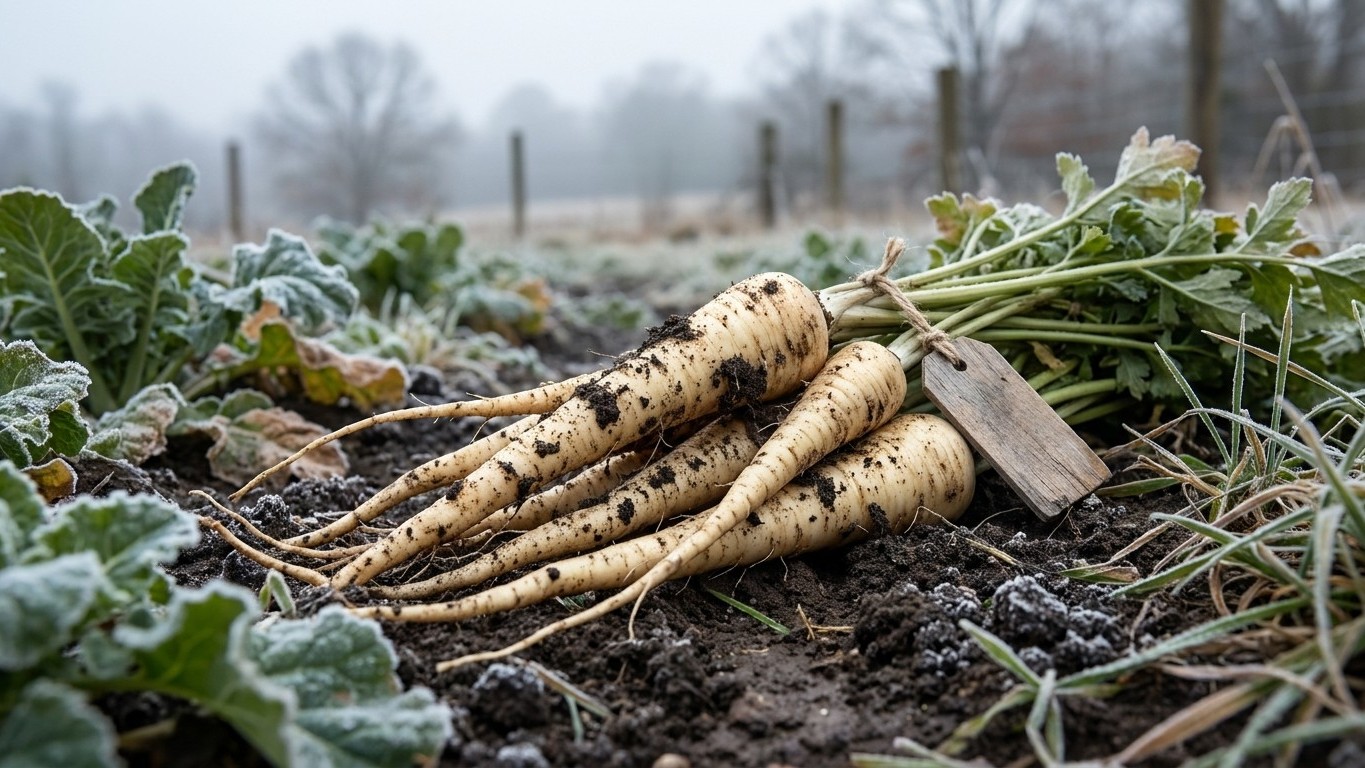

Yes, Connecticut delivers the frost exposure parsnips need. The reference station at Bridgeport records a mean daily minimum of 24.4°F in the coldest month, well below freezing, and the growing season lines up so the roots mature months before that cold arrives. Left in the ground through the first hard frosts, Connecticut parsnips convert their stored starch to sugar and come out sweet, not just grown.
The short answer
The question that actually decides this isn’t which hardiness zone a map assigns to Connecticut. It’s whether the territory delivers several frosty weeks once the roots are mature, because that cold exposure is the trigger that turns a bland, starchy parsnip into a sweet one. Hardiness zones tell you whether a plant survives winter. They say nothing about whether frost gets cold enough, or lasts long enough, to trip the starch-to-sugar conversion in a root vegetable sitting in the ground.
Connecticut answers that question with a firm yes. At the Bridgeport reference station, the mean daily minimum temperature for the coldest month sits at 24.4°F, according to NOAA NCEI Climate Normals covering 1991 to 2020. That’s not a record low or a fluke cold snap. It’s the average low across the coldest stretch of winter, which means sub-freezing nights aren’t the exception here, they’re the norm for weeks at a stretch.
That matters directly for parsnips. Utah State University Extension notes that parsnips taste best after several weeks of cool, frosty weather, because that exposure converts stored starch into sugar. A root pulled in warm weather grows just fine but stays flat and starchy. A root left in ground through repeated freezes develops the sweetness gardeners actually want. Connecticut’s winter, at least at this reference point, provides exactly that repeated freeze exposure rather than a single token frost.
Worth flagging: Bridgeport sits on Long Island Sound, and it’s the mildest part of the state by a wide margin. Inland and northwest Connecticut freeze earlier in fall and thaw later in spring, which means those areas almost certainly see more frost exposure, not less, than the coastal reference figure suggests. If anything, gardeners away from the immediate coast should expect an even more reliable sweetening window than the 24.4°F figure implies on its own.
So the short answer holds up under scrutiny: Connecticut parsnips will sweeten, provided the gardener leaves them in the ground long enough to catch that cold rather than pulling them the moment they’ve sized up.
Does the season fit?
Sweetening only matters if the roots actually reach maturity before winter shuts the garden down. Parsnips need 100 to 120 days from seeding, sown in place 2 to 3 weeks before the last spring frost, according to Utah State University Extension. Here’s how that timeline lays out against Connecticut’s frost calendar.
- Find the sowing window. NOAA NCEI 1991-2020 Climate Normals for station USW00094702 put Connecticut’s last spring frost between April 2 and April 12. Sowing 2 to 3 weeks ahead of that pushes the seeding date back to roughly mid-March through the very end of March.
- Account for slow germination first. Parsnip seed is notoriously slow to sprout, typically taking 14 to 21 days. That germination period is already counted inside the 100 to 120 day maturity window, but it means a gardener staring at bare soil for three weeks shouldn’t assume the seed failed and re-sow on top of it.
- Run the maturity math. Counting 100 to 120 days forward from a mid-to-late March sowing lands maturity somewhere between late June and late July.
- Compare against the first fall frost. NOAA NCEI places Connecticut’s first fall frost between October 28 and November 10, using the same station data (NOAA NCEI 1991-2020 Climate Normals).
- Measure the gap. Between a late-June-to-late-July maturity date and an late-October-to-mid-November first frost sits roughly three to four months of open season.
- Read the fit. That’s not a tight squeeze. It’s a comfortable margin, wide enough that the roots don’t just barely make it to maturity before frost, they sit mature in the ground for months, fully exposed to the cool autumn weeks and the first hard freezes that actually do the sweetening.
Inland and northwest gardeners should nudge their fall harvest expectations later still, since those areas run colder and see their first frost sooner than the Bridgeport reference date, which only tightens the frost-exposure side of the equation in their favor.
What goes wrong here
- Forked roots from heavy or stony ground. Parsnips push a single long taproot straight down, and anything that blocks that path, compacted clay, rocks, or a hardpan layer, splits the root into forks. Utah State University Extension recommends deep sandy soil, and heavy soil should be double dug before sowing so the root has a clear, loose path down through the profile.
- Forked roots from overwatering. This is a separate cause from soil texture, not the same problem wearing a different name. Excess water, especially inconsistent watering that swings from soaked to dry, encourages the root to branch rather than push straight down. The fix is steady, moderate moisture rather than heavy soaking followed by neglect.
- Pulling the roots before the season runs its course. Given Connecticut’s wide margin between maturity and first frost, this is more a discipline problem than a climate problem. Gardeners eager to harvest in August or early September, right when the roots look ready, skip the whole point of growing parsnips this far north. The remedy is patience: let the roots sit through at least a few hard frosts before digging.
- Assuming a mild microclimate still sweetens on schedule. The 24.4°F figure comes from a coastal reference station that’s the mildest spot in the state. A garden tucked right against Long Island Sound, buffered further by urban heat or a south-facing wall, may see fewer hard freezes than that average suggests. In those pockets, checking a few roots for sweetness before committing to a full harvest is a reasonable precaution rather than an overreaction.
Common questions
When should I sow parsnips in Connecticut?
Aim for roughly mid-to-late March, 2 to 3 weeks before the last spring frost, which NOAA NCEI places between April 2 and April 12 at the Bridgeport reference station. Sow directly in place, since parsnips don’t transplant well, and expect germination to take 14 to 21 days before any seedlings appear.
Can I leave parsnips in the ground over winter in Connecticut?
Yes, and that’s exactly how the sweetening happens. With a mean daily minimum of 24.4°F in the coldest month, the ground sees repeated hard freezes that convert stored starch to sugar. Leaving roots in place through several frosty weeks, rather than harvesting at first maturity, is what separates a sweet parsnip from a merely edible one.
Why are my parsnip roots forked instead of straight?
Two separate causes produce the same result. Heavy, stony, or compacted soil physically blocks the taproot and forces it to split. Overwatering, especially uneven watering, does the same thing through a different mechanism, encouraging branching rather than a single downward push. Double digging heavy soil addresses the first cause; steadier watering addresses the second.
Does soil type matter as much as the frost timing?
It matters, but differently. Frost timing decides whether the crop sweetens at all. Soil decides whether the root grows straight or forks. Utah State University Extension points to deep sandy soil as ideal, with heavy ground needing to be double dug first, but even excellent soil won’t produce sweetness without the cold exposure Connecticut’s winter reliably provides.