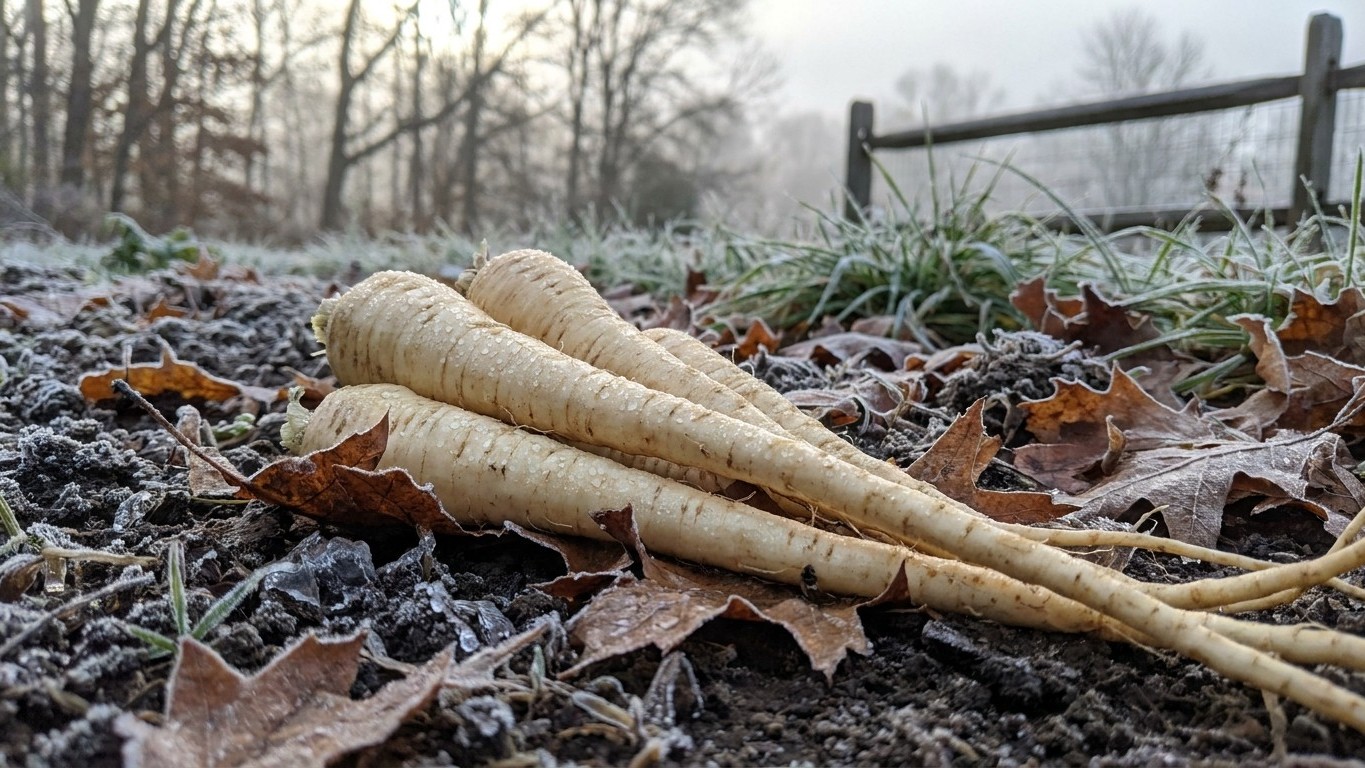

Yes, if you leave the roots in the ground into fall. Connecticut’s coldest month averages a nightly low of 24.4°F at the Bridgeport reference station, which is enough frost exposure to convert stored starch into sugar. The season also runs long enough, start to finish, for parsnips to mature and then sit through those cold snaps before you dig them.
The short answer
The question that actually decides this isn’t how cold Connecticut winters get on paper. It’s whether the ground here delivers several consecutive weeks of frosty conditions while the roots are still sitting in the soil. That’s the mechanism that matters for parsnips, and it’s a different question than asking what hardiness zone you’re in.
NOAA’s 1991-2020 climate normals put the average daily minimum for the coldest month at 24.4°F, using Bridgeport as the reference station. That’s a full 7.6 degrees below freezing, night after night, for weeks at a stretch. A single overnight dip to 32°F wouldn’t do much. What sweetens a parsnip is repeated, sustained cold acting on the root while it’s still underground, and a mean minimum in the mid-20s tells you that’s exactly what’s happening across most of the state.
Worth flagging here: Bridgeport sits on Long Island Sound, and it’s the mildest corner of Connecticut. Inland towns and the northwest hills run colder in both directions, freezing earlier in fall and thawing later in spring. If Bridgeport already delivers a coldest-month average of 24.4°F, inland gardens are seeing at least that much cold, often more. That works in a parsnip grower’s favor. The frost exposure this crop needs isn’t marginal here. It’s built into the climate.
So the short answer holds across the state, not just along the coast: a parsnip grown in Connecticut and left in the ground through a stretch of cold weather will sweeten. It won’t just grow and sit there starchy the way it might in a genuinely mild-winter region. The starch-to-sugar conversion that gardeners wait for happens because the cold is real and it lasts, not because a zone map says winter is “cold enough” in some general sense. Those are two different claims, and only the frost exposure one tells you what’s happening to the sugar content of the root.
None of this means the crop takes care of itself. The sweetening is a function of what happens after the root reaches size, and getting there requires fitting a fairly long growing season into Connecticut’s frost calendar first.
Does the season fit?
Parsnips need 100 to 120 days from seeding to maturity, and they’re sown directly in the ground, not started indoors and transplanted. The standard timing is to sow 2 to 3 weeks before your last spring frost. Lining that up against Connecticut’s frost dates shows exactly how much room there is to work with.
- Find the local last-frost window. Connecticut’s average last spring frost falls between April 2 and April 12, based on NOAA’s 1991-2020 normals for the Bridgeport station. Inland and northwestern areas typically run later than this coastal figure.
- Set the sowing date. Sowing 2 to 3 weeks ahead of that window puts seed in the ground roughly in mid to late March for the mildest parts of the state, later inland.
- Account for germination. Parsnip seed is slow, taking 14 to 21 days to emerge. Don’t assume a bare bed three weeks in means a failed sowing. It’s normal, and re-sowing too early just wastes a second batch of seed.
- Count forward the 100 to 120 days. From a mid to late March seeding, maturity lands somewhere between late June and late July, well within summer.
- Compare against the first fall frost. Connecticut’s first fall frost arrives between October 28 and November 10. That leaves roughly three to four months between maturity and that first cold snap, time the roots can spend sitting in the ground, sizing up further and waiting for the cold to arrive.
- Read the arithmetic. A season running from mid-March sowing to early-November frost totals somewhere near 230 days. The crop only needs 100 to 120 of them to mature, leaving a wide cushion both for a slow start and for the frosty stretch that does the sweetening afterward.
The season fits comfortably in Connecticut, coastal or inland. There’s no tight squeeze here the way there would be in a state with a short frost-free window. The margin is generous enough that a late seeding, a cool spring, or a stretch of slow germination won’t push the harvest past the point where sweetening can happen.
What goes wrong here
- Forked roots from heavy or stony ground. Parsnips send a single taproot straight down, and anything that blocks it, clay, compacted soil, or rocks, splits the root into forks. Connecticut’s soils run heavier and stonier than the deep sandy loam parsnips prefer. The remedy is to double dig the bed before sowing, working the soil to at least a foot of loose depth and pulling out stones as you go.
- Forked roots from overwatering. This is a separate cause from heavy soil, and it’s easy to blame the wrong one. Keeping the bed too wet, especially early on, encourages the root to branch instead of growing straight and deep. The fix is steady, moderate moisture rather than heavy, frequent watering, particularly once seedlings are established.
- A season that runs out before maturity. This is more of a risk for late sowings or for gardens well inland, where the last frost lands later and the first fall frost arrives sooner than the coastal averages suggest. Sowing at the early edge of the 2-to-3-week-before-last-frost window, rather than waiting, protects the full 100 to 120 days the crop needs.
- Harvesting before the cold has done its work. A parsnip pulled the moment it reaches size, before any real frost, will be a fine-looking root with none of the sweetness gardeners grow it for. The fix is patience: leave mature roots in the ground once the first frosts of fall arrive, and let several cold weeks pass before digging.
Handling parsnips carries a risk that has nothing to do with soil or timing. North Carolina Extension’s Gardener Plant Toolbox states it plainly: “All parts of this plant contain furocoumarins which can make skin sensitive to light causing burns so be sure to wear gloves, long sleeves and long pants when dealing with it.”
The word “all” is doing real work in that sentence. It’s not just the leafy tops that carry furocoumarins. It’s the whole plant, roots included, and the compounds are what make skin reactive to sunlight after contact with the sap.
That’s the part that catches people off guard. The burn doesn’t come from the sap alone. It takes sap plus sunlight acting on the skin together, which is why it shows up after a bright afternoon spent pulling tops or digging roots, and why it can take hours to appear rather than showing up the moment sap touches skin. Because the reaction depends on sunlight exposure after contact, washing your hands afterward doesn’t undo it the way it would with an ordinary irritant. The protection that actually works is preventing the sap from reaching skin in the first place, which is exactly what gloves, long sleeves, and long pants do.
Checking this against your own county
The figures here come from a single reference station on the coast, and Connecticut’s frost dates and coldest-month averages shift as you move inland or north. Before finalizing a sowing date, it’s worth checking those specifics against your own county rather than relying on a statewide generalization.
UConn Extension, the state’s land-grant extension service, is the resource built for exactly this. It’s reachable at extension.uconn.edu, and it can supply the local frost data, soil guidance, and seasonal timing specific to your part of the state, whether that’s the milder coast or the colder northwest hills.
Common questions
Do parsnips need a hard freeze to sweeten?
They need sustained frosty conditions, several weeks of cold acting on the root while it’s still in the ground, which converts stored starch into sugar. A single light frost isn’t the mechanism at work here; it’s the cumulative cold exposure over time.
Can I sow parsnips indoors and transplant them?
No. Parsnips are sown directly in place. Their taproot doesn’t tolerate transplanting well, and disturbing it tends to produce the same forked, misshapen roots that heavy soil or overwatering can cause.
Why hasn’t my parsnip seed come up after two weeks?
That’s normal. Germination takes 14 to 21 days, which is slow compared to most garden vegetables. Digging up the bed or resowing before three weeks have passed usually wastes seed on a bed that just needed more time.
Is it safe to compost parsnip tops?
The safety concern with parsnip foliage is about skin contact and sunlight, not about compost safety. Handle the tops with gloves and covered skin while pulling and cutting them, the same precaution that applies to the roots, since furocoumarins are present throughout the plant.