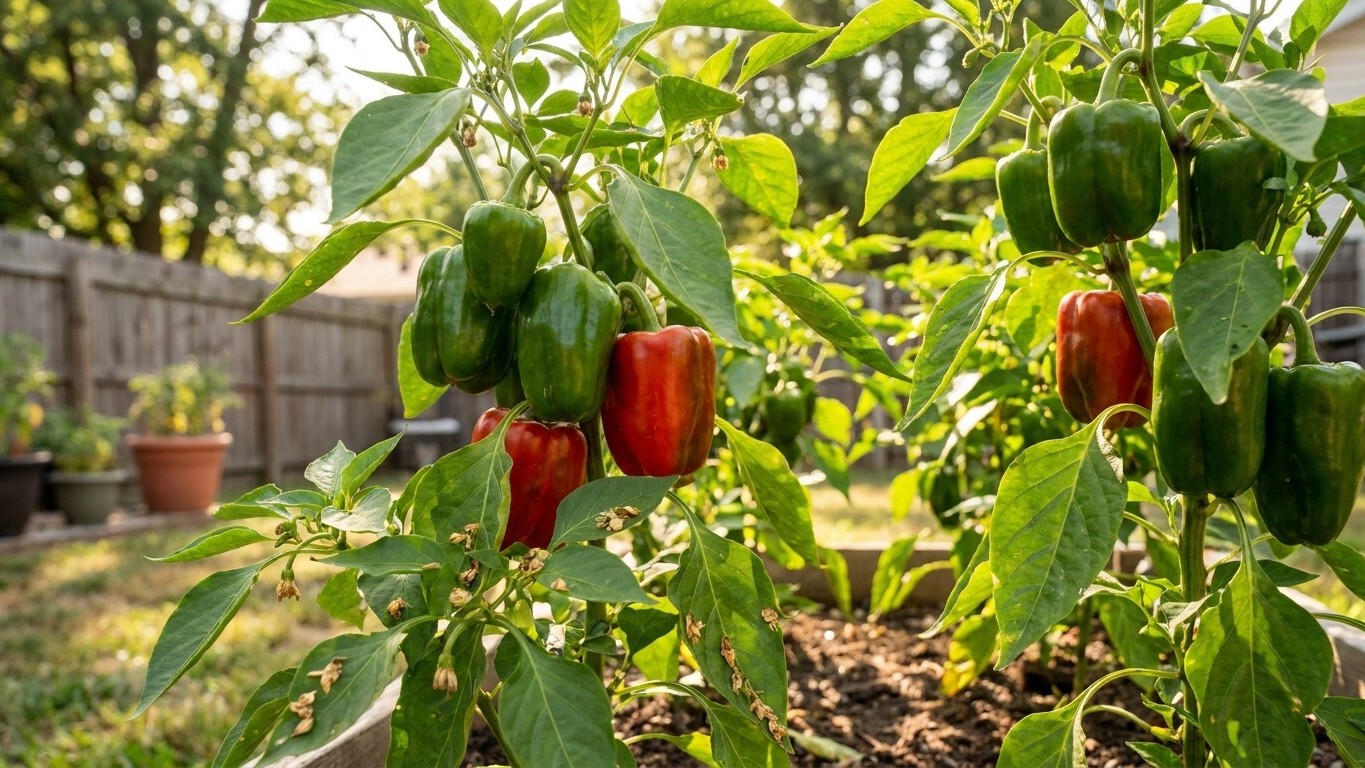

Connecticut gardeners growing peppers mainly deal with five insects documented by UConn Extension: brown marmorated stink bug, Colorado potato beetle, cutworms, four-lined plant bug, and Japanese beetle. Cutworms strike right after transplant, stink bugs and plant bugs show up as fruit and foliage develop, and Japanese beetle pressure peaks in the hottest stretch of summer. Timing tracks the state’s frost-free window, not a fixed date on the calendar.
Which pests attack pepper in Connecticut
UConn Extension documents ten insect pests for home gardens in this territory: Allium leafminer, brown marmorated stink bug, Colorado potato beetle, cutworms, four-lined plant bug, Japanese beetle, lily leaf beetle (Lilioceris lilii), squash bug (Anasa tristis), squash vine borer (Melittia cucurbitae), and striped cucumber beetle (Acalymma vittata). That’s the full documented list for the state. Not all ten belong on a pepper plant, and lumping them together is how misdiagnosis starts.
Half the list can be dismissed outright. Allium leafminer feeds exclusively on onions, garlic, leeks, and other alliums, so it has no reason to be anywhere near a pepper bed. Lily leaf beetle is an ornamental problem tied to true lilies in the genus Lilium, not vegetables. Squash bug, squash vine borer, and striped cucumber beetle all target cucurbits, squash, pumpkin, cucumber, and won’t touch a pepper stem or leaf. If you spot any of these five on a pepper plant, the damage almost certainly traces back to something else in the garden, or to a different crop growing nearby.
That leaves five species with a real claim on pepper foliage or fruit: brown marmorated stink bug, Colorado potato beetle, cutworms, four-lined plant bug, and Japanese beetle. Colorado potato beetle is a nightshade specialist, and pepper sits in that family alongside tomato, potato, and eggplant, so it’s a legitimate risk wherever those crops rotate through the same beds. Cutworms are generalists that ambush young transplants at the soil line regardless of species. Four-lined plant bug and brown marmorated stink bug both have wide host ranges that include pepper foliage and developing fruit. Japanese beetle will skeletonize almost anything green, pepper included, once populations build.
Transplant timing decides how exposed a young pepper plant is to the worst of this pressure: seedlings go into the ground after the last frost, once soil temperature reaches 60°F, following 8 to 10 weeks growing indoors. A plant set out too early, into cold soil, spends more time small and vulnerable exactly when cutworms are most active.
When each one shows up, and what it does first
Connecticut’s last spring frost falls between April 2 and April 12 at the coastal reference station, and inland and northwest parts of the state trail behind that, with frost lingering later into spring and arriving earlier in fall. Pepper transplants go in after that window closes and after the soil itself reaches 60°F, so the pest calendar for this crop really starts at transplant, not at a specific week on the wall calendar.
Cutworms are the first threat a transplant faces. They work at night, severing a young stem right at the soil line, and the first sign most gardeners notice is a seedling lying flat in the morning with no chewing on the leaves, just a clean cut near the base.
Colorado potato beetle turns up as nightshade foliage fills in over the following weeks. The earliest clue is usually a cluster of small orange-yellow eggs on the underside of a leaf, followed by ragged, chewed leaf margins as the humped, striped larvae begin feeding.
Four-lined plant bug shows up on tender new growth not long after. It feeds by piercing leaf tissue, leaving small dark, sunken spots scattered across the leaf surface rather than torn edges, since it sucks rather than chews.
Brown marmorated stink bug becomes a concern once fruit starts to set. It feeds directly on developing peppers, and the first sign is often a corky, discolored patch on the fruit itself rather than anything visible on the leaves.
Japanese beetle activity builds through the hottest stretch of the season. The reference station for this territory averages 6.2 days a year at or above 90°F, and Japanese beetle feeding tends to intensify alongside that heat, skeletonizing leaves down to a lace of veins.
Telling the damage apart from everything else
Insect feeding gets blamed for a lot of problems it didn’t cause. Heat, water stress, and simple mechanical damage all leave marks that look like pest activity at first glance, and treating the wrong cause wastes a growing season that’s already short.
The most common mix-up on pepper involves dropped flowers or shriveled fruit. Fruit set on pepper fails at both ends of the temperature scale: nights below 55°F or days above 90°F, according to Utah State University Extension. No insect is required to explain a plant that flowers heavily but sets no fruit during a hot stretch; that’s a temperature problem, and the reference count of 6.2 days a year at or above 90°F gives a sense of how often the hot end comes into play here. This site does not track summer night minimums, so if the cool end seems more likely, that’s something to watch in your own garden rather than assume from the season or the month.
| What you see | Likely insect cause | What points elsewhere |
|---|---|---|
| Seedling toppled, stem severed at soil line | Cutworm | A pinched, rotted stem instead of a clean cut points to damping-off disease, not an insect |
| Leaves skeletonized, only veins remain | Japanese beetle | Ragged chewed margins with egg clusters underneath point to Colorado potato beetle instead |
| Small dark sunken spots on leaves | Four-lined plant bug | Uniform yellowing between leaf veins with no spotting suggests a nutrient issue, not feeding |
| Corky, discolored patch on fruit | Brown marmorated stink bug | A flat, leathery black patch at the blossom end with no insect present is blossom end rot, a calcium and watering issue |
| Flowers or small fruit dropping with no chewing marks | Not insect damage | Check recent temperatures against the fruit-set thresholds above |
When the cause isn’t obvious from the plant itself, a local Extension office can look at a sample or a clear photo and rule things in or out faster than guessing at home.
What actually works here, and what is a waste of time
Connecticut’s growing season is short enough that timing beats almost any product decision. A physical barrier placed at transplant does more for cutworm control than anything applied afterward, since the vulnerable stage lasts only a couple of weeks.
A simple collar pushed into the soil around the stem at transplant, right when the plant goes into the ground after the last frost, blocks cutworms from reaching the base entirely. Waiting until damage appears is too late, since a severed seedling doesn’t recover.
For Colorado potato beetle and Japanese beetle, checking the undersides of leaves regularly and hand-picking adults and egg clusters in the cool of early morning, when beetles move slowly, keeps small populations from becoming large ones. This works because both insects are large enough to see and slow enough to catch, not because of any special timing trick.
What wastes time is treating fruit drop or flower loss as a pest problem when the thresholds above point to heat or cold instead. No barrier, no hand-picking, and no spray schedule fixes a plant that’s dropping flowers because nights ran below 55°F or days climbed past 90°F. It’s also a poor use of effort to apply any broad treatment before confirming, with a clear look at the plant, which of the five relevant insects is actually present. Because this site doesn’t prescribe pesticides or name products, anything beyond physical barriers and hand-picking is a question for the local Extension office, which knows what’s currently labeled for use in Connecticut.
Where to check this for your own county
UConn Extension is the source for everything documented on this page, and its county-level offices are the next step for anything specific to a particular yard. State-wide documentation tells you what’s possible across Connecticut; it doesn’t tell you what’s actually feeding on the pepper plants in a particular garden.
That gap matters more here than it might elsewhere. The last frost date of April 2 to April 12 comes from a coastal reference station, and inland and northwest Connecticut run measurably behind that, with later spring frosts and earlier fall ones. A pest calendar built around transplant timing shifts along with that frost date, so a garden in the northwest corner of the state can see cutworm and beetle activity start noticeably later than one near Long Island Sound.
Pest pressure also varies with what’s growing nearby, past crop rotation, and even how a particular yard is shaded or exposed. A county Extension office can speak to local pressure in a way a statewide list can’t, and most accept a photo or a physical sample for identification when the damage doesn’t clearly match anything above.
The next step for a gardener seeing damage that doesn’t fit these five patterns is a call or visit to the county office, not another round of guessing from a list.
Common questions
Do all five documented pests attack pepper every year in Connecticut?
Not necessarily. UConn Extension documents these as present in the state, but which ones show up in a given garden in a given year depends on local conditions, nearby host plants, and weather. Presence documented at the state level isn’t a guarantee for any one yard.
Can Colorado potato beetle spread from potatoes to pepper plants nearby?
Yes, because it’s a nightshade specialist and pepper belongs to the same plant family as potato, tomato, and eggplant. Beetles moving between these crops in the same garden is a known pattern, which is one reason crop rotation matters.
Is blossom end rot on pepper caused by an insect?
No. It’s tied to calcium availability and watering consistency, not to any of the five insects documented for pepper in this territory. The giveaway is a flat, leathery, dark patch at the blossom end of the fruit with no insect feeding marks nearby.
What’s the single most important timing decision for avoiding pest damage on pepper in Connecticut?
Transplanting after the last frost, once soil reaches 60°F, and protecting the stem with a barrier at that moment. That single window, right at transplant, covers the cutworm threat entirely and sets the plant up to handle the pests that follow later in the season.