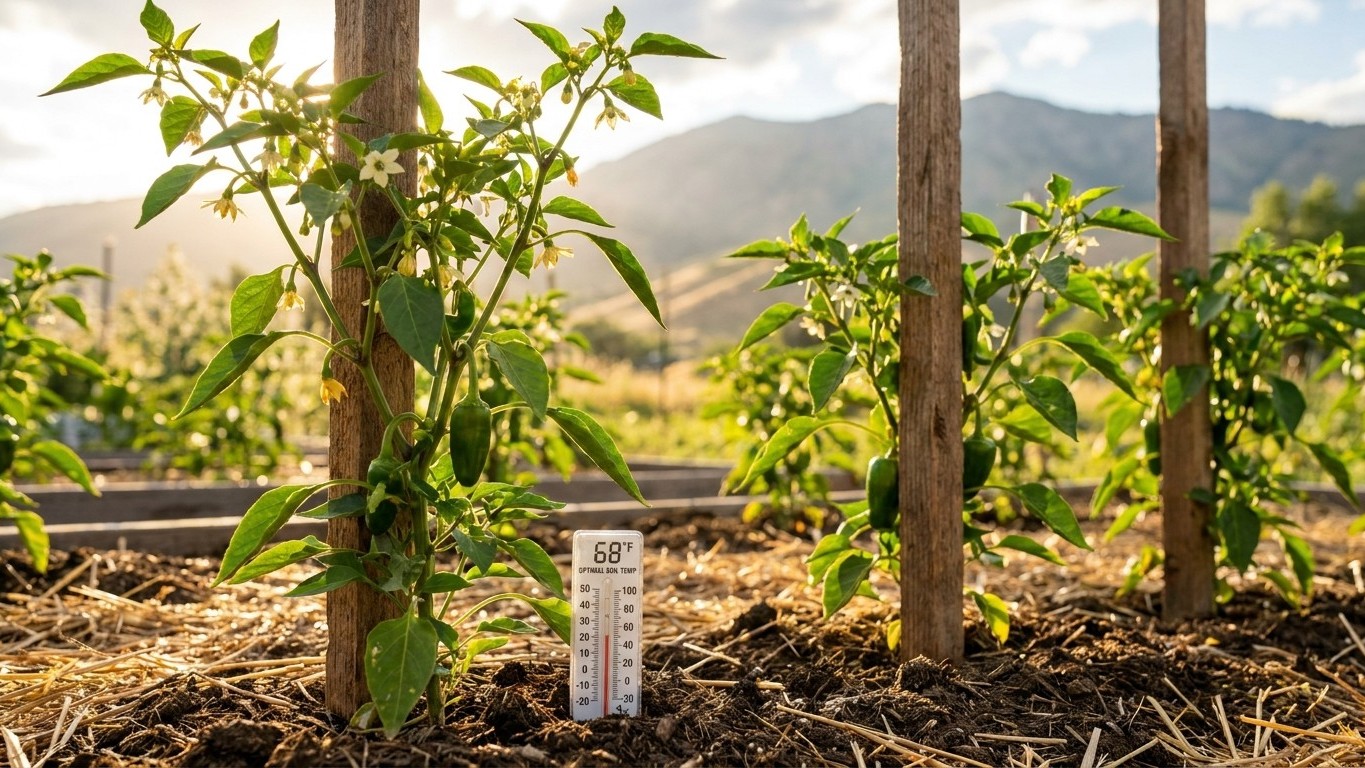

Most sweet and many hot pepper varieties ripen fully within a Connecticut season, but success depends less on the state’s average summer heat and more on timing at both ends of the calendar. Bridgeport’s climate record shows only 6.2 days a year at 90°F or above, so blossom drop from heat is uncommon here. The bigger risk is starting seed too late or transplanting into cold soil, because pepper flowers stall just as easily when nights run cool as when days run hot.
The short answer

Connecticut’s summer heat load, measured at the Bridgeport reference station, averages 6.2 days a year at 90°F or higher. That’s a low number as heat-stress counts go, and it matters because pepper flowers can abort when daytime temperatures push past that 90°F mark for stretches during bloom. With only 6.2 days a year crossing that line, most gardeners across the state won’t see repeated heat-driven blossom drop in a typical season. Peppers set fruit within a fairly narrow band, and Connecticut’s summers sit mostly inside it rather than pushing against the hot edge.
The heat side isn’t the real risk here
That’s the reassuring half of the picture. Utah State University Extension notes that pepper fruit set fails at both ends: nights below 55°F stall flowering just as surely as days above 90°F do. In a state where 90°F days are rare, the hot-end failure mode simply doesn’t come up often enough to worry most home gardeners. The exception is a plant grown against a south-facing wall, in a black plastic-mulched bed, or in a greenhouse or hoop house where trapped heat can push local temperatures well past what the open garden sees, even on a day the outdoor thermometer never touches 90°F.
The cold side is the one you have to track yourself
This site’s climate data for Connecticut covers daytime heat extremes, not summer night minima. That’s a real gap for pepper growers, because the 55°F threshold is the one most likely to bite in a state with cool coastal breezes off Long Island Sound and cold-air drainage in inland valleys. Nobody can tell you, from a state average or a latitude, what your own yard drops to on a clear June or July night. Low-lying gardens, valley bottoms, and spots away from the moderating influence of the coast can run several degrees cooler overnight than a station reading suggests. If you want to know whether cool nights are limiting your pepper set, put an actual min-max thermometer in the garden. That’s the only way to know your own numbers.
When to start seed here
Working out a start date is arithmetic, not guesswork, once you know your local frost date and are willing to track your own soil temperature. Here’s how the calculation runs, using Connecticut’s own numbers as the example.
- Start with the frost window. NOAA’s 1991-2020 climate normals put the last spring frost at the Bridgeport station between April 2 and April 12. That station sits on the Long Island Sound coast, the mildest part of the state, so treat this as the earliest realistic date rather than a statewide guarantee.
- Adjust for where you actually garden. Inland and northwest Connecticut freeze noticeably later in spring than the coast, so a gardener in Litchfield County or the Northwest Hills should expect their own last frost to land later than the Bridgeport window, not on the same date.
- Don’t transplant on the frost date alone. Utah State University Extension is specific here: peppers go into the ground after frost has passed and once soil temperature has reached 60°F. Air can feel warm enough while soil, especially in a shaded or heavy clay bed, still lags behind. A simple soil thermometer pushed a few inches down settles the question in seconds.
- Count back 8 to 10 weeks for indoor seed starting. If your target transplant date lands in the second half of April on the coast, or in early May inland, count backward 8 to 10 weeks from that date to find your seed-starting window. A mid-April transplant target means starting seed indoors around mid-to-late February; a mid-May inland target pushes seed-starting into early-to-mid March.
- Build in a buffer, not a fixed date. Because soil temperature, not the calendar, is the real gate for transplanting, keep seedlings ready to hold indoors a bit longer if a cold, wet spring delays soil warmup. Peppers are patient in pots; they aren’t forgiving of cold soil.
Redoing the math for your own county
The exercise above only works if you plug in your own frost date rather than borrowing Bridgeport’s. Check whether your town sits closer to the coast or further inland, note that inland spots trend later in spring and earlier in fall, and shift your seed-starting window accordingly. The 8-to-10-week rule and the 60°F soil threshold don’t change from town to town. Your calendar date does.
What goes wrong here
Three failure patterns tied to this climate
- Blossom drop from a hot spell or a cool night. Pepper flowers abort when temperatures push past 90°F during the day or drop below 55°F overnight, and either extreme can happen even in a state where 90°F days average only 6.2 a year. A short heat spike during bloom, or a run of unusually cool nights in a low-lying garden, can knock a plant’s flowers off without any visible disease or pest involved. The remedy is patience rather than intervention: the plant usually resumes setting fruit once temperatures settle back into its comfort range, so resist the urge to fertilize heavily or replace what looks like a “failed” plant.
- Sunscald on exposed fruit. Peppers that ripen on a plant with sparse foliage, especially after aggressive pruning or storm damage that strips leaves, can develop pale, sunken patches on the side facing direct sun. This is a physical burn, not a disease, and it shows up more often in years or spots with strong, unshaded afternoon sun. The fix is prevention: avoid heavy pruning during fruit set, and let the plant’s own leaf canopy shade the fruit rather than removing foliage to “let more light in.”
- Blossom-end rot. Peppers, like tomatoes, can develop a dark, leathery patch at the blossom end of the fruit when calcium can’t move fast enough to the developing pepper, usually because soil moisture has swung between too dry and too wet. Even soil moisture through the growing season, rather than a calcium supplement, is the more dependable remedy, since the underlying problem is usually water delivery, not a shortage of calcium in the soil itself.
Common questions
Can I still grow peppers if I garden inland instead of near the coast?
Yes, but expect your last frost date to land later than Bridgeport’s April 2 to April 12 window, since inland and northwest Connecticut freeze later in spring and earlier in fall. Shift your seed-starting and transplant dates back accordingly rather than using the coastal window as your own.
Do I need to worry about 90°F days damaging my pepper crop?
Rarely. Bridgeport averages only 6.2 days a year at or above 90°F, so sustained heat-driven blossom drop is uncommon across most of the state. Fruit set can still stall during isolated hot spells, but this isn’t the dominant risk in a typical Connecticut season.
How do I know if my nights are too cool for fruit set?
This site’s data covers daytime heat, not summer night minima, and there’s no way to infer your yard’s overnight lows from the state average or your latitude. Set a min-max thermometer in the garden during bloom; readings consistently below 55°F point to cool nights as the likely cause of stalled fruit set.
Why do the 35 to 45 days to maturity not match what I expected from my transplant date?
That count runs from flowering, not from seed-starting or transplanting. A plant that flowers later because of a cool spring, or because it sat in a pot longer than planned, will push its harvest date back by the same amount, independent of when it went into the ground.