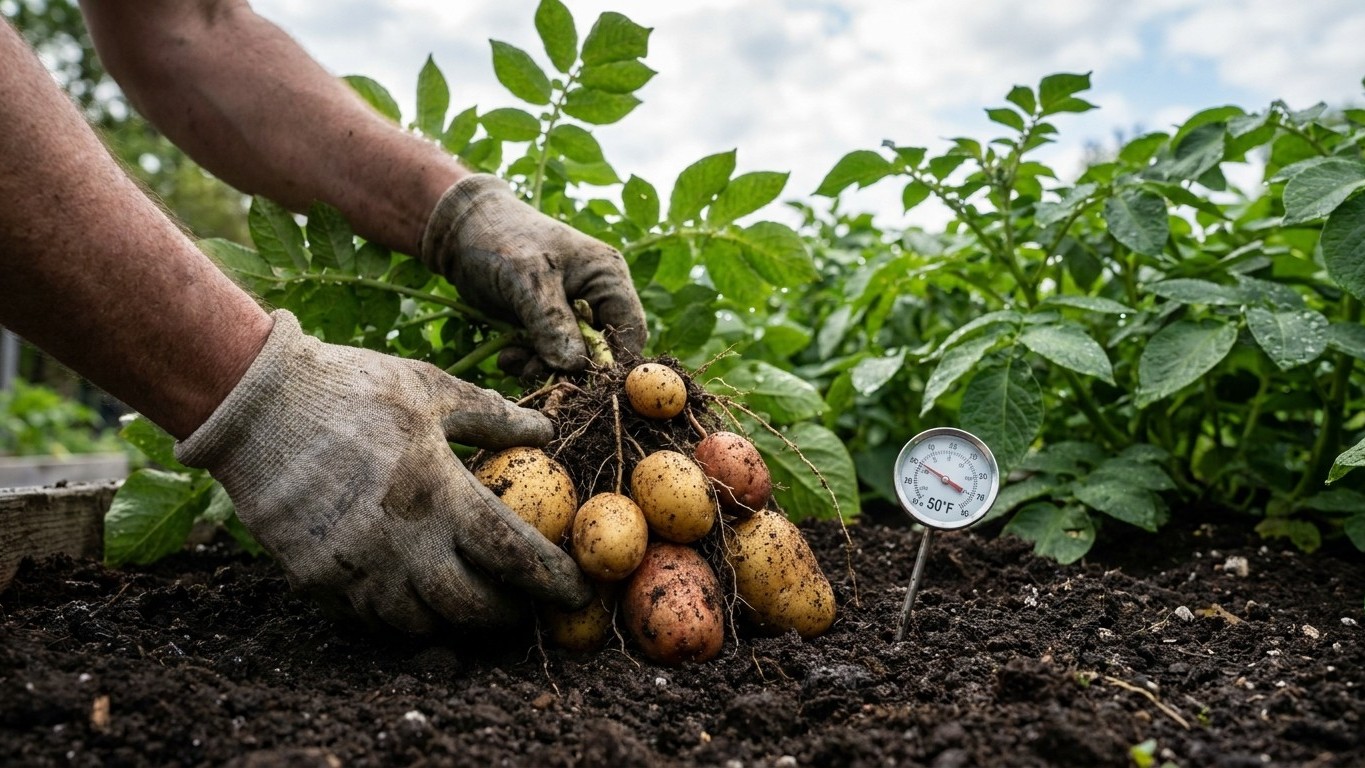

Connecticut carries one of the lowest summer heat loads in the potato-growing map: just 6.2 days a year reach 90 F or higher at the Bridgeport reference station. The last spring frost there falls between April 2 and April 12. That combination means tuber set and fill almost never shuts down from heat, and a full-season crop, planted as soon as soil hits 50 F, is a realistic goal for most of the state.
The short answer

Two numbers decide whether a potato crop in this state sizes up or stalls: the count of days above 90 F, and the last spring frost window. Utah State University Extension identifies 90 F soil temperature as the ceiling above which tuber set and fill are inhibited, regardless of watering. At Bridgeport, that threshold gets crossed an average of 6.2 days a year, according to NOAA NCEI Climate Normals covering 1991 to 2020. Compare that to a hot southern state where 90 F days run into the dozens or more, and the difference is not subtle. Connecticut gardeners are working with a season that almost never punches through the ceiling that stops tubers from growing.
That changes the whole planning question. In a hot state, the answer to “when do I plant” is often “as early as physically possible, so the crop finishes before the heat arrives.” Here, that urgency mostly disappears. A gardener can plant early-season varieties for an early harvest, or let mid-season and late varieties run through the summer months, because the soil rarely gets hot enough to stop them cold, which gives extra weight to choosing Potato Varieties That Suit Connecticut. The constraint that matters more in Connecticut is the frost window itself, not heat.
Why the frost date, not the heat count, drives the calendar
The last spring frost at the Bridgeport station falls in the April 2 to April 12 range, based on the 32 F freeze probability data NOAA NCEI publishes for that station, a key data point covered in depth in When to Plant Potatoes in Connecticut. Coastal Connecticut, where Bridgeport sits on Long Island Sound, is the mildest part of the state. Planting decisions built around that date will run early for inland and northwest Connecticut, where the freeze-free window opens later in spring and closes earlier in fall.
Put the two figures together and the state’s growing pattern comes into focus: a long, cool-enough season with a narrow but usable spring frost window at one end, and almost no summer heat pressure at the other. That’s a favorable setup by national standards, and it’s why gardeners here have more flexibility on variety choice than growers in hotter climates, where the season class of a potato (early, mid-season, or late) has to be matched tightly against a shrinking window before heat arrives. That same favorable setup carries through to the end of the season, making Harvesting and Storing Potatoes in Connecticut a straightforward task compared to hotter growing regions.
When to plant here
Working backward from the frost date is the reliable method, and it’s simple enough to redo for any county once you know the local last-frost estimate. Utah State University Extension and the University of Maine Cooperative Extension both describe the same target: soil at 50 F, reached 14 to 21 days before the last frost date.
- Start with the local last spring frost date. For the Bridgeport reference station, NOAA NCEI puts that window at April 2 to April 12.
- Subtract 14 to 21 days from that date. Counting back three weeks from April 12 lands in the last third of March; counting back two weeks from April 2 lands in the third week of March. That span, roughly mid to late March along the coast, is the planting window this data supports.
- Confirm soil temperature before planting rather than relying on the calendar alone. The target is 50 F at planting depth, measured with a soil thermometer rather than guessed from air temperature.
- Adjust the whole window later for inland and northwest counties, where spring freeze risk lingers longer than it does at the coastal reference station.
- Once soil holds at 50 F for a few consecutive days, plant. Waiting for a warm afternoon reading that doesn’t hold is a common way to plant too early into soil that’s still cold underneath.
Because Connecticut’s summer heat load is so low, there’s little penalty for planting on the later end of that window if soil is still cold. The bigger risk here runs the other direction: planting into wet, unwarmed soil to hit an arbitrary date on a seed packet, rather than waiting for the actual 50 F reading.
What the heat does to the crop
The mechanism is the same everywhere potatoes grow, and it’s worth stating plainly because it explains why watering can’t rescue a struggling crop. Above 90 F in the soil, tuber set and fill are inhibited. The plant isn’t short on water at that point; it’s operating past the temperature range where it can size tubers at all. Utah State University Extension and the University of Maine Cooperative Extension both describe this ceiling as a hard biological limit, not a stress that irrigation offsets.
In a state where 90 F soil days average only 6.2 a year at the Bridgeport reference point, this mechanism rarely gets triggered. That’s the practical upside of Connecticut’s climate for this crop: a full-season variety planted in spring can generally run through summer without hitting the ceiling that shuts tuber growth down in hotter regions. Gardeners here aren’t typically racing to dig a spring crop before June heat arrives, because June heat capable of pushing soil past 90 F is a rare event at the state level.
That doesn’t mean heat is irrelevant. A hot, dry stretch, even short of the 90 F soil threshold, still raises water demand and can stress plants that are already marginal from other causes, poor drainage, disease pressure, or crowding. But the specific failure mode Utah State describes, tubers that stop sizing because soil temperature crossed 90 F, is uncommon in this climate. Where it does show up, it’s more likely in a hot microclimate: a south-facing raised bed with dark soil, tucked against a wall that reflects heat, can run hotter than the open-field averages NOAA NCEI reports for the reference station. The lesson holds regardless of location: if soil temperature is the problem, more water is not the fix. Shade, mulch to buffer soil temperature, or accepting an earlier harvest are the actual responses.
What goes wrong here
- Uncertified seed potatoes. Seed potatoes without certification can carry viruses that reduce yield and spread to future plantings. Buying certified seed potatoes from a reputable supplier is the remedy, and it’s a one-time decision that protects every season after it.
- Planting into cold, wet soil. Connecticut’s soils can stay saturated well into spring, and pushing seed potatoes into cold mud before the 50 F soil threshold invites rot rather than growth. Checking soil temperature directly, rather than planting by calendar date alone, avoids this.
- Skipping the hilling and getting green tubers. Tubers that develop near the surface and get exposed to light turn green and produce solanine, which makes them unsafe to eat. Hilling soil or mulch up around the stems as the plant grows keeps developing tubers covered and prevents this.
- Digging too early. Because Connecticut’s mild heat load removes the pressure to rush a harvest ahead of summer temperatures, there’s little reason to dig before the plant has finished its natural cycle. Digging too soon sacrifices yield that a few more weeks would have added, particularly for mid-season and late varieties.
Checking this against your own county
The Bridgeport figures anchor this page because they come from a documented NOAA NCEI station, but Bridgeport is a coastal city on Long Island Sound, the mildest corner of Connecticut. Elevation and the state’s north-south spread move both dates in the FACTS by real weeks: the northwest hills and the Litchfield County uplands see later last-frost dates in spring and earlier first frosts in fall than the coast does, and low-lying valley pockets can trap cold air on quiet nights even where the regional average looks mild.
A state-wide window is a starting point for planning, not a substitute for local data. The University of Connecticut Cooperative Extension System, reachable at extension.uconn.edu, tracks county-level conditions and is the resource to check before finalizing a planting date for a specific town or garden site.
Common questions
Does Connecticut ever get hot enough to stop tubers from sizing?
Rarely, at least at the state level. The Bridgeport reference station averages only 6.2 days a year above 90 F, the threshold Utah State University Extension identifies for inhibited tuber set and fill. A hot microclimate, like a reflective raised bed, could still cross that line locally even when the regional average stays low.
What variety should I plant if I want to avoid summer heat issues entirely?
Given how low Connecticut’s 90 F day count runs, heat avoidance isn’t the main variety selection factor here the way it would be in a hotter state. Choosing by season class, early, mid-season, or late, and by intended use, baking or boiling, published by Utah State University Extension and the University of Maine Cooperative Extension, matters more than chasing a heat-dodging early harvest.
How do I know when soil actually hits 50 F, rather than guessing from the weather?
A soil thermometer inserted to planting depth is the direct method both extension sources point to. Air temperature on a warm afternoon can read well above soil temperature, especially in soil that was cold and wet just days earlier, so relying on air temperature alone risks planting too soon.
Is certified seed really necessary if the potatoes look healthy?
Yes. Viruses that certified seed programs screen for aren’t always visible on the tuber itself, and an infected planting can carry that virus into every future crop grown from saved seed. Starting with certified seed potatoes each season is the straightforward way to avoid that risk.