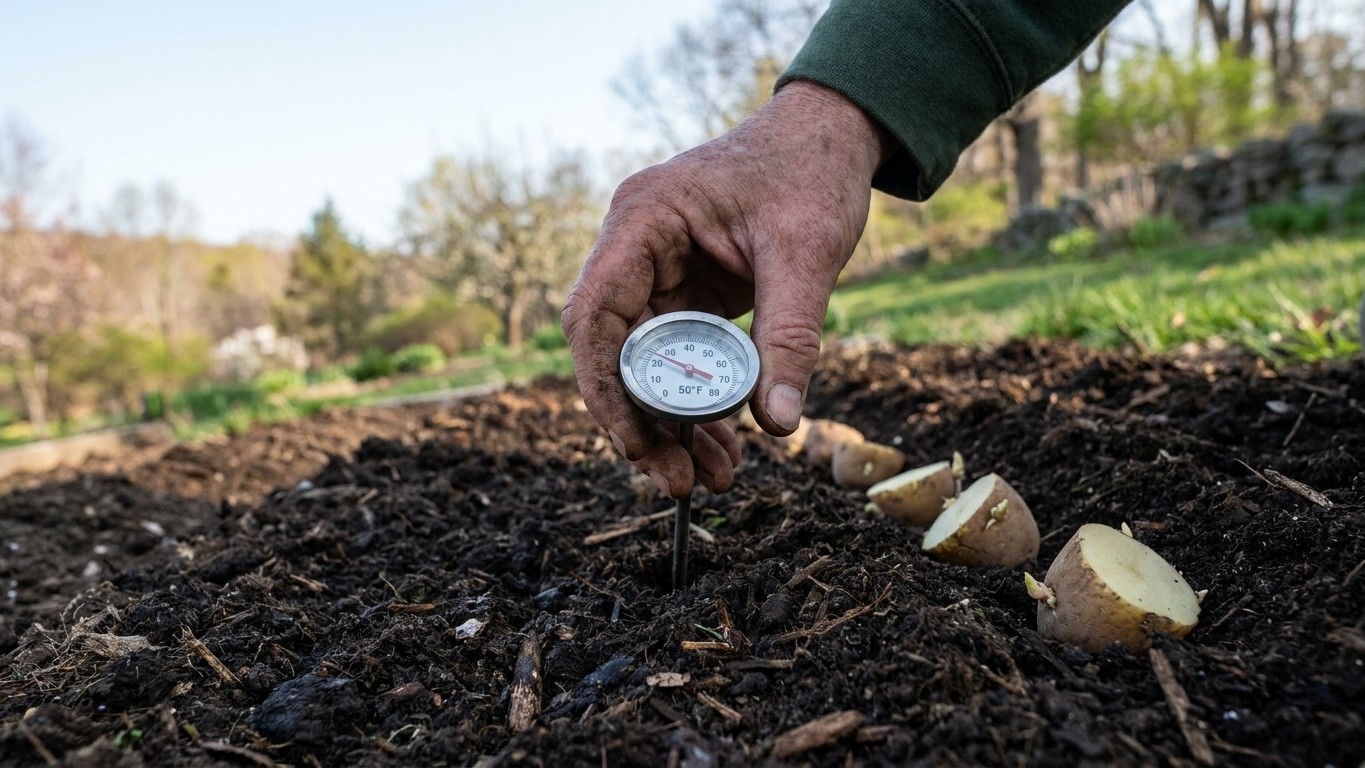

Connecticut gardeners get the most reliable results from early- and mid-season potato varieties, planted as soon as soil hits 50°F, which falls 14 to 21 days before the state’s last spring frost. At the reference station in Bridgeport, that frost date runs April 2 to April 12, according to NOAA NCEI’s 1991-2020 Climate Normals. Late-season varieties struggle here because Connecticut summers push soil past the 90°F ceiling that stops tuber sizing.
The short answer
Plant early or mid-season potatoes in Connecticut, and time the planting to soil temperature rather than the calendar. The number that matters most is 50°F: that’s the soil threshold Utah State University Extension and the University of Maine Cooperative Extension both point to for setting seed potatoes in the ground. Work backward from the Bridgeport last-frost window of April 2 to April 12 (NOAA NCEI, 1991-2020 Climate Normals, station USW00094702), and that soil-warming point lands roughly two to three weeks earlier, meaning coastal Connecticut gardeners are often planting in mid to late March.
That timing only tells part of the story. The other half is season class. Neither Utah State nor Maine Extension publishes a days-to-maturity figure for any variety, and there’s a good reason for that: maturity in potatoes is driven by heat units and daylight, not a fixed clock, so any specific number would be a guess dressed up as data. What both sources do publish, and what actually matters for a Connecticut garden, is season class: early, mid-season, or late. Early and mid-season types set and fill their tubers before the hottest stretch of a Connecticut summer arrives, which is the window when soil temperatures are most likely to climb above the 90°F mark that halts tuber development, per Utah State University Extension and University of Maine Cooperative Extension Bulletin #2077.
Late-season varieties aren’t banned from Connecticut soil, but they’re fighting the clock against a heat ceiling instead of working with it. A late variety planted at the same time as an early one will still be trying to size its tubers when soil temperatures are at their summer peak, and watering more won’t reverse that stall. This is why the practical answer to “which potato variety suits Connecticut” isn’t a single cultivar name. It’s a season class paired with a use: early and mid-season types for baking or boiling, planted on soil-temperature timing rather than a date circled on a calendar.
What actually decides it
Three separate mechanisms stack on top of each other in Connecticut, and understanding how they interact lets a gardener reason through a season the weather doesn’t cooperate with.
The soil temperature switch
Seed potatoes don’t respond to air temperature or to the calendar. They respond to soil temperature, and the trigger point is 50°F, according to Utah State University Extension. Below that, seed pieces tend to sit in cold, wet ground and are more prone to rotting before they ever sprout. The 14-to-21-day window before the last frost isn’t arbitrary either: potato foliage tolerates a light frost far better than most garden vegetables, so gardeners can plant while frost risk is still present, as long as the soil itself has already crossed that 50°F line.
The heat ceiling that ends the season
The mechanism that decides the whole crop is the one most gardeners never check: soil temperature above 90°F inhibits tuber set and fill, per Utah State University Extension and University of Maine Cooperative Extension. This isn’t a wilting problem you can water your way out of. Once soil crosses that threshold, the plant’s energy stops going into bulking up tubers, no matter how green the top growth still looks. Connecticut summers can push soil past that line, especially in exposed, unmulched beds with dark soil. This is exactly why season class Matters More Than variety name: an early or mid-season crop is finishing its bulking before that heat window typically arrives, while a late-season crop is often still trying to size tubers right as the soil is hottest.
Where in Connecticut you’re gardening
The Bridgeport frost dates come from a coastal Long Island Sound station, the mildest part of the state. Inland and northwest Connecticut freeze noticeably earlier in fall and later in spring than that coastal reading suggests. A gardener in Litchfield County working off the Bridgeport window risks planting too early into soil that hasn’t actually reached 50°F yet, or getting caught by a fall frost sooner than the coastal date implies. The mechanism (soil temperature governs planting, heat governs tuber fill) stays the same everywhere in the state. What shifts by location is when those thresholds are actually crossed.
How to do it
- Buy certified seed potatoes rather than saving grocery-store tubers or last year’s harvest; uncertified seed commonly carries virus that reduces yield and spreads to future plantings.
- Check your soil temperature directly with a soil thermometer rather than guessing from air temperature, since the planting trigger is 50°F in the soil, per Utah State University Extension.
- Count back 14 to 21 days from your local last-frost date to find your planting window, adjusting for the fact that the Bridgeport range of April 2 to April 12 (NOAA NCEI) applies to the coast, not inland Connecticut.
- Choose early- or mid-season varieties for the main crop, since these classes finish tuber bulking before Connecticut’s hottest soil temperatures typically arrive.
- Cut and plant seed pieces once soil has reached that 50°F threshold, even if a light frost is still possible in the days that follow.
- Hill the growing plants with soil or mulch as they grow, which helps buffer soil temperature swings around the root zone through the warmer months.
- Monitor soil temperature again as summer progresses, watching for conditions approaching that 90°F ceiling that stops tuber set and fill.
- Harvest early and mid-season potatoes once foliage begins dying back, rather than leaving them in ground that’s heating up past the point where they’re still sizing.
What goes wrong
- Planting uncertified seed potatoes. Grocery-store or saved tubers frequently carry virus that stunts growth and lowers yield. The fix is buying certified seed potatoes each season, which is the one caution worth stating plainly rather than hedging.
- Planting a late-season variety expecting it to size normally in a Connecticut summer. Once soil crosses 90°F, tuber fill stops regardless of watering, per Utah State University Extension and University of Maine Cooperative Extension. The remedy is choosing early or mid-season varieties for the main planting so bulking finishes before that heat window.
- Using the coastal Bridgeport frost date for an inland or northwest Connecticut garden. That NOAA NCEI window of April 2 to April 12 reflects the mildest part of the state; inland gardens freeze later in spring and earlier in fall. The fix is adjusting the planting window later in spring for inland locations rather than planting by the coastal date alone.
- Planting before checking actual soil temperature. Going by air temperature or a circled calendar date instead of a soil thermometer reading risks setting seed into ground still below 50°F, where rot is more likely. Check soil temperature directly before planting, not the forecast.
- Leaving a crop in unmulched, exposed soil through the hottest weeks. Soil without hilling or mulch heats faster and can cross the 90°F threshold sooner. Hilling and mulching buffer root-zone temperature and buy the crop more time before tuber fill stalls.
Common questions
Can I still grow a late-season potato variety in Connecticut?
Nothing stops a gardener from planting one, but a late-season variety is working against the state’s summer heat ceiling rather than with it. Because soil above 90°F inhibits tuber set and fill (Utah State University Extension; University of Maine Cooperative Extension), a late variety risks still trying to bulk tubers right when Connecticut soil is at its hottest. Early and mid-season classes are the more reliable choice for a main crop here.
What’s the earliest I can Plant Potatoes in Connecticut?
That depends on when your soil reaches 50°F, not on a fixed date. Utah State University Extension and University of Maine Cooperative Extension both tie planting to that soil temperature, occurring 14 to 21 days before the last frost. At the Bridgeport coastal station, the last frost falls between April 2 and April 12 (NOAA NCEI, 1991-2020 Climate Normals), which puts planting in mid to late March there; inland and northwest Connecticut will run later.
Is Bridgeport’s frost date accurate for the whole state?
No. Bridgeport sits on Long Island Sound and is the mildest reporting station in Connecticut. NOAA NCEI’s own data notes this is a coastal reading, and inland and northwest parts of the state freeze noticeably earlier in fall and later in spring. Gardeners outside the immediate coast should expect their actual planting window to fall later in spring than the Bridgeport figures suggest.
Should I choose potato varieties by whether they’re waxy or floury?
Neither Utah State University Extension nor University of Maine Cooperative Extension classifies varieties that way. What they do publish is intended use, such as baking or boiling, along with season class (early, mid-season, or late). Choosing by published use and season class is the approach grounded in these sources, rather than terms not used by either Extension.