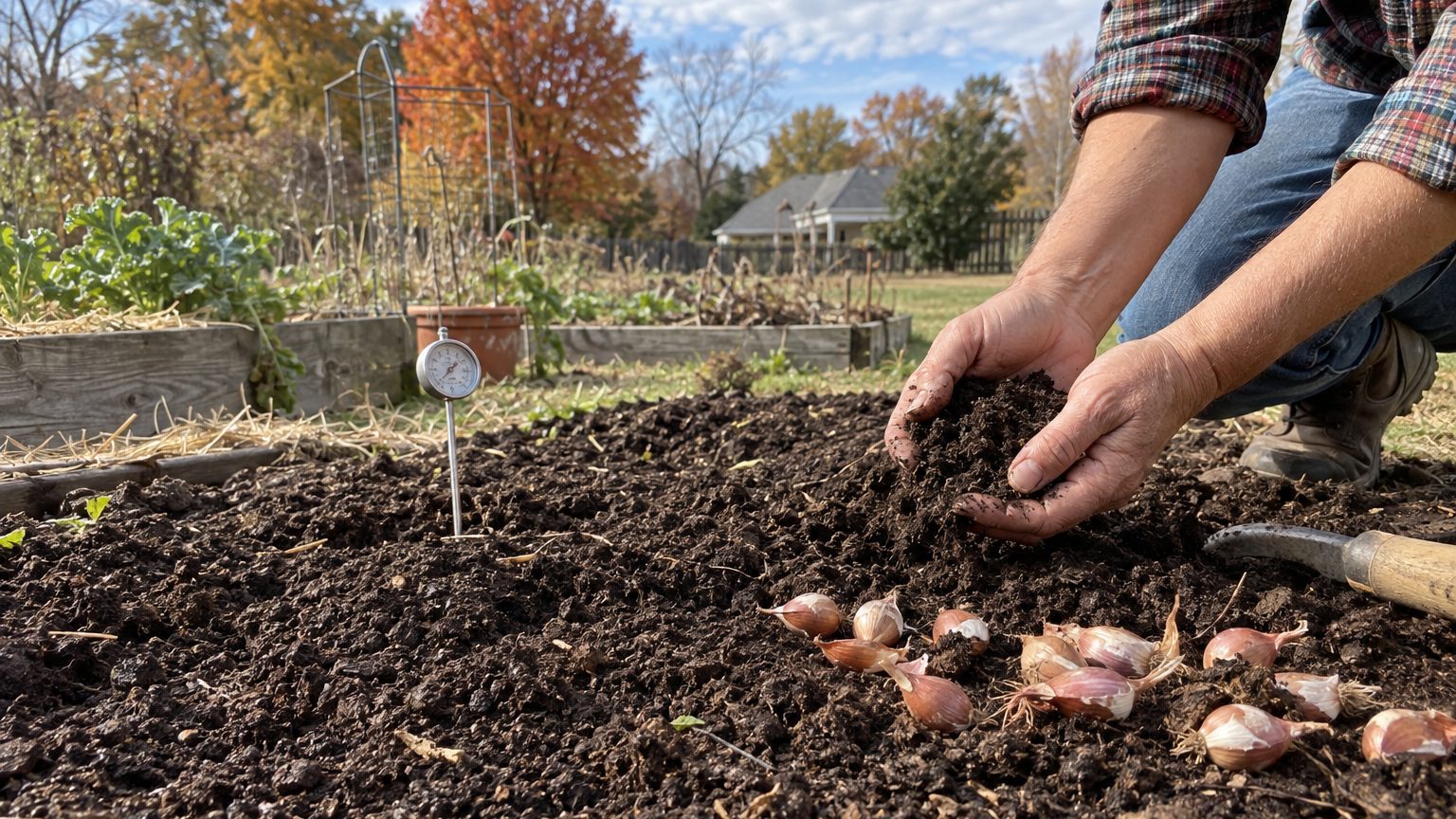

In Connecticut, plant shallot sets in early spring as soon as the soil crumbles in your hand instead of smearing. In the mildest coastal pockets you can also plant in autumn. NOAA’s 1991-2020 normals put the last spring freeze at Bridgeport between April 2 and April 12, but that is the coast, and inland gardens run later. The ground, not the calendar, sets your planting day.
When the soil is warm enough in Connecticut
The Bridgeport station (USW00094702) in NOAA NCEI’s 1991-2020 Climate Normals puts the last spring 32°F freeze between April 2 and April 12, using the 30-70% probability band. Treat that as odds, not a promise: some springs the last freeze lands earlier, some later. Bridgeport also sits on Long Island Sound and is the mildest part of the state. Inland and northwest Connecticut freeze noticeably later in spring, so a gardener in the Litchfield Hills should shift every date in this article later. The USDA Plant Hardiness Zone Map (2023) runs from 6a to 7b across the state, and that spread shows how different two Connecticut gardens can be.
Why the frost date is only a proxy
A frost date describes night air. Shallot roots care about the soil, and the soil lags behind the air. Ground that was frozen or saturated in March does not become a friendly seedbed on the day the freeze risk ends. It gets there days or weeks after, depending on drainage, exposure and how much snowmelt and rain has soaked in.
Shallot tops that are already up shrug off a light frost. What they dislike is cold, waterlogged ground around newly planted sets, where roots stall and bulbs sit rotting. So use the ground itself as your signal. Squeeze a handful from planting depth. If it holds a loose ball and breaks apart under a poke, it is ready. If it smears, shines or drips, wait. A cheap soil thermometer helps, but the number that matters for your area is the one your state extension service publishes, not a figure from a national chart.
Spring or autumn, and what carries over from garlic
Autumn planting is the bridge between shallots and garlic. The mechanics (timing roots ahead of the freeze, mulching, bed preparation, rotating alliums) are covered in the garlic section of this site, with its pages for each state and territory, and I won’t repeat them here. What differs for shallots is mostly size and habit. A shallot set is smaller and shallower-rooted than a garlic clove, so it has less reserve to survive a bad winter. It also multiplies into a cluster, which means tighter spacing mistakes show up later as crowded, undersized bulbs. For the basics of that one-in, many-out habit, see Growing Shallots: One Bulb In, a Handful Out.
Rotation is the part most gardeners skip. Shallots belong to the same family as onions, garlic and leeks, so keep them out of any bed where those grew recently. Soil-borne allium diseases persist in the ground for years, and a fresh planting only feeds them.
How long the season lasts here
Both frost dates come from the same Bridgeport normals, which gives us the arithmetic. The first fall freeze falls between October 28 and November 10. Count from the end of the spring band (April 12) to the start of the fall band (October 28) and you get 199 days. Count from the start of the spring band (April 2) to the end of the fall band (November 10) and you get 222 days. So the frost-free stretch at the coast runs roughly 199 to 222 days. Inland, where spring freezes linger and fall arrives sooner, expect less, and no figure on this page can say how much less for your hills.
That is a generous window for a bulb crop, and what it allows is more interesting than the number. A long window lets you make a second, staggered planting of sets two or three weeks after the first, which spreads your harvest instead of dumping it all in one week. The later batch will have less time to build leaves before the bulbs start forming, so expect smaller bulbs from it. It is a way to stretch the supply, not a way to double it. The succession sowing guide on this site walks through the spacing of those waves.
The window also settles whether transplanting is worth the trouble. Starting shallots from seed indoors and moving them out gives a head start, and with 199 days or more on the table, Connecticut can afford either route. The cost is the root check: before you set a transplant out, slide it from its cell and look for white, healthy roots wrapping the plug, not a tangle or a mushy base. In a place with a short season, where the first sowing is the only one, a stalled transplant costs the whole crop. Compare that with Growing Shallots in Wyoming or Growing Shallots in Northwest Territories, where the window is what decides everything. Connecticut forgives a late start in a way those places don’t.
The end of the window matters too, because that is where curing happens. When the tops flop and yellow, lift the bulbs on a dry day and let them dry in a shaded, airy spot. Then inspect each one by hand. A neck that is soft or damp, or a base showing mold, ends the question: that bulb does not go into storage, and it should not be eaten on the theory that it looks fine. A bulb that looks sound is not proof that it is. I won’t give a keeping time, because it depends on the type, the cure and how the bulbs are kept. Check them regularly and pull any that soften.
Heat and water in Connecticut
This page does not carry a sourced count of days above 90°F or a summer rainfall total for Connecticut, so it won’t print either one. Any number I offered would be a guess, and a count from one reference station would not describe the whole state anyway. What can be said is qualitative. Connecticut summers are humid, rain tends to come in bursts, and the coast and the hills differ. For shallots, that means the main summer risk is wet foliage and slow drying, not scorched plants.
Warm, damp weather is when fungal problems take hold in alliums: downy mildew on the leaves, neck rot as the bulbs mature, and white rot in the soil if it has been introduced. The practices that help are all dull and all effective. Give plants room for air to move, keep weeds down, water at the base in the morning instead of overhead, and harvest in a dry spell. Mulch keeps soil from splashing onto leaves and shades the root zone, which helps in a hot stretch. I won’t name any spray, because the right choice and rate depend on a diagnosis, and your extension office can supply one.
The winter low decides autumn against spring
The number that settles the planting season is not summer heat. At Bridgeport, the mean daily minimum of the coldest month is 24.4°F (NOAA NCEI Climate Normals, 1991-2020). That is below freezing even at the mildest reference point in the state, and it is the measure of whether a plant survives the cold, not a record low. Inland Connecticut runs colder, and so the choice splits by site:
| Criterion | Autumn planting | Spring planting |
|---|---|---|
| Best suited to | Milder, well-drained coastal and near-coastal sites | Inland, northwest and low-lying, wet ground |
| Main risk | Rot in wet soil, or sets heaved out by freeze and thaw | Planting too early into cold, saturated soil |
| What you gain | Larger, earlier bulbs | A safer, more predictable crop |
| Mulch role | Protects sets through winter | Moderates soil moisture and temperature |
Where the ground freezes hard and stays wet, autumn-planted sets rot or heave, and spring is the safer call. A milder winter gives the larger, earlier bulbs that autumn planting is grown for. If you can’t tell which side of the line your yard is on, hedge: plant a small batch in autumn and the rest in spring, and let your own soil show you what works.
Which shallots suit Connecticut
Choose by type, not by name, and let three facts about the state steer you. Connecticut has a long coastal season but a shorter, colder one inland, so the earlier-maturing types are the safer pick in the hills. Summers are humid, so disease resistance should be the first criterion on any list, ahead of size and flavor. And where summer heat arrives, the better choice is one you can give airflow and a shaded root zone through mulch and spacing.
The first choice is between sets and seed-grown shallots. Sets, which are small bulbs, are the simpler start for most home gardeners and the quicker route to a harvest. Seed-grown types cost you the extra step of starting and transplanting but open a wider range of choices, and they begin disease-free because they never carried over from a previous crop. Whichever you choose, buy planting stock from a reputable supplier that sells it for planting. Grocery-store shallots may carry disease and may be treated to resist sprouting, so they are a gamble.
I’m deliberately not naming any variety. This page does not have the trial data that would justify one, and in a state with zones from 6a to 7b, a variety that thrives in a Fairfield County garden can fail in Litchfield County. Local trial results are the only recommendation that means anything. UConn Extension is the place for that, since its horticulture staff can tell you which varieties have been grown and evaluated in your part of the state, what disease pressure looks like locally, and when your county can plant. For a broader grounding in growing the crop itself, Growing Shallots: One Bulb In, a Handful Out is the place to start.
Common questions
Can I plant shallots in Connecticut in autumn?
Yes, in sites that drain well and see milder winters, and the payoff is larger, earlier bulbs. Where the ground freezes hard and stays wet, sets can rot or heave, so spring planting is safer. If you’re unsure, split your planting between the two seasons.
Is April 2 the date to plant?
No. April 2 to April 12 is the band for the last spring freeze at Bridgeport, a coastal station, and it is a probability, not a planting date. Plant when the soil is workable and crumbles in your hand, which can be well after that date inland.
Can I follow garlic or onions with shallots in the same bed?
Avoid it. They are all alliums and share soil-borne diseases that persist after the crop is gone. Rotate shallots into a bed where no allium has grown in recent years, and see the garlic section of this site for the rotation reasoning.
How do I know my cured shallots are safe to store?
Inspect every bulb by hand. A soft or damp neck, or mold at the base, ends the question, and that bulb should be discarded. Looking sound is not proof of being sound, so check stored bulbs regularly and remove any that soften.
One last caution on the numbers above: every frost figure here comes from a single station on Long Island Sound. A garden near the Massachusetts line may see its last spring freeze later than April 12 and its first fall freeze earlier than October 28, so subtract from your window accordingly.