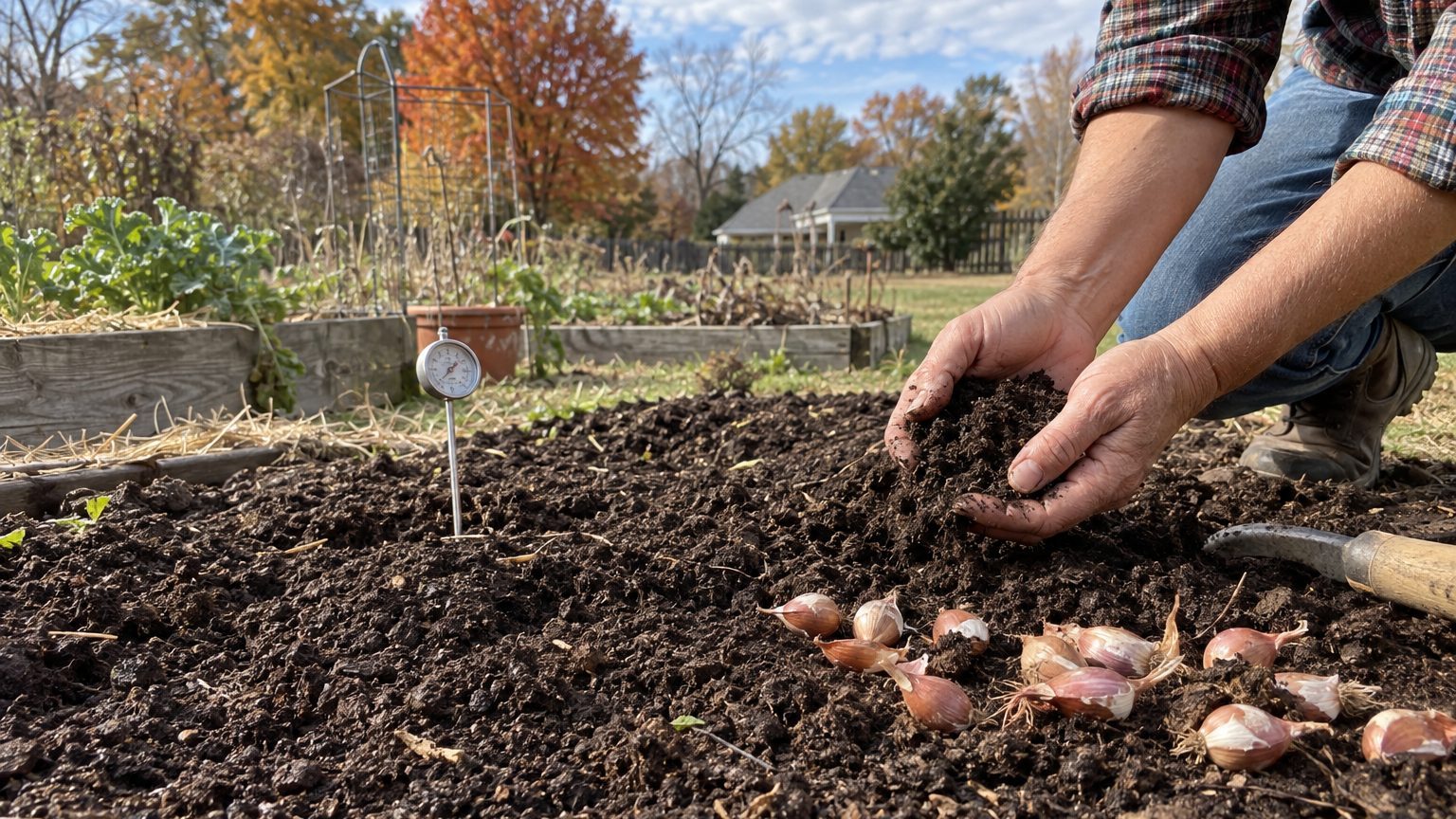

Plant shallots in spring, as soon as the soil has thawed, drains and crumbles in your hand. Around Yellowknife that usually means late May or early June. Autumn planting is a gamble where the winter low is far below zero. A short season favors early types, and the harvest has to be lifted and cured before the first fall frost.
When the soil is warm enough in Northwest Territories
At the Yellowknife A station, the last spring frost falls on average on May 25 (Environment and Climate Change Canada, Canadian Climate Normals 1981-2010). That is a midpoint. In one year out of two the last frost arrives later, and northern or upland districts run weeks behind this station. Treat May 25 as the middle of a window.
Shallots do not read the calendar, and they do not respond to air temperature either. They respond to soil. The ground warms after the frost risk ends, not at the same moment, so the frost date is a stand-in for what is happening a few inches down. A late-May frost can come with soil that is still cold and wet. Sets pushed into that soil sit idle and are open to rot.
How do you tell the soil is ready for shallots?
Look for three signs. The ground has thawed to the full depth of the sets. A handful squeezed in your fist breaks apart instead of smearing into a ribbon. And the weather has been mild for several days in a row, not just one warm afternoon. A cheap soil thermometer helps, but the squeeze test catches the problem that matters most, which is soggy ground.
Raised beds drain faster and warm sooner than flat ground, and dark soil warms faster than pale. A layer of clear or black plastic laid over the bed for a week or two before planting takes the chill off. Pull it back before the sets go in. Plant each set with its pointed tip at or just below the surface, because a deeply buried shallot grows a long, pale neck and ripens slowly.
What do shallots share with garlic?
Quite a lot. Autumn planting, curing, storage and allium rotation all work much as they do for garlic, and the garlic guides on this site cover them in detail. The differences are small but real. Shallots multiply, so one planted set becomes a cluster of bulbs, and each set sits closer to the surface than a garlic clove. Their smaller sets also have less in reserve to survive a hard, wet winter. Keep shallots out of any bed that carried onions, garlic or leeks recently, since the same soil diseases attack all of them.
Curing and storage touch food safety, so inspect every bulb. A neck that is still soft or damp, or any mold at the base, ends the question: that bulb goes in the compost, not the pantry. A bulb that looks fine on the outside can still be failing at the neck, so squeeze the neck of each one and check the base before storing anything.
How long the season lasts here
The Yellowknife A station has a mean last spring frost of May 25 and a mean first fall frost of September 18, both from the 1981-2010 normals. Since each date is an average, a cold year can cut that window noticeably at either end.
For shallots, a window that short means one planting per year. A long season can hold a second sowing a few weeks after the first, which spreads the harvest. The succession sowing guide on this site covers that for crops with room to spare. Here there is no room. A second batch planted in late June would still be small when fall frost arrives, and small, unfinished bulbs store poorly.
The short window also changes the question about transplanting. Shallots grown from sets go straight into the ground, and that is the simplest choice. Types grown from seed are different. Starting them indoors gives them a head start the season cannot otherwise provide, and in a 116-day window that head start can be the difference between a finished bulb and a green one. But each seedling has to survive the move, so check the roots before you commit.
Slide one seedling out of its cell. If white roots reach the edge of the soil and hold it together, it is ready. If the roots are a tight, circling mat, they have been in the cell too long. If the soil falls away from sparse roots, wait another week. Harden seedlings off for several days before planting out, since the nights in late May can still be sharp.
Long summer daylight works in your favor, so watch your shallots as the season progresses. The finish is where the season runs out. Stop heavy watering as the tops yellow and fall over, then lift the bulbs on a dry day before the first fall frost. Cure them somewhere covered, dry and well ventilated, since September air can be cool and damp. Lay them in a single layer so air moves around each one. Cured shallots have dry, papery skins and a tight, dry neck. Do not store anything with a soft neck or a moldy base, and do not rely on appearance alone.
Heat and water in Northwest Territories
Heat is not the problem here. Summers are cool and short at the Yellowknife A station. Shallots here do not need shade at the root, and a hot-climate plan is not needed. They need every bit of warmth the season gives, which is another reason to use raised beds, dark soil and a sheltered, sunny spot.
Water works the opposite way from a hot summer. Shallots have shallow roots and need steady moisture while the tops grow, then a gradual easing off as the bulbs mature. The usual trouble in a cool, damp summer is not drought. It is mildew on the leaves, slow ripening and rot in the neck and base. Space the plants so air can move between them, water at the soil and not over the leaves, and keep the bed free of weeds that hold moisture around the stems. If a wet spell hits as the tops start to fall, pull back any mulch and let the soil surface dry.
Can you plant shallots in the fall in Northwest Territories?
The winter decides it. The mean daily minimum of the coldest month at Yellowknife is -29.5 °C (-21.1 °F), and Natural Resources Canada places the city in Canadian hardiness zone 1b. That is a different system from the USDA map and does not convert to a USDA zone, because the Canadian one weighs seven climate variables. For a gardener the practical meaning is simple. The ground freezes hard and can stay wet through thaws, and that is when autumn-planted sets rot or heave out of the soil.
| Planting time | What it offers | What it risks here |
|---|---|---|
| Autumn | Larger, earlier bulbs where winters are milder | Rot in wet, frozen soil; sets pushed up by freeze and thaw |
| Spring | Sets go in when the soil is workable and the risk is low | A later, smaller harvest and a tight finish before fall frost |
Where winters are milder, autumn planting gives larger and earlier bulbs, and that is why people grow shallots that way. With a winter this cold, spring is the safer call. A grower who still wants to try autumn planting can mulch heavily and plant only a few sets as a test. The garlic guides on this site cover the mulching details. Do not stake the whole crop on it.
Which shallots suit Northwest Territories
The choice comes down to type. Three traits matter most in this climate:
- Early maturity. At the reference station, the earliest-maturing types have the best chance of finishing before fall frost.
- Disease resistance, because cool, damp stretches invite mildew and neck rot, and resistant types lose less in a bad year.
- A habit that holds up in cold, wet soil, with healthy, firm sets that root well in spring.
Hot-climate traits, such as heat tolerance or a need for shade at the root, can be ignored. Choose between set-grown and seed-grown types by how much time you have. Sets are the simpler route. Seed-grown types can be started indoors, and the root check described above decides whether the move is worth it.
A shallot that does well in Ontario or Colorado can fail in the Northwest Territories, and the only recommendation worth following comes from trials in your own climate. The territorial Industry, Tourism and Investment agriculture office is the place to ask which varieties northern growers have actually brought through to harvest. Ask them about local seed and set suppliers as well, since stock bought elsewhere may not suit the cold.
For comparison, the Growing Shallots in Nunavut guide describes a still shorter window, and Growing Shallots in Colorado shows how a very different climate shifts the same choices. The general guide, Growing Shallots: One Bulb In, a Handful Out, explains how the multiplying habit works in any garden.
Common questions
When should I plant shallots in the Northwest Territories?
Plant in spring once the soil has thawed to planting depth and crumbles in your hand. At Yellowknife A the mean last spring frost is May 25, but half of all years run later, so judge by the soil and not the date.
Will shallots survive the winter in the ground?
Rarely, and the odds are poor. The coldest month averages a daily minimum of -29.5 °C (-21.1 °F), and wet, freezing soil rots or heaves autumn-planted sets. Spring planting is the safer choice.
Can I grow shallots from seed in a short season?
Yes, if you start them indoors and check the roots before transplanting. Seedlings with white roots holding the soil together are ready. Plan on one planting a year, because there is no room for a second.
How do I know shallots are safe to store?
Cure them in a covered, airy place until the skins are papery and the necks are dry. Check every bulb before storing it. A soft neck or a moldy base means the bulb should be thrown out, whatever the rest of it looks like.