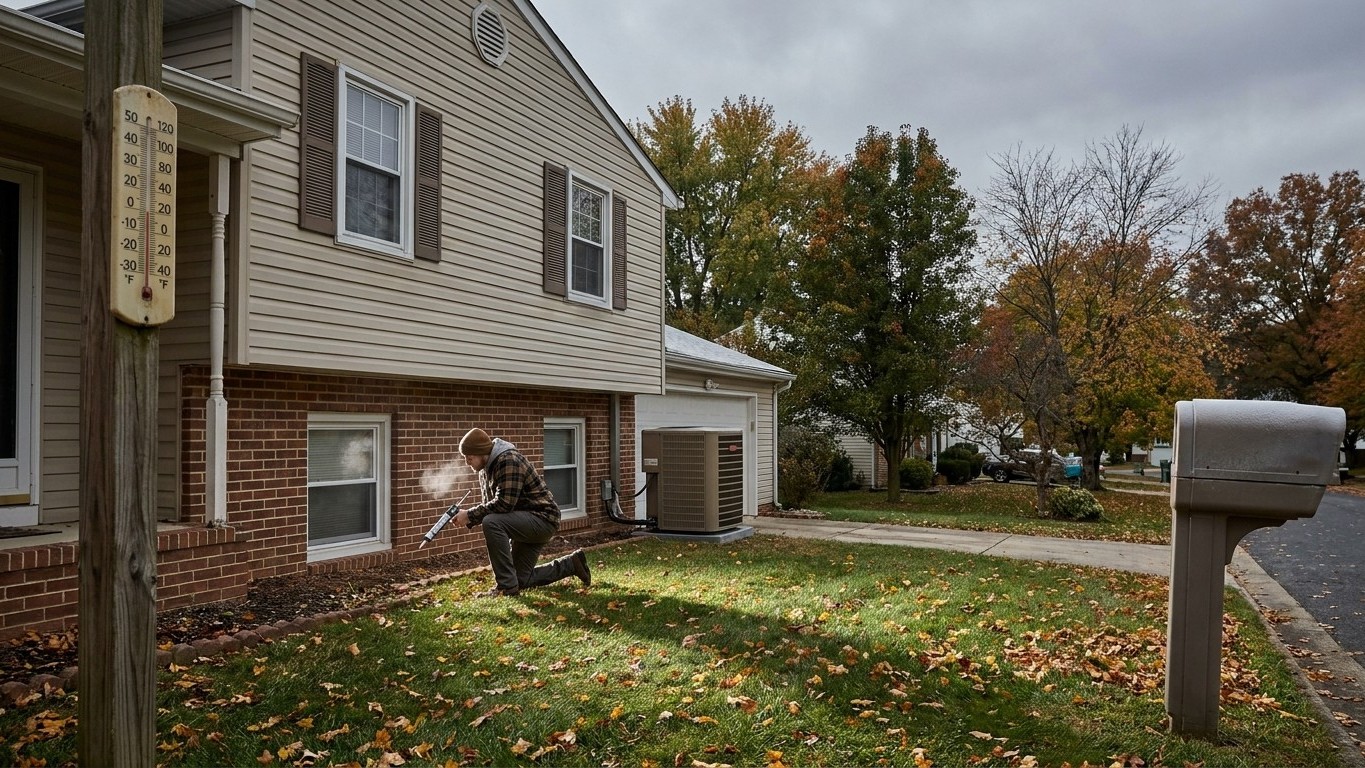

Heating season in Delaware opens in October, when the statewide reference station’s average temperature first drops below the 65°F mark used to count heating degree days. Demand peaks in January, and the season runs roughly eight months before the mean climbs back above 65°F in June. That’s the calendar answer, what happens inside it is more interesting.
When the heating season starts in Delaware

October is the pivot month at Wilmington New Castle County Airport, the NOAA reference station for the state. Its 1991-2020 normal mean temperature for October sits at 57.2°F, the first monthly average of the fall to fall below the 65°F baseline NOAA itself uses to tally heating degree days. That’s not a guess about comfort. It’s the point where the math of heating degree days starts accumulating again after a summer at or above zero.
January carries the heaviest load of the year, with 976 heating degree days in an average month there. The season then tapers through spring, and the mean temperature climbs back above 65°F by June, which is why the table below skips a stretch of the calendar.
None of this names a date, and it shouldn’t. A monthly normal is an average built from thirty years of Octobers, not a forecast for any single one. A hard freeze can show up in late September some years, well before the month-long average says the season has arrived. Treat October as the season’s center of gravity, not a trigger date.
Monthly heating degree days at Wilmington New Castle Co AP
| Month | Heating Degree Days |
|---|---|
| January | 976 |
| February | 824 |
| March | 676 |
| April | 347 |
| May | 122 |
| June | 13 |
| September | 38 |
| October | 266 |
| November | 551 |
| December | 832 |
July and August don’t appear in that table at all. Heating has nothing to do in either month at this station, and the normal monthly product simply doesn’t carry a figure for them.
How hard the winter works here
Add up a full year at this station and you land at about 4,647 heating degree days, on the 65°F base, alongside roughly 1,228 cooling degree days on the summer side. Heating degree days work like a fuel meter built from climate data: a house that sees twice the degree days of another, similar house, burns roughly twice the fuel to stay at the same indoor temperature, all else being equal.
What the annual number can’t tell you is the shape of the season, and that’s exactly what the monthly table above is for. Two places can post the same yearly total while one gets there through a long stretch of mild chill and the other through a short, brutal freeze. Delaware’s pattern leans toward the first kind: an eight-month season, but a January peak of 976 degree days that’s firm without being extreme, spread out rather than concentrated into a couple of punishing months.
That distinction matters for how a house is built and run here. A long, moderate season rewards steady, well-maintained equipment and decent insulation more than it rewards a system built to handle short bursts of extreme cold. It’s also the reason two houses with identical thermostats and similar square footage can end up with noticeably different fuel bills if one has aging ductwork or drafty windows the other doesn’t.
What most homes in Delaware actually heat with
Federal survey data on home heating equipment shows a state that leans heavily on forced-air systems, with heat pumps as the clear second choice.
| Heating Equipment | Share of Homes |
|---|---|
| Furnace | 62% |
| Central heat pump | 20% |
| Steam or hot-water boiler | not reported (estimate suppressed) |
On the fuel side, natural gas heats about 41% of homes and electricity powers about 40%, with fuel oil or kerosene at 8% and propane at 9%. That “not reported” line for boilers doesn’t mean nobody in Delaware runs one. It means the survey sample was too thin, or the estimate too shaky, to publish a reliable number, which is a different thing entirely from zero.
A furnace being the most common system in the state says something about what got installed when these houses were built and which fuel was cheap at the time. It’s not a verdict on which system is best for any particular house today. A furnace heats a room fast, cycles on and off in short bursts, and depends entirely on the duct system that carries that heat around the house. It’s also unforgiving about one thing in particular: a filter that clogs, restricts airflow, forces the blower to work harder, and can shorten the life of the whole unit.
Run it once before you need it
The worst night to discover a dead furnace is the first genuinely cold one, right when every technician in New Castle, Kent, and Sussex counties is already booked solid. October, before demand spikes, is the window to find out if the system works.
- Turn the thermostat down, then back up above room temperature, and listen for the system to kick on within a minute or two, no clicking, no delay, no grinding.
- Let it run a full short cycle and expect a faint burnt-dust smell on that first firing. That’s dust burning off the heat exchanger and it’s normal; it should fade within minutes and not return.
- Replace or check the filter. A clogged filter is the single most common reason a furnace underperforms or shuts itself off early.
- Clear the space around vents, registers, radiators, or an outdoor heat pump unit, furniture, curtains, leaves, or debris all choke airflow and waste output.
- Press the test button on every carbon monoxide alarm in the house. Combustion heating equipment can leak carbon monoxide when something’s wrong, and a working alarm is the cheapest insurance against it.
- Watch for anything past that point: a burning smell that doesn’t fade, a burner that won’t stay lit, strange noises, or a system that runs constantly without warming the house. That’s the moment to call a licensed technician rather than keep troubleshooting.
Even a furnace that passes every one of those checks can still be losing serious ground before its heat reaches a room. According to the Department of Energy, “in a typical house, about 20%-30% of the air that moves through the duct system is lost due to leaks, holes, and poorly connected ducts.” That’s a national average, not a diagnosis of any one house, but it’s a fair reason to have ductwork inspected if a room never quite gets warm no matter how the system checks out.
What turning it down is actually worth
The Department of Energy puts a specific number on thermostat setbacks: “You can save as much as 10% a year on heating and cooling by simply turning your thermostat back 7-10°F for 8 hours a day from its normal setting.” That’s a yearly figure tied to a specific setback range held for a specific stretch of hours, covering both heating and cooling together, not a per-degree formula and not a heating-only number.
In a state where the heating season runs about eight months, that setback has a long runway to work. A schedule that dials the thermostat back overnight or during an empty workday touches a large share of the year here, from the first cool mornings in October through the tail end of the season in late spring. The longer that season stretches, the more hours a consistent setback routine has to actually do something, rather than being a habit that only matters for a few weeks in the dead of winter.