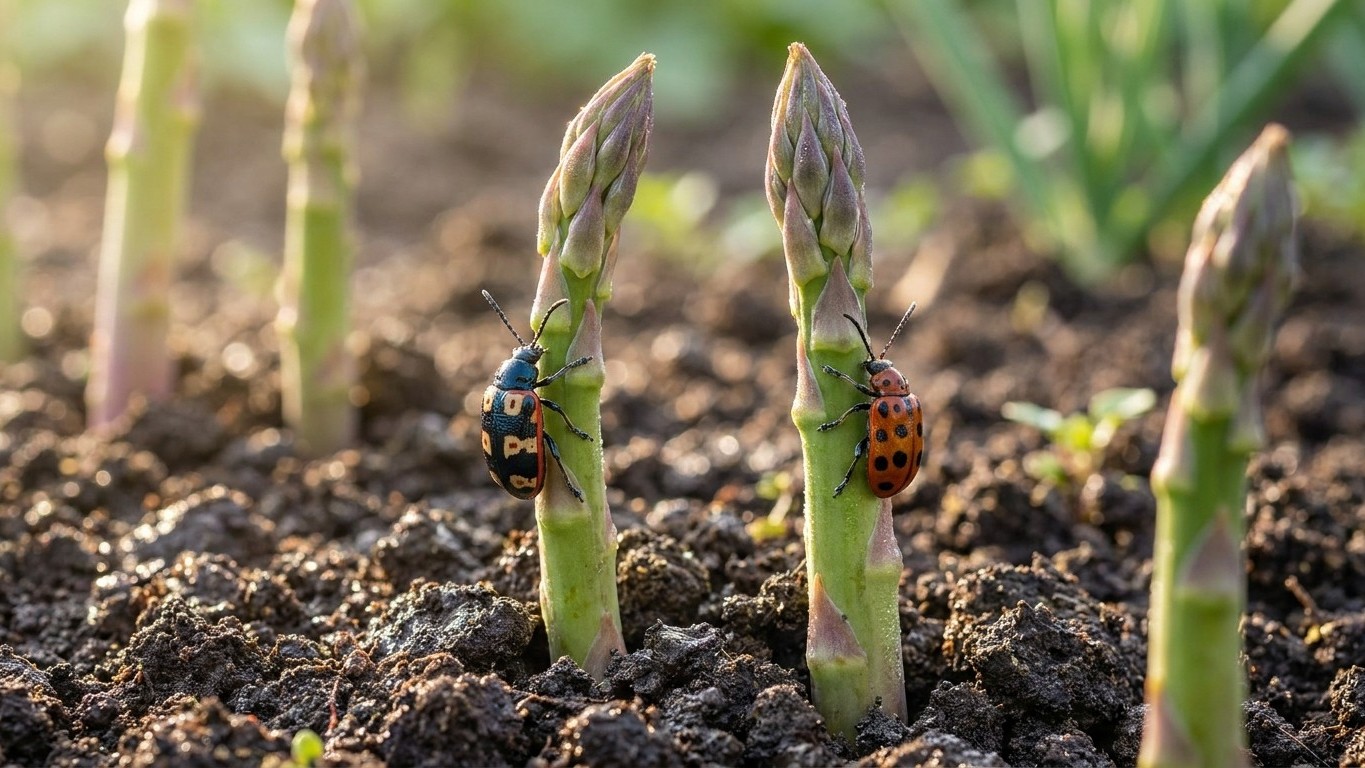

The direct answer is unsatisfying but true: the pest list University of Delaware Cooperative Extension keeps for home gardens in this state doesn’t name a single species that feeds on asparagus. The nine insects it documents belong to tomatoes, squash, cabbage, and beans. That gap matters more than it sounds, and it changes how you should watch a bed you’re planting for the next fifteen years.
Which pests attack asparagus in Delaware

University of Delaware Cooperative Extension documents nine garden pests for this state: Colorado potato beetle, cucumber beetles (spotted and striped), harlequin bug, imported cabbageworm, Mexican bean beetle, squash beetle, squash bug, squash vine borer, and tomato hornworm. That’s the full list this service tracks here, and it isn’t padded out further on this page.
Sort them by what they actually eat and the picture gets clear fast. Colorado potato beetle and tomato hornworm feed on nightshades, potatoes, tomatoes, eggplant. Cucumber beetles, squash beetle, squash bug, and squash vine borer are cucurbit specialists, tied to squash, cucumbers, and melons. Harlequin bug and imported cabbageworm work the cabbage family. Mexican bean beetle, despite the name, is a lady beetle relative that feeds on bean foliage.
Asparagus doesn’t belong to any of those plant families. It’s a perennial in the lily relatives, and none of the nine documented species are built to feed on it. None of the nine pests this extension service documents for the state has asparagus as a host plant, which is the closest thing to a direct answer this data allows. That doesn’t mean an asparagus bed in Delaware is risk-free. It means the documented risk here, at the state level, sits with the vegetables planted around it, not with the asparagus itself.
Why does that matter for a crop you plant once and harvest for a decade or more? Because a gardener who sees ragged foliage on asparagus and reaches for a Colorado potato beetle diagnosis is chasing the wrong insect. The nine names above are worth knowing if you’re also growing tomatoes, squash, or cabbage nearby, since a shared garden means shared insect pressure on those other crops. For the asparagus bed specifically, this list tells you what isn’t the cause more than what is.
When each one shows up, and what it does first
Since none of the documented species feed on asparagus, there’s no pest emergence calendar for this crop to hand over here. What there is instead is a planting calendar for the bed itself, and it’s worth lining up against the pest pressure building in the rest of the garden at the same time.
Asparagus crowns go into 8-inch furrows in early spring, which in this state means working around a last spring frost that lands between April 3 and April 14 at the reference weather station used for these normals (NOAA NCEI 1991-2020 Climate Normals). Suburban and rural gardens away from that station often see frost let go a week or two later, so treat that window as a starting point rather than a fixed date for your own yard.
That same early spring stretch is also when Colorado potato beetle adults climb out of the soil where they overwintered, and it’s roughly when squash and cucumber seedlings go in, drawing cucumber beetles and squash bugs to the garden. None of that traffic touches the asparagus furrow, but it does mean the bed sits inside a garden that’s already active with insects looking for their preferred hosts elsewhere.
No asparagus is harvested at all until the third year after planting, and that’s the number that should anchor a grower’s attention more than any pest calendar. In the years before that, the priority is establishment: the furrow gets backfilled gradually, about two inches every other month across the season, rather than filled in all at once. Once harvest does start, it runs on a short leash, four weeks the first cutting year, six the next, eight after that, and it stops for the season the moment most spears come up thinner than a pencil, whatever the calendar says.
What you’re watching for in that stretch isn’t a documented insect, since there isn’t one for this crop here. It’s whether the fern that follows each harvest window stays upright and green, since that top growth is what feeds the crown for next year’s spears.
Telling the damage apart from everything else
With no documented insect feeding on asparagus in this state’s extension records, a damaged-looking bed is more likely telling you about the site than about a bug. That’s actually useful, because it narrows the list of suspects to things you can check.
Thin, sparse spears in a bed that’s already past its third year often trace back to soil that doesn’t drain the way this crop needs. The state’s representative soil, the Greenwich series, is well drained by nature, but that’s a description of one mapped soil, not a guarantee about the ground under any particular bed. A furrow dug into heavier, poorly drained soil will show stunted, yellowing growth that looks like a feeding problem but isn’t one.
Drought stress is the other common look-alike, and it lines up with a specific month. Summer rainfall here averages about 13.1 inches across June, July, and August, but August is the driest of the three at 3.98 inches. A bed that looked fine in July and starts wilting or yellowing in August is more likely short on water than under insect attack, especially on sandy ground that drains fast.
| What you see | Likely cause | What separates it from insect damage |
|---|---|---|
| Yellowing, wilted fern | Drought stress, especially in August | No chewed edges or holes; soil is dry several inches down |
| Thin, weak spears late in harvest | Normal end-of-season signal, or nutrient shortage in low-organic-matter soil | Uniform across the bed, not scattered feeding marks |
| Broken or bent spears | Mechanical damage from foot traffic or tools | Clean breaks, not ragged edges from chewing |
| Discolored, spotted foliage | Fungal disease | Spreads over days to weeks rather than appearing overnight |
None of this replaces an on-site look. If a symptom doesn’t match anything on that list, the next step is a county extension office, not a guess.
What actually works here, and what is a waste of time
Given that no documented pest targets this crop in the state’s records, spending money on an insect treatment for asparagus specifically is effort aimed at a problem that isn’t there. The extension service’s own pest list is the reason to skip that step, not a reason to skip watching the bed.
What earns the effort is site selection, done once, since this bed isn’t moving for a decade or more. The bed needs to drain well, because a mistake made at planting can’t be corrected later without starting over. If the ground holds water after a hard rain, raised rows or a different spot beat any treatment applied after the fact. That decision has to happen before the crowns go into the 8-inch furrow, not after.
Timing the gradual backfill, two inches every other month rather than all at once, also does real work: it keeps the crown from sitting too deep too soon while the roots are still establishing, which matters more to a healthy bed than any pest control routine would. And holding to the harvest limits, stopping at four weeks the first cutting year and letting the fern grow through the rest of the season, protects the crown’s ability to feed itself. That’s a bigger lever on a productive bed than anything sprayed on it.
Physical barriers, the kind that make sense against a documented feeder, don’t have a job to do here since there’s no confirmed target. Rotating tomatoes, squash, or beans away from the asparagus bed is worth doing for those crops’ own sake, but it isn’t asparagus protection, since the insects tied to those plants aren’t coming for the asparagus anyway. Save the barrier and treatment budget for the crops that actually appear on that nine-name list.
Where to check this for your own county
A state-level pest list, even one this specific, describes the state. It doesn’t describe one backyard. University of Delaware Cooperative Extension keeps county offices for exactly this reason, and a call or visit there is how a documented statewide pattern gets checked against what’s actually present on one property.
That gap runs both directions. A pest common in one part of the state can be rare a county over, and a soil series that drains well on paper can behave differently once a builder has graded or filled the lot. The Greenwich series is the state’s official representative soil, not a prediction of the ground in any specific garden, and the same caution applies to the frost dates cited above, which come from a single reference station rather than every yard in the state.
A soil test through the local extension office answers the drainage and fertility questions that this page can only frame in general terms. If a bed shows damage that doesn’t match drought, mechanical injury, or disease, the county office is also the place to confirm whether something outside the nine documented species has moved in, since pest ranges shift over time and a home page like this one reflects what’s recorded, not what might be emerging.
The next step, for anyone about to commit a corner of the yard to asparagus for the next fifteen years, is that call before the crowns go in the ground, not after a problem shows up.
Common questions
Does asparagus beetle occur in Delaware?
It isn’t on University of Delaware Cooperative Extension’s documented pest list used for this page. If you suspect it in your own garden, a county extension office is the place to confirm it, since documentation can lag behind what’s actually present.
If none of these pests eat asparagus, why does the extension service track them?
Because they feed on other common garden vegetables, tomatoes, squash, cabbage family plants, and beans, that most home gardens grow alongside asparagus. The list serves the whole vegetable garden, not one crop.
When should I actually worry about my asparagus bed?
When the fern that grows after harvest doesn’t stay upright and green, or when spears come up consistently thin before the normal end-of-harvest point. Those signs point toward site conditions, drought, or disease rather than a documented pest.
Is it safe to plant asparagus near tomatoes or squash in this state?
The soil facts and pest list here don’t rule it out. The insects tied to those crops target their own hosts, not asparagus, so proximity mainly matters for those other plants’ pest pressure, not for the asparagus itself.