
Delaware gardeners get two collard seasons: a spring planting that has to beat the summer heat, and a fall planting that gets sweeter with every frost. At the Wilmington reference station, the last spring freeze falls between April 3 and April 14, and the first fall freeze between October 26 and November 7. Spring plantings go in cool, fall plantings in midsummer, and winter cold decides whether you pick past December.
When the soil is warm enough in Delaware

The last spring frost at the reference station in Wilmington (NOAA station USW00013781) falls between April 3 and April 14, according to the NOAA 1991-2020 Climate Normals. That range is the 30 to 70 percent probability band for a 32 F freeze, so a freeze after the later date still happens some springs. Suburban and rural gardens usually see the last frost one to two weeks later than the airport does, and more at higher ground, so check your own county before you set a planting date.
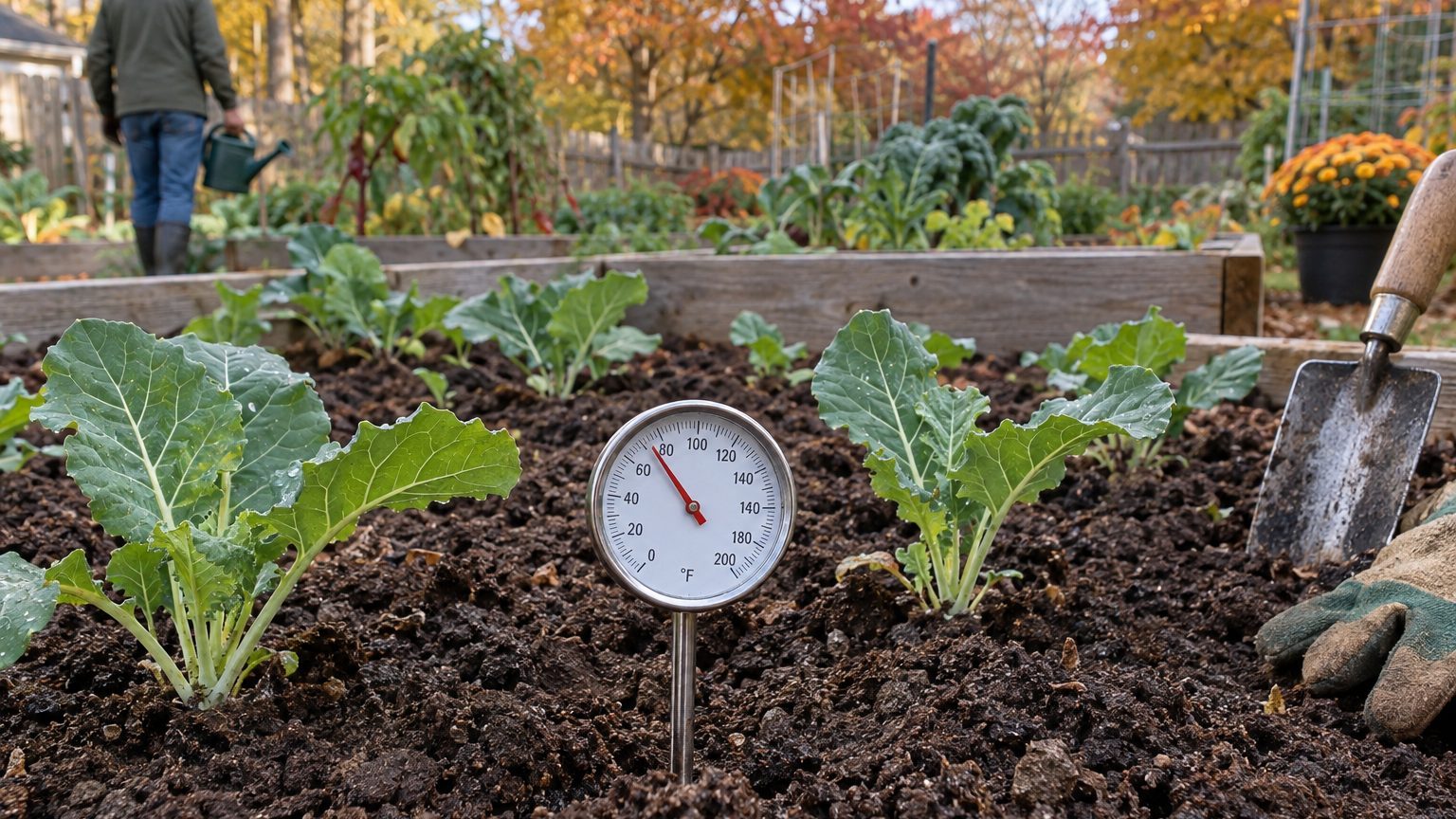
The frost date is only a stand-in for what collards care about, which is the temperature of the soil. Soil warms after the frost risk ends, not with it. Cold ground in March can sit in the 40s F even on a mild afternoon. Seed sown into it rots or sprouts slowly. Once the soil climbs into the 60s F, germination speeds up and seedlings grow without a stall. A cheap soil thermometer pushed 2 to 4 inches down, read in the morning, tells you more than the calendar does.
Can collard transplants go out before the last frost?
Yes, with conditions. Collards are among the hardiest greens, and a hardened-off transplant shrugs off a light frost. That is why many Delaware gardeners set out transplants in late March or early April, a little ahead of the frost range, and cover them with row cloth on nights forecast near 30 F. Seed sown directly should wait until the bed is workable and the soil has started to warm, which in most years means mid-April or later. In a cold, wet spring, wait. A seedling that sits in cold mud loses ground to weeds and slugs.
What should you check on a transplant before planting?
Slide the plant out of its cell and look at the roots. White, firm roots that hold the soil together are what you want. A tight mat of circling roots, brown tips or a sour smell means a plant that will struggle for weeks. Tease out circling roots gently before planting. Skip any transplant with a stem that is dark, thin and pinched at the soil line.
Collards are brassicas, in the same family as cabbage, kale and mustard, and so are turnips and rutabagas. They share the same diseases and insects. A bed that grew any of those last year has not been rested for collards, so rotate to a spot where no brassica has grown recently.
How long the season lasts here
The reference station has about 195 to 218 frost-free days between the mean last spring frost (April 3 to April 14) and the mean first fall frost (October 26 to November 7). Rural gardens trim that by a week or two at each end.
That is a long window for a leafy crop, and it allows something a northern gardener cannot do: two plantings in the same bed. The first goes in during early spring and is picked before the worst of summer. The second is sown or transplanted in midsummer so that it matures as the nights cool. Of the two, the fall planting is usually the better one. Cool weather sweetens the leaves, and cabbage worms and aphids ease off as temperatures drop.
A long window also changes the transplanting question. In a place with a short season, a store-bought transplant buys you weeks you cannot get any other way, and the root check is worth the trouble. Here, seed sown directly in the garden has time to catch up. Transplants still make sense for the spring crop, when you want to beat the heat, and for the midsummer crop, when sowing seed into hot, crusted soil is a poor bet. For the fall planting, seedlings started in a shaded spot or in cells for a few weeks, then moved out, tend to do better than seed sown directly into 90 F ground.
Staggering helps too. Two or three small sowings spaced a few weeks apart give a steadier supply than one big block that all matures at once. The Growing Collards: One Planting, Months of Harvest guide covers how a single planting can keep producing through the season, which is a good companion to a succession plan.
The window runs out in autumn, and not suddenly. First frost is a probability range, like the spring one, and a mature collard plant barely notices a 32 F night. The plants that suffer are the ones set out too late to reach full size before the days get short and growth slows to a crawl.
Heat and water in Delaware

Summers here are hot and humid, and that shapes the whole plan. Collards handle heat better than lettuce or spinach, but they are not happy in it. Leaves turn tough and strong-flavored when temperatures stay high for weeks, and a spring planting that has not been picked by midsummer is usually past its best. Mulch over the root zone keeps the soil cooler and slows evaporation. Where the afternoon sun is brutal, a bit of shade on the south side helps through July and August.
How much water do collards need in a humid summer?
Steady moisture matters more than volume. A deep soaking once or twice a week beats a daily sprinkle, because shallow watering keeps roots near the surface where the soil is hottest. A rain gauge or a cheap tuna can set out in the bed tells you what rain actually delivered, and thunderstorm weeks often deliver less to the ground than they seem to. Water at the base and in the morning, so leaves dry before evening. Humid air and wet foliage invite leaf spots and black rot, a bacterial disease that brassicas share, which shows as yellow wedges on leaf edges and darkened veins.
Spacing helps for the same reason. Crowded plants hold moisture and stay damp long after rain. Give each plant room for air to move through, pull off yellowing lower leaves and clean up plant debris at the end of the season.
Insects follow the warmth. Cabbage worms, aphids and flea beetles all show up on collards. Row cover set over the bed right after planting keeps most of them off, and hand-picking worms in the morning works well in a small garden. Both are practices worth building into the routine before the pests arrive.
Do collards survive a Delaware winter?
Here the cold decides more than the heat. The mean daily minimum of the coldest month at the Wilmington reference station is 25.6 F, and the USDA Plant Hardiness Zone Map (2023) puts Delaware in zones 7a to 8a. Those numbers sit in the middle ground. Where the coldest month stays mild, collards are a standing crop, picked leaf by leaf from November into March. Where winter turns hard, they are an autumn crop that ends at the first serious freeze.
Delaware can go either way depending on the year and the garden. A mean low of 25.6 F means plenty of nights colder than that, and a hard cold snap can finish the plants in an open bed. Plants in a sheltered spot, mulched at the base and covered with row cloth during the worst nights, often keep producing well into winter. Coastal and southern parts of the state usually run milder than Wilmington. So plan the fall bed as if it were an autumn crop, and treat winter harvest as a bonus.
Gardeners farther north plan this differently. The Midwest, for example, rarely carries collards through winter (see Growing Collards in Indiana), and in a much cooler maritime climate the season itself is the constraint (see Growing Collards in Nova Scotia). Delaware sits in a more forgiving zone, with a longer window and a real chance of winter picking.
Which collards suit Delaware
Choose by type, and let local trials pick the names. Delaware’s conditions point to a few criteria: a long season with a hot, humid middle, a spring that can turn warm quickly, and a winter cold enough to test hardiness. Listing a specific variety here would be a guess, because a name that thrives in one county can sulk in another. The only recommendation worth following is one from University of Delaware Cooperative Extension, which knows what has been grown in the state’s soils and weather and can steer you to seed that has been tried in your county.
The table below shows which type to look for, and why.
| Type to look for | Why it fits Delaware | Best use |
|---|---|---|
| Early-maturing types | Gives a spring crop time to be picked before summer heat toughens the leaves | Spring planting |
| Disease-resistant types | Humid summers favor leaf spots and black rot, so resistance is the first thing to check on a seed packet | Any planting, especially summer |
| Heat-tolerant, upright types | Open growth gives airflow and keeps the lower leaves drier | Midsummer sowings for fall |
| Cold-hardy types | Lets plants stay productive through winter cold in a milder garden | Fall planting you hope to pick into winter |
| Slow-bolting types | Delays flowering when spring warms fast | Late spring sowings |
Of those criteria, disease resistance comes first in a humid summer. A plant that holds up to black rot and leaf spots will outlast one that grows faster but collapses in August. Seed packets often list resistances in small print, and the extension office can tell you which ones matter most in your county.
If you plant both a spring and a fall crop, you can buy two types, one that matures early and one that holds up in heat and cold. Many gardeners also try a small trial row of something new beside their usual choice, then keep notes. After a season or two, the notes are worth more than any catalog description.
Common questions
When should I plant collards in Delaware for a fall harvest?
Sow seed or set out transplants in midsummer, early enough that plants reach full size before growth slows in the short days of late autumn. First frost at the reference station falls between October 26 and November 7, but gardens inland and on higher ground often get it a week or two sooner, so count backward from your own county’s date.
Will collards live through the winter?
Sometimes. The coldest month at Wilmington averages a nightly low of 25.6 F, and zones 7a to 8a cover the state. Mature plants in a sheltered, mulched bed, with row cloth on the coldest nights, often keep producing into winter. A hard freeze in an exposed bed can end them.
Can I rotate collards into a bed where turnips or rutabagas grew?
No. Turnips and rutabagas are brassicas, like cabbage, kale and mustard, and they share diseases and insects with collards. Rotate into a bed where no brassica has grown recently, such as beans, tomatoes or onions.
How do I tell if harvested collards are still good to eat?
Look at the leaves before you cook them. Sound leaves are firm and green with a clean smell. Slimy patches, a sour odor, weeping spots or mold mean the leaf should be discarded, and a leaf that merely looks fine is not proof it is safe once any of those signs appear on the bunch. Refrigerate leaves promptly after picking and check them again before use.