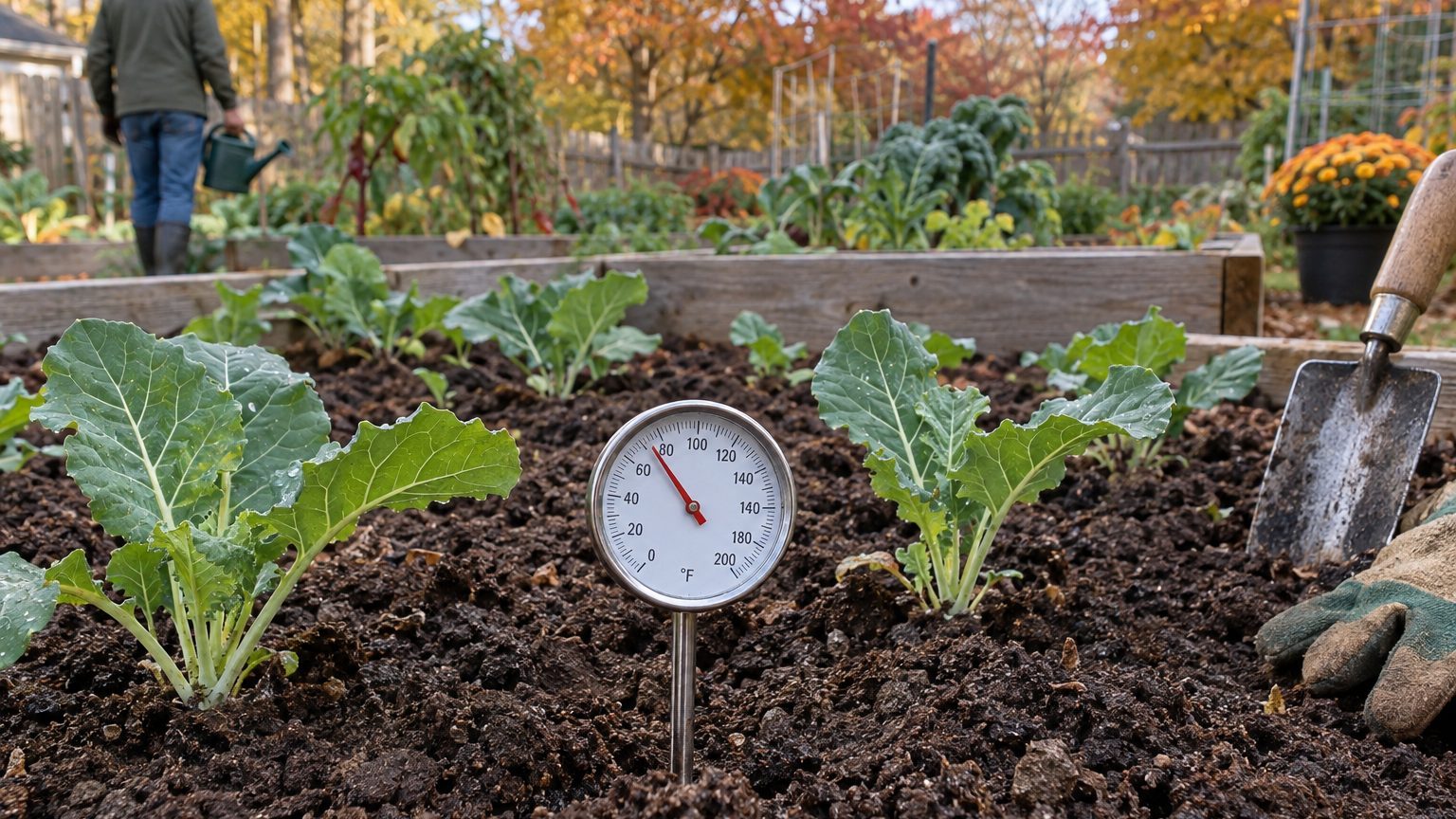

Collards grow reliably in Nova Scotia, but timing matters more here than in most of the collard-growing range. The soil needs real warmth before seed goes in, the frost-free window is shorter than in a lot of American gardens, and a cold winter low can turn what might be a standing crop elsewhere into a strictly autumn one. Everything below comes from Halifax-area climate records, not a general rule of thumb.
When the soil is warm enough in Nova Scotia

A frost date tells you almost nothing about the soil under your boots. It tells you when the air stopped freezing on most years, and soil warms on its own schedule, usually a couple of weeks behind that. In the Halifax area, Environment and Climate Change Canada puts the average last spring frost at May 7, based on the 1981-2010 normals recorded at Halifax Stanfield International Airport. That date is a mean, not a guarantee. In roughly half the years on record, frost showed up after it. Treat May 7 as the middle of a window, not a green light.
What that means for collards specifically: don’t sow the day the frost risk supposedly clears. Wait until the soil has actually lost its winter chill, crumbles instead of clumping in your hand, and has had a stretch of sun on it. Seed sown into cold, wet ground germinates slowly if at all, and slow, stressed seedlings are the ones aphids and flea beetles find first. Coastal and valley gardens in the province often warm a little faster than inland or upland spots, so a gardener twenty minutes from Halifax on higher ground should expect to wait longer than this station’s date suggests.
Collards are brassicas, in the same family as cabbage, kale, mustard, turnip and rutabaga, and they carry the same soil-borne troubles: clubroot, cabbage root maggot, and the flea beetles that shred young leaves. Planting collards where any of those crops grew in the last three years isn’t a rotation, it’s the same disease pressure with a different name on the seed packet. The full sowing and rotation sequence for this crop is laid out on the main collards growing guide, and it’s worth reading before the bed gets marked out, not after the first outbreak.
How long the season lasts here
Run the two Halifax normals against each other and the frost-free window comes out to roughly 164 days, from the average last spring frost on May 7 to the average first fall frost on October 18. That’s a genuinely workable length for a leafy brassica, longer than a lot of gardeners assume when they picture Nova Scotia’s climate.
A window that long changes the plan. It’s not just enough time for one planting to mature, it leaves room for a second sowing timed for a cooler, less pest-pressured autumn harvest, something a gardener in a truly short-season district doesn’t get to consider at all. In a shorter window, the first sowing is the only sowing, and every decision, including whether to start indoors and transplant, gets built around not wasting a single week. Here, there’s slack to work with, and a mid-summer second sowing often outperforms the spring one anyway, since it skips the coolest, slowest part of spring germination and finishes in weather collards actually prefer.
The trade-off is that 164 days is a mean figure built from two mean dates, and both ends of it can slide. A late spring frost eats into the front of the window, an early fall one closes it from the back, and a gardener planning a second sowing should build in a buffer rather than counting on the full length every year. For the actual spacing between a first and second sowing, and how to judge when a bed is ready to be reused, the collards growing guide covers the sequencing in more detail than a single regional page can.
| Measure | Value | Source |
|---|---|---|
| Average last spring frost | May 7 | ECCC normals, Halifax Stanfield Int’l A |
| Average first fall frost | October 18 | ECCC normals, Halifax Stanfield Int’l A |
| Frost-free window | about 164 days | calculated from the two dates above |
| Coldest month, mean daily minimum | -10.4°C (13.3°F) | ECCC Canadian Climate Normals 1981-2010 |
| Hardiness zone | 6b (Canadian system) | Natural Resources Canada, 1991-2020 normals |
Heat and water in Nova Scotia

Halifax’s climate records don’t flag heat as a concern here, and that’s the honest answer rather than a gap in the data. Days above 90°F barely register as a category at this station in a typical year, and summers along this stretch of coast bring frequent rain off the Atlantic rather than the dry, baking stretches that push collards to bolt or scorch further south. The risk in a Nova Scotia summer isn’t heat stress, it’s the opposite: cool, damp weeks that slow ripening and give mildew and other leaf diseases the humidity they need to take hold. Good airflow between plants and picking outer leaves promptly matters more here than shading anything from the sun.
What actually shapes how this crop gets planned is the winter, not the summer. The mean daily minimum of the coldest month at the Halifax reference station is -10.4°C (13.3°F), and that single figure decides more than any summer statistic on this page. Where a coastal winter stays mild enough, collards can be treated as a standing crop, picked leaf by leaf from November into March without ever being pulled. Where the coldest month drops this low, that’s not realistic. A mean daily minimum around -10.4°C points to a winter cold enough to end the crop with a hard freeze, which makes collards here an autumn crop with a defined finish, not an all-winter one.
That distinction should shape the planting date more than anything else in this article. A gardener aiming for a standing winter harvest in a genuinely mild coastal pocket of the province might push a sowing later into summer, while most of the province should plan around finishing the harvest before the hard freeze typically arrives, using the fall frost date from the section above as the backstop, not the target.
Which collards suit Nova Scotia
None of this points to a variety name, and that’s a deliberate answer, not a dodge. A cultivar that performs well in a trial in Ontario or Maine may not have been tested against this coast’s cool, damp summers and its particular winter low at all, and naming one here would be a guess dressed up as advice. What the local facts do point to is a type of collard, and that’s a decision a gardener can make without a seed catalog in hand.
Given a season this long but a summer this cool and damp, three traits matter more than any brand name:
- An early-to-mid maturing type, to make the most of a workable but not endless window and leave room for a second sowing
- Good disease resistance, since humid, cool summers favor mildew and leaf spot over heat stress
- Open, upright growth habit, since airflow between plants does more to prevent trouble here than shade ever would
The Nova Scotia Department of Agriculture tracks which types actually hold up under these conditions, and that’s the recommendation worth trusting, since it reflects seasons that have already happened on this coast rather than a general national list. A gardener comparing notes with a different climate can also look at how the same crop is planned in a much warmer summer, as on the Connecticut collards page, or in a colder winter with a much shorter frost-free window, as covered on the Minnesota collards page. The contrast between those three territories, more than any single number, is what makes clear why Nova Scotia’s plan starts with the winter low and works backward from there.