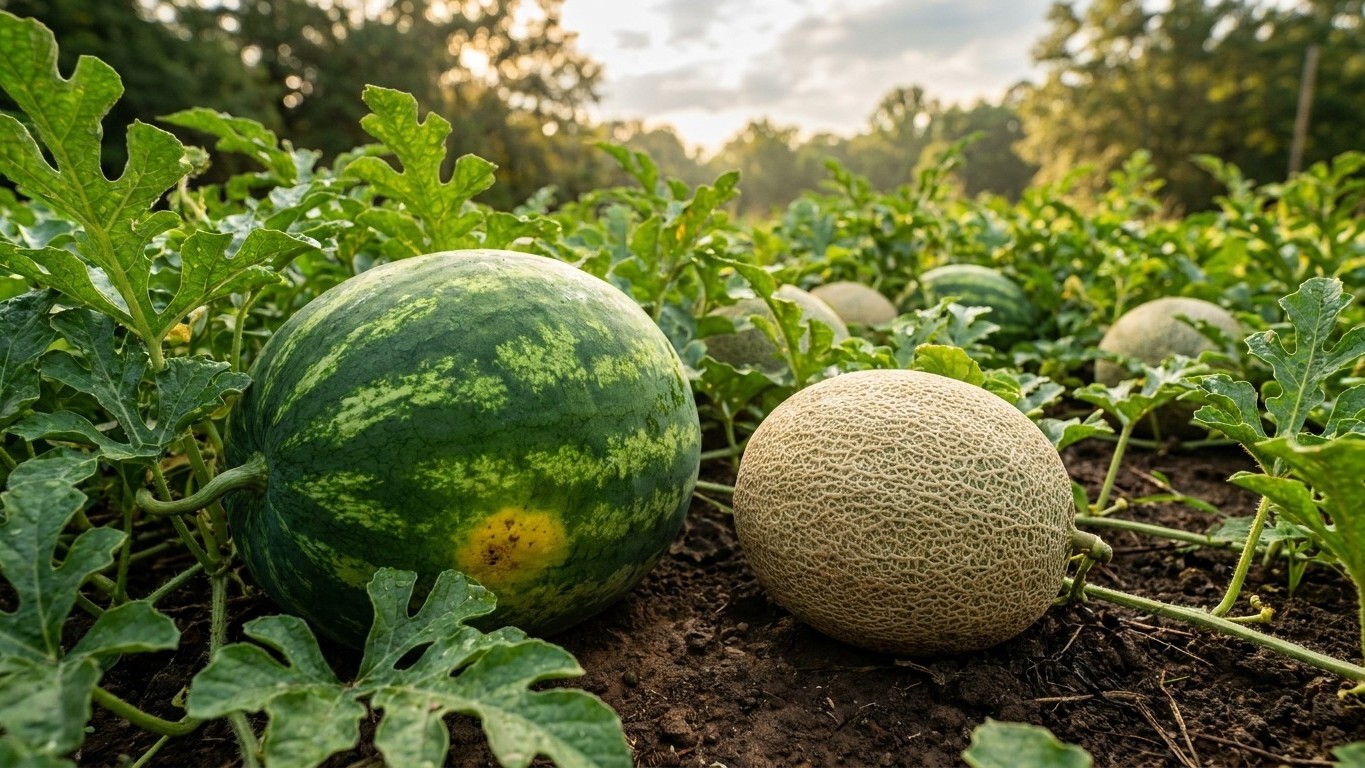

Delaware gardeners get a long enough season for nearly every melon type: cantaloupe, watermelon, and honeydew all mature comfortably between the spring and fall frost windows. The real deciding factor isn’t heat or season length, it’s humidity. Varieties bred for disease resistance in wet summers beat those developed for the dry West, and knowing which type fits your county’s rainfall pattern matters more than any seed packet’s days-to-maturity number.
The short answer for Delaware
Start with the calendar. Delaware’s last spring frost falls between April 3 and April 14, and the first fall frost arrives between October 26 and November 7, both from the Wilmington reference station. Even using the tightest version of that window, that’s roughly 195 frost-free days, and the wider version stretches past 215. Almost no melon on the market needs that much time. An 80-to-90-day cantaloupe, a 90-day honeydew, even a full-size 100-day watermelon all fit with weeks to spare.
That margin changes the question. In a state where the frost-free window is short, the deciding factor is speed. Here, it’s resilience. Delaware averages 17.6 days a year at 90 degrees Fahrenheit or hotter, real heat, but not extreme, paired with about 13.1 inches of rain across June, July, and August. That combination, warm and wet rather than warm and dry, is exactly the setup that breeds fungal disease on melon foliage. So the smart move isn’t picking the fastest variety. It’s picking the toughest one.
By type
| Type | Typical days to maturity | Fit for Delaware’s climate |
|---|---|---|
| Cantaloupe / muskmelon | 75-90 days | Strong fit; look for disease-resistant lines, plenty of season margin |
| Watermelon (standard or icebox) | 75-100 days | Strong fit; heat load is sufficient for full-size fruit and sugar |
| Honeydew | 80-100 days | Workable, but wants the driest microclimate available in the yard |
| Casaba, Crenshaw, Persian types | 90-110 days | Risky; these were bred for arid-climate ripening, not humid air |
Cantaloupes and watermelons handle Delaware’s mix of heat and humidity the best, because breeders have spent decades selecting them for exactly this kind of pressure. Honeydew is fine but benefits from a spot with morning sun and afternoon airflow. The specialty types built for California or the Southwest’s dry heat are the ones that tend to disappoint here.
What will not work here
Season length isn’t Delaware’s problem, so don’t waste money chasing the shortest-season melon on the rack out of habit. The failure mode here is different. It’s disease pressure building up over a long, humid summer. A melon vine that stays wet from dew and thunderstorm runoff for weeks at a time, especially through July’s 4.41 inches and June’s 4.67, is a vine that’s vulnerable to powdery mildew, downy mildew, and gummy stem blight. Varieties without built-in resistance to those diseases can look fine in June and collapse by the first week of August, right when the fruit needs another three or four weeks to finish.
Tight spacing makes this worse. A planting scheme copied from a drier state, where vines are packed close because water is the limiting factor, backfires in Delaware. Dense foliage traps humidity at leaf level and slows drying after rain, which is exactly the condition that lets mildew spores establish. Melons here need more room between plants than a seed packet written for Arizona or Colorado would suggest, simply so morning dew has somewhere to evaporate.
The other trap is planting for a drought that mostly doesn’t arrive. August is the driest of the three summer months at 3.98 inches, but that’s still meaningful rainfall, and it often lands as a single storm rather than a steady soak. A gardener who assumes Delaware summers are dry and sets up a once-a-week watering routine can end up with a vine that’s both overwatered right after a storm and stressed in the days before the next one. Consistent moisture, not a rigid weekly schedule, is what these vines actually want.
Finally, don’t count on planting before the frost window closes just because a warm stretch shows up in late March. The April 3 to April 14 range is a probability band, not a guarantee, and a transplant set out into soil that hasn’t warmed enough will simply sit and sulk, or get nipped by a late cold snap that the calendar says is still possible.
What changes across Delaware
Delaware’s USDA hardiness zone spans 7a to 8a, built from the average annual extreme minimum temperature. That’s not a huge spread compared to some states, but it’s real, and it maps roughly to the difference between the inland north and the coastal south. A zone 7a garden, generally further from the coast’s moderating effect, tends to see a later last frost and an earlier first frost than a zone 8a spot near the Delaware Bay or the Atlantic shoreline.
That gap matters for melons because it shifts both ends of the transplant window. A gardener in the milder zone 8a pocket can often get plants in the ground a little earlier and push the harvest a little later, stretching an already generous season even further. A gardener in the cooler 7a pocket should treat the state-level frost dates as the earlier, more cautious end of the range rather than the average.
There’s no single answer for “when does my melon season start” that covers the whole state, because Delaware isn’t one climate. It’s a gradient from the fall line near Wilmington down to the flat, maritime-influenced counties along the coast. This page can tell you the statewide pattern: ample season length, humid heat, disease pressure as the main risk. It can’t tell you which side of that gradient your own yard sits on.
Figuring that out means checking the USDA Plant Hardiness Zone Map for your specific address rather than assuming based on which end of the state you live in. Soil type shifts too, from the sandier ground common near the coast to heavier clay loam further inland, and that changes how long the same rainfall stays available to a melon’s roots after a storm.
Where to check this for your own county
Everything above is a state-level pattern, built from one reference weather station and one statewide hardiness range. It’s a starting point, not a county forecast. The University of Delaware Cooperative Extension is the source built for that next step, and it’s worth going there before buying seed.
Two things are worth looking for specifically once there. First, a county-level or regional planting calendar, which will reflect actual local frost patterns rather than the single-airport figures cited on this page. Second, and more useful for the variety question this page is really about, any list of melon cultivars that extension trials or county agents have actually grown and recommended for Delaware conditions. Extension programs regularly run variety trials precisely to answer which cantaloupe or watermelon lines hold up against local disease pressure, information that a national seed catalog simply can’t offer because it isn’t written for Delaware’s specific mix of heat and humidity.
A county recommendation will always beat a state one, for the same reason a tailor beats a size chart. This page has described the pattern across the whole state: generous season length, moderate but real heat, humid summers that favor disease-resistant types over drought-adapted ones. Your county extension office can narrow that down to what’s actually thriving in gardens near you this season, which matters more than any general guideline, however well-sourced.
Checking this against your own garden
Once the seed is bought and the calendar’s been checked, the most reliable information source is the garden itself. Three things to watch tell you more about your own microclimate than any regional average.
Soil warmth by feel is the first. Melon seed and transplants stall in cold soil no matter what the calendar says. Push a finger a few inches into the bed in the morning; if it feels cool and damp rather than mild, the ground hasn’t caught up to the air temperature yet, and waiting another week costs nothing compared to a stalled crop.
The first flush of male flowers is the second signal. Melons produce male blossoms before female ones, sometimes by a week or two, and a strong early flush of males with no females yet is completely normal, not a sign of trouble. It tells you the plant has shifted into reproductive mode and female flowers, the ones with the tiny swollen ovary at the base, are close behind.
The first true leaves, the ones that emerge after the rounder seed leaves and actually look like a melon leaf, mark the point where the plant is drawing real energy from the sun rather than the seed’s stored reserves. Slow, pale true leaves in a spot that should be getting six or more hours of sun usually point to either compacted soil or a shadier corner of the yard than expected, both worth fixing before the vines sprawl too far to move.