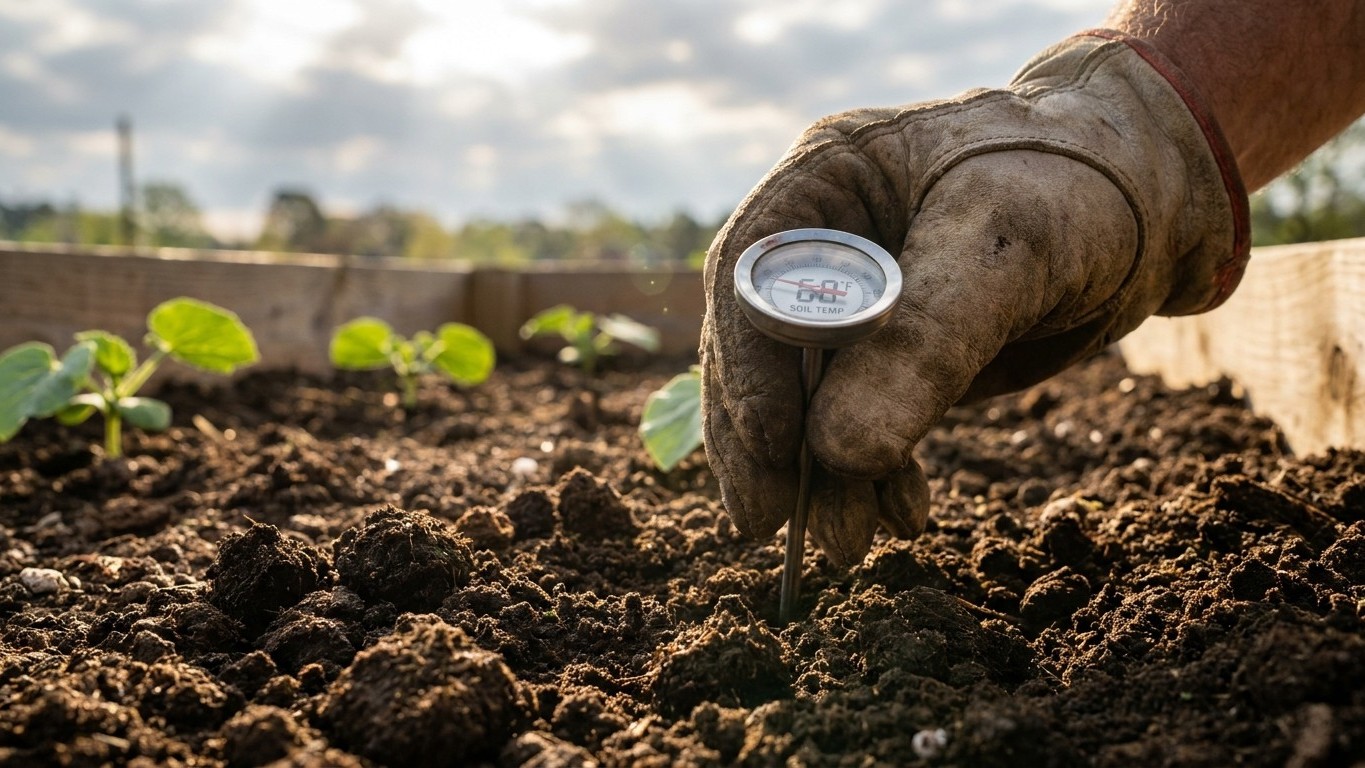

Melons need warm soil, not just a frost-free date, to germinate and thrive. In Delaware, that generally means waiting until late April or into May, once nighttime temperatures settle and the ground holds heat instead of losing it overnight. The reference station data below pins down the timing but the real trigger is soil temperature, not the calendar.
When the soil is warm enough in Delaware
The question every Delaware gardener asks first is: when can I actually put melon seed or transplants in the ground? At the Wilmington reference station (USW00013781), NOAA’s 1991-2020 Climate Normals put the last spring frost somewhere between April 3 and April 14, based on the 30-70% probability band for a 32F freeze. That’s a real, sourced window, not a guess, but it’s also a probability, not a promise: some years the last frost lands earlier, some years later, and a county garden away from the airport tarmac often sees frost linger a week or two past that date.
Here’s the part that trips people up. Frost date is a proxy, not the actual requirement. Melon seed germinates poorly, and often rots, in soil colder than the mid-60s Fahrenheit. Air can feel mild while six inches down the soil is still cold and wet from spring rain. That’s why experienced growers in this region don’t plant the week the frost risk clears; they wait another week or two, until the soil itself has caught up. Black plastic mulch, raised beds, or simply picking a south-facing slope all speed that process along by trapping solar heat in the ground rather than letting it radiate off overnight.
Delaware sits in USDA Hardiness Zone 7a to 8a, according to the USDA Plant Hardiness Zone Map built on 1991-2020 normals. That zone range describes the average annual extreme minimum temperature, useful for perennial survival, but it says nothing about spring soil warming, which is the number that actually matters for melon planting. Treat the Wilmington frost window as your reference point and adjust later if you garden inland, at higher elevation, or in a low-lying frost pocket where cold air pools overnight.
Skip the temptation to chase a specific variety name from a catalog description written for another climate. The state’s University of Delaware Cooperative Extension tracks which melon types actually perform in local trial gardens, and that’s the only recommendation worth following, since trial results reflect this soil, this humidity, and this exact frost pattern rather than a national average.
How long the season lasts here
Subtracting the frost dates gives a real number, and it’s a useful one for planning. Using the Wilmington normals for both ends of the season, the frost-free window runs from roughly 195 days (using the later spring frost date of April 14 paired with the earlier fall frost date of October 26) up to about 218 days (using the earlier spring frost of April 3 paired with the later fall date of November 7). That’s a six-and-a-half to seven-month growing window in a typical year.
| Milestone | Date range (Wilmington, USW00013781) |
|---|---|
| Last spring frost | April 3 to April 14 |
| First fall frost | October 26 to November 7 |
| Frost-free window | approximately 195 to 218 days |
A window that long changes what’s worth attempting. Melons typically need most of a full summer to size up and ripen, so a season stretching close to seven months leaves genuine room for a second sowing if an early planting fails to germinate, gets flooded out by a wet June, or falls to early disease pressure. It also opens the door to succession sowing for gardeners who want a staggered harvest instead of one big flush in late August. If that interests you, the site’s succession sowing guide walks through spacing plantings two to three weeks apart to spread the harvest window.
A shorter season, by contrast, would force a single planting and put more weight on getting that one sowing right, including the choice between direct seeding and transplants. With Delaware’s window running toward the longer end of the mid-Atlantic range, transplants raised indoors three to four weeks before the last frost make sense here: they buy extra weeks of growth without risking that a late cold snap wipes out the only planting of the year. Just check root systems before transplanting; melons resent root disturbance more than most vine crops, so a plug tray or biodegradable pot that goes into the ground intact beats bare-root transplanting.
Heat and water in Delaware
Melons ripen on accumulated warmth, not on the calendar, and that’s where Delaware’s numbers tell a specific story. The Wilmington reference station logs an average of 17.6 days a year at or above 90F, per NOAA’s 1991-2020 Climate Normals. That’s a moderate heat load, meaningfully warmer than New England but well short of the extended 90-plus stretches seen in the Deep South or the desert Southwest. It means melons here get enough warm days to size up and sweeten, but not so many that irrigation alone determines the outcome.
Rainfall matters just as much, and it arrives generously through the summer months. The same reference station shows about 13.1 inches of rain across June, July and August, broken down as 4.67 inches in June, 4.41 in July, and 3.98 in August, the driest of the three. That’s a fairly even, moderate supply rather than a bone-dry summer punctuated by irrigation days. The upside is that vines rarely face true drought stress. The downside is humidity: consistent summer rain combined with warm nights creates exactly the conditions that favor powdery mildew and other foliar diseases on melon leaves, especially once the canopy thickens in July.
That combination, moderate heat plus regular rain, points to a different set of priorities than a hot, dry territory would. Growers in a desert climate worry mainly about irrigation volume and the final two weeks before harvest, when withholding water concentrates sugars. In Delaware, the bigger lever is airflow: wide plant spacing, pruning to open the canopy, and watering at the soil line rather than overhead all matter more than chasing extra water. An August dry spell (the driest month in the data) can still show up, so a rain gauge on the actual plot is worth more than any regional average, since a sandy garden drains that same rainfall in a day while a clay-heavy one holds it for a week.
Which melons suit Delaware
Given a frost-free window near 200 days, moderate heat around 17 to 18 days above 90F, and consistent summer humidity, three traits matter more than any brand name on a seed packet:
- Earlier-maturing types, since even a seven-month window includes weeks lost to cool spring soil at the start and shortening days at the end
- Compact or well-trellised vine habits that improve airflow through the canopy, cutting down the mildew risk that comes with a wet summer
- Disease resistance bred specifically against powdery and downy mildew, which are the two problems Delaware’s rainfall pattern makes most likely
Notice what’s missing from that list: an actual variety name. That’s deliberate. Any melon type performs differently depending on the specific soil, the specific rainfall year, and the specific disease pressure a garden faces, and a name pulled from a national seed catalog reflects trials run somewhere else entirely. What Delaware gardeners need instead is the list of melon types the University of Delaware Cooperative Extension has actually trialed in-state, tested against this exact humidity and this exact frost pattern.
That’s not a dodge, it’s the honest answer. A page written for a national audience has no way to know which melon type handled last year’s wet July in Kent County or which one folded under mildew pressure near the coast. The Delaware Cooperative Extension service publishes exactly that kind of local trial data, updated as new disease-resistant types come to market, and it’s the only source that can responsibly point to a specific cultivar for a specific county. Start there once the type and traits above have narrowed the search; that’s where the local knowledge, and the local growers, actually live.