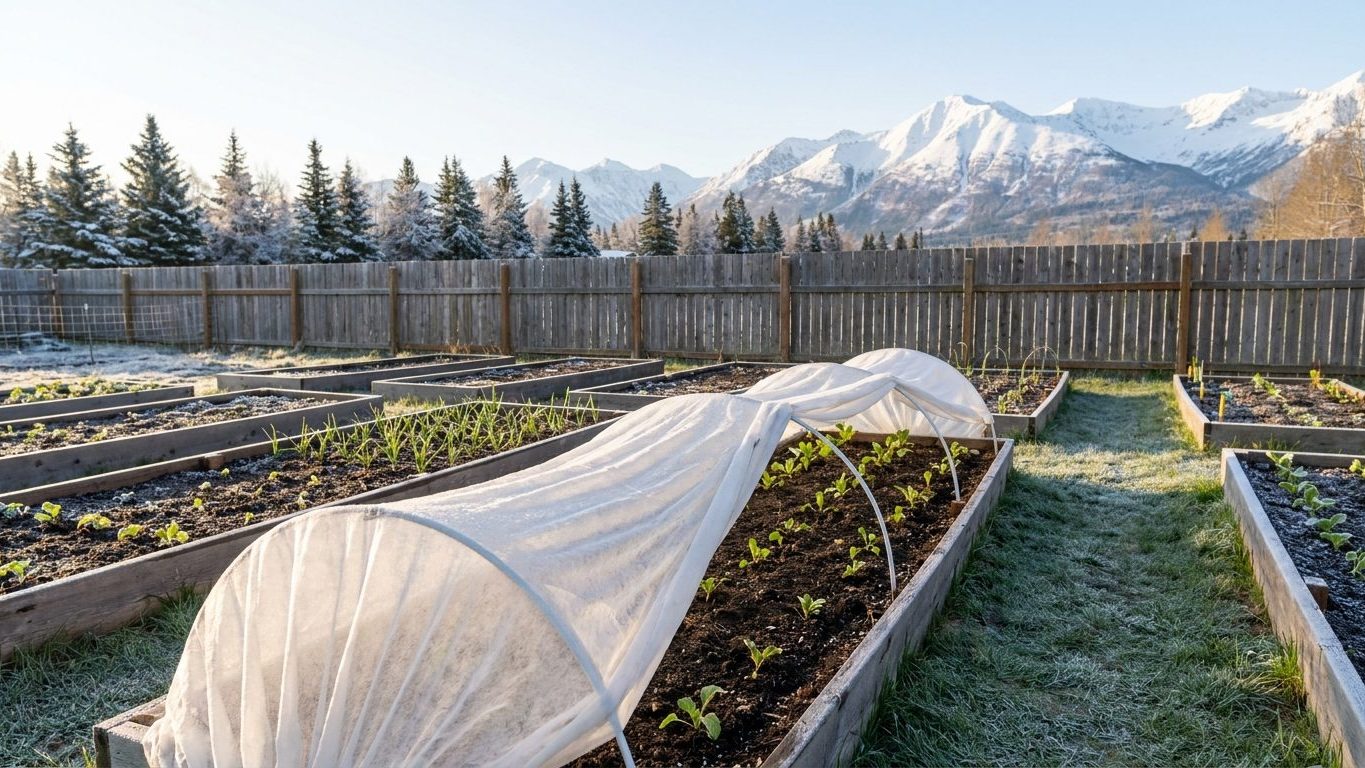

Cover your garden on any night the forecast low reaches 32°F, not on a fixed calendar date. In Delaware, that means keeping covers handy from early April through spring planting, then again from late October onward. The dates below come from the Wilmington airport weather station, and gardens in the suburbs and countryside usually freeze later in spring and earlier in fall. Use the dates as a cue to start checking forecasts.
The short answer for Delaware
Cover tender plants whenever the forecast low is 32°F or colder, and start watching for that from April 3 in spring and from October 26 in fall. For the reference city, NOAA’s 1991-2020 Climate Normals put the last spring frost between April 3 and April 14 and the first fall frost between October 26 and November 7. This page treats those as starting points for the broader topic of Extending the Growing Season in Delaware.
Those figures are probabilities, not deadlines. They are drawn from 32°F freeze probabilities at the Wilmington airport station (USW00013781), using the band where the odds fall between 30 and 70 percent. In spring, the window marks the stretch when one more freeze is still a real possibility, roughly a coin flip. In fall, it marks when the first freeze goes from unlikely to likely. A freeze can still arrive before or after either window. The numbers describe a climate, and your forecast describes tonight.
Spring: cover after you plant, not before
If you set out tomato, pepper, or squash transplants in April, the cover belongs on the nights when the forecast dips toward freezing. The airport figures describe a city station. The caution that comes with the data is clear: suburban and rural gardens typically see the last spring frost later than the airport, often by one to two weeks. A rural bed could still be getting freezes at the end of April, well past the airport’s April 14.
Fall: cover before the first hard night
Fall works in reverse. Rural gardens often see the first frost one to two weeks earlier than the airport’s October 26 to November 7 band, so protection may be needed in mid-October. A frost cover set out the evening before a cold night can carry peppers, late tomatoes, and beans through to a milder stretch of weather. It can’t carry them through a season.
| Season | Reference city (Wilmington airport) | What to expect outside the city |
|---|---|---|
| Last spring frost | April 3 to April 14 | Often one to two weeks later |
| First fall frost | October 26 to November 7 | Often one to two weeks earlier |
Think of the covers as a habit tied to the forecast. Keep them folded near the garden gate so the decision takes thirty seconds, not a scramble at dusk.
What will not work here
Picking one date and trusting it is the first thing to fail. A band that runs April 3 to April 14 is twelve days wide, and the odds inside it hover between 30 and 70 percent. A gardener who plants tomatoes on April 15 because “the frost date has passed” is relying on a number that never promised that. The airport figure is also the optimistic one for anyone living outside the city.
Covers don’t make up for a missing season either. Wilmington’s coldest month has a mean daily minimum of 25.6°F, so an average January night sits below freezing before any cold snap arrives. A fabric cover or a low tunnel can blunt a frost. It does not hold off a month of nights like that, and it won’t let heat-loving crops such as tomatoes or peppers sit through a Delaware winter. If you want to know which materials and structures suit which job, Which Season Extenders Work in Delaware sorts that out.
Day length is another limit no cover can fix. Wilmington sits at 39.67 degrees north, and that latitude governs how many hours of light a crop gets in a given month. Onions are the clearest example: it is day length, not warmth, that tells them to stop growing leaves and start forming a bulb. Covering onion sets in winter won’t shift that trigger, and a gardener near the northern or southern edge of the state should check their own latitude rather than lean on Wilmington’s.
Late sowing in fall also runs into a wall. A cover that adds some protection on a frosty night can’t make a slow crop finish when the days are shortening and the soil is cooling. Fast, cold-tolerant crops such as salad greens are the sensible fit for the last weeks of the season. A pepper plant that has barely set fruit on October 20 is not.
And leaving covers on around the clock fails in its own way. Fabric stays on through a warm, sunny afternoon and the bed overheats. In squash and cucumbers, a cover that stays on past flowering also keeps pollinators out. Covers are for cold nights, and they should come off when the weather turns.
What changes across Delaware
Delaware is not one garden. The USDA Plant Hardiness Zone Map (2023 edition, built on 1991-2020 data) places the state in zones 7a to 8a. That is a spread of a full zone inside one small state, so no single answer fits everyone. The USDA system rests on one variable only, the average annual extreme minimum temperature. It tells you what winter cold a perennial survives, and it says little about the date of the last spring frost.
The Wilmington figures sit at the northern end of the state, and the page has no station data for Kent or Sussex County. A reader farther south should expect their own frost dates to differ from the airport’s, and a reader in the far north of New Castle County has a different latitude from the reference point. The practical shift is simple. If your garden sits in a colder pocket, treat the airport dates as the earliest you could safely stop covering, and push your own start later.
Elevation plays a smaller part here than in mountain states, but local terrain still matters. Cold air settles in low spots, along creek bottoms, and at the base of a slope, so the lowest corner of a yard can freeze while the top stays clear. The caution attached to these frost dates notes that rural and suburban gardens typically run later in spring and earlier in fall than the airport, and more so at higher elevation.
To learn your own zone, use the USDA map and enter your ZIP code. This page can’t tell you which zone you’re in, and guessing from a neighbor’s yard is a poor substitute. Once you have your zone, keep its limits in mind: it points to winter survival, while frost dates and cover decisions depend on spring and fall nights.
Where to check this for your own county
Your state extension service is the next stop. University of Delaware Cooperative Extension is the land-grant program for the state, and it works with local growers and agents who know how conditions play out in each county.
Look for two things when you get there. The first is a local planting calendar: dates for sowing and transplanting in your part of the state, which will be more precise than anything built from a single airport station. The second is a list of varieties that have been trialed in your county. A variety that performs well in a cool, short spring may stall in a hot summer, and trial results show which ones hold up in the conditions you actually have.
This page does not have a Delaware county planting calendar, and it won’t borrow one from another state. Extension calendars are written for specific crops and regions, so a calendar from another state, or for a different crop, would send you wrong.
A county recommendation beats a state one, and this page is the state one. It works from a single reference station. County extension offices can account for local soil, frost pockets, and what has been tested nearby. If the two disagree, go with the county. Use this page to understand why the dates are fuzzy, then let local advice fix the numbers.
Checking this against your own garden
No date on this page outranks what your own beds are telling you. Three things are worth watching, and none needs equipment.
- Soil warmth by feel. Push your hand into the bed at planting depth in the morning. Soil that feels cold and damp is not ready for warm-season transplants, whatever the calendar says. A bed against a south-facing wall will feel warmer than one in an open, shaded corner, which tells you where your early spots are.
- The first male flowers on squash and cucumbers. Male blooms usually open before female ones. When they appear, the plants are established and the days are warming. If you have been using row cover, this is your signal to take it off so pollinators can reach the flowers.
- The first true leaves on seedlings. The first pair are seed leaves. The leaves that follow are the true ones. Plants with true leaves are sturdier, so you can judge when to set out hardy crops. Seedlings that stay small and pale in one part of the yard suggest that spot runs cold.
Over a season or two, those observations add up to a map of your own yard: which corner warms first, which one frosts first, and how far your garden sits from the airport numbers. Jot them down. A short note beside the date, such as “frost on the low bed, none on the raised one,” will serve you better next April than any statewide average.
Common questions
Should I cover plants if the forecast low is 34°F?
It depends on your garden. Forecasts are usually for a town or an airport, and a clear, still night can leave a low corner of your yard colder than the reported number. If you have tender plants in the ground and the night looks clear and calm, covering them is cheap insurance.
Is April 14 safe for planting tomatoes in Delaware?
Not as a guarantee. April 14 is the end of the Wilmington airport band, and that band is a probability range, not a promise. Gardens outside the city often run one to two weeks later, so check your forecast and your county extension office before setting out transplants.
Do I need to take covers off during the day?
Often yes. Fabric or plastic left on in warm sun can overheat plants, and squash and cucumber blooms need open access for pollinators. Cover for the cold night, uncover when it warms.
Can covers carry plants through a Delaware winter?
For some crops, a cover helps, but it has limits. The coldest month’s mean daily minimum at Wilmington is 25.6°F, so below-freezing nights are normal in winter. Hardy greens are the usual candidates, and tender crops are not. Your county extension office can tell you which varieties have been trialed locally.