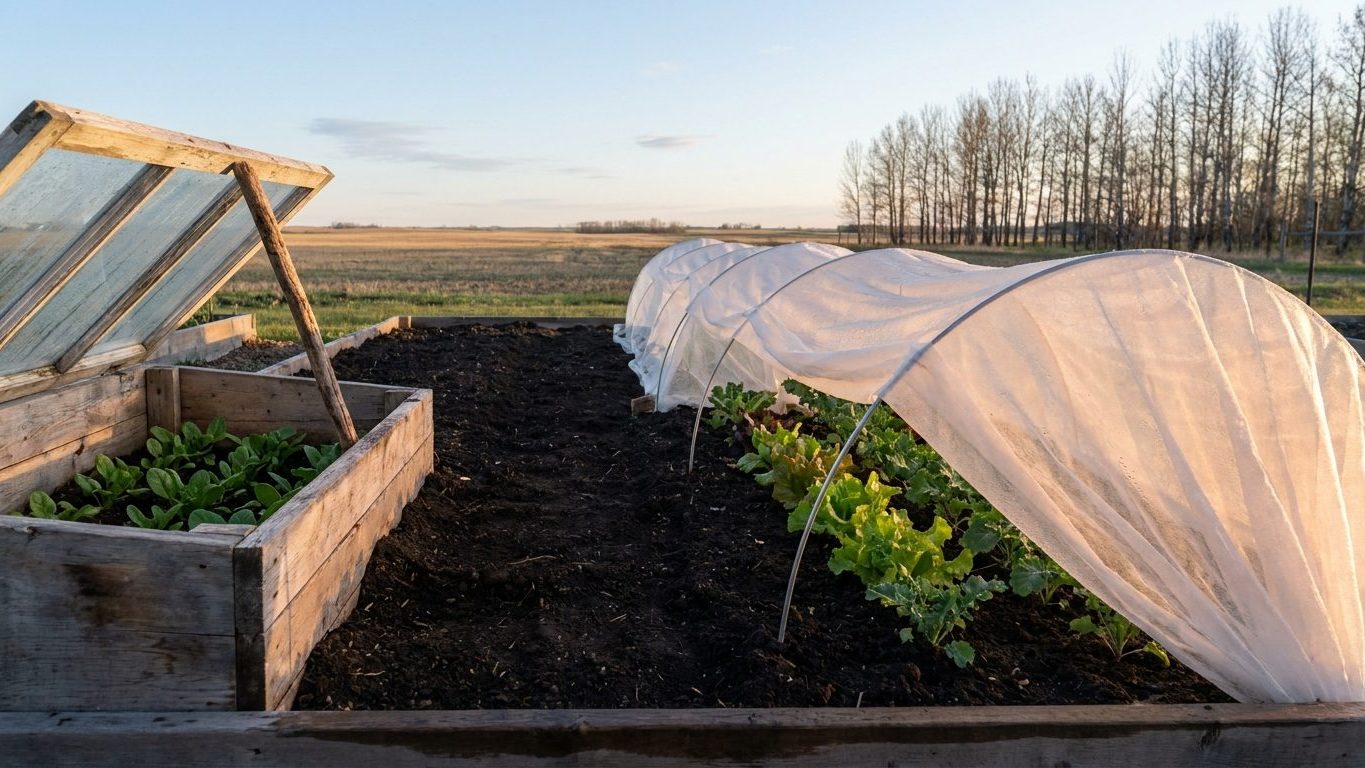

For most Delaware gardens, three tools cover the job: floating row cover, low tunnels over hoops, and a cold frame. They buy you weeks at both ends of the season, not a tomato harvest in January. The state’s frost dates leave you stretching a long season, not rescuing a short one, and that changes what is worth buying.
The short answer for Delaware
Start with lightweight row cover, since it is cheap and handles the most common problem: a late freeze after you have already planted. Add hoops with heavier fabric or clear plastic for fall and winter greens, and a cold frame for starting seedlings early and holding spinach, lettuce and kale through the coldest weeks.
The numbers behind that advice come from the Wilmington airport weather station (NOAA 1991-2020 Climate Normals). They are probabilities of a 32°F freeze. The last spring freeze falls between April 3 and April 14, the band where the odds of another freeze drop from roughly 70 percent to 30 percent. The first fall freeze falls between October 26 and November 7. Treat these as the reference-city figures, not a state-wide guarantee. Suburban and rural gardens usually see the last spring frost later and the first fall frost earlier, often by one to two weeks.
Winter is the other number that matters. The mean daily minimum in Wilmington’s coldest month is 25.6°F. Most nights in midwinter dip below freezing, but not by a wide margin. Hardy greens can sit under a double layer and survive, while tender crops cannot.
| Extender | Best Delaware use | Limit |
|---|---|---|
| Floating row cover | Late-spring freezes, early fall frosts, pest exclusion | Adds only a few degrees; heavy snow and hard freezes beat it |
| Low tunnel (hoops plus fabric or plastic) | Fall and winter greens, early spring carrots and beets | Needs venting on sunny days; wet snow can flatten it |
| Cold frame | Seedlings, holding hardy greens through winter | Small footprint; must be opened daily in sun |
| Individual cloches or water-filled wraps | Getting tomato and pepper transplants out a bit early | One plant at a time; not for large plantings |
For the full picture of how these fit together across a year, see Extending the Growing Season in Delaware. This page narrows it to which tools earn their place here.
What will not work here
Heated greenhouses and elaborate winter-tomato setups are the first things to cross off. They solve a short-season problem, and Delaware does not have one. With the first fall freeze arriving between October 26 and November 7 at the reference station, the gap you are filling is a few weeks of shoulder season, which a $20 roll of fabric handles. Spending four figures on heat to chase a tomato in February is a poor trade for a home gardener.
Light is the limit in winter
Wilmington sits at 39.67 degrees north. By December, day length is the constraint, not temperature. Plants under a tunnel will hold what they have, but they grow very little. A bed of lettuce seeded in November will mostly sit there. The practical rule: get fall crops close to harvest size before the days shorten, then use cover to keep them alive and edible through winter, not to grow them. Plan to harvest from the bed, not to wait for it to fatten up.
Closed plastic in a humid, sunny climate
Clear plastic left sealed is the classic mistake. A sunny March afternoon can cook seedlings under a closed tunnel even when the air outside is cool, and Delaware’s humid summers make a sealed tunnel a breeding ground for fungal disease. If you will not be home to vent it, use fabric, which breathes, instead of plastic. The same goes for pushing row cover into summer. Heavy fabric over warm-season crops in July traps humidity and heat, and tomatoes and squash do not thank you for it.
Two more failures are specific to a mid-Atlantic winter. Wet coastal snow is heavy, and a flimsy hoop with plastic stretched tight will collapse under it, so brace the hoops or brush snow off after a storm. And planting tender crops out on the airport’s frost date is a gamble. If you garden inland or on the edge of town, your last frost may run one to two weeks later, so a cover that would have saved the Wilmington airport’s garden may arrive too late for yours. For the timing decision itself, When to Cover Your Garden in Delaware walks through it.
What changes across Delaware
Delaware is small, but it is not one garden. The USDA Plant Hardiness Zone Map (2023 edition, built on 1991-2020 normals) places the state in zones 7a to 8a. That is a spread, not a single answer, so no one recommendation fits every county. Zones are built on one variable only, the average annual extreme minimum temperature, so they tell you what survives winter, not when the last frost will be.
The frost dates and the 25.6°F coldest-month figure on this page belong to Wilmington, in the north of the state. A gardener in New Castle County is closest to those numbers. Farther south, toward Kent and Sussex counties and the coast, winters are generally milder and the cold-hardy list gets longer. That means a cold frame may be enough to carry greens through, where a northern garden would want a low tunnel on top of it. Inland rural sites that sit away from the water and the city can still run colder than the airport on clear, still nights, so a southern address is not a guarantee of an easy winter.
Latitude shifts things too. Wilmington’s 39.67 degrees north is one city’s figure. A reader near the state’s southern edge sits at a somewhat different latitude, which affects day length, a factor that matters for onions and for how much winter growth you can expect under cover. Check your own location rather than assuming Wilmington’s numbers apply.
Which zone are you in? This page will not guess. Look up your address on the USDA Plant Hardiness Zone Map and read the zone for your spot, then treat the Wilmington dates as a reference point to adjust from, not a rule.
Where to check this for your own county
The best next stop is University of Delaware Cooperative Extension, the state’s land-grant extension service. Its staff work with Delaware growers and gardeners directly, and its guidance reflects local soils, pests and weather, not a national average.
Look for two things. First, a local planting calendar that gives sowing and transplant windows for your county, not just the state. Second, the varieties that have been trialled in Delaware conditions, particularly for cool-season crops you will be covering. A spinach or kale variety that performs well in an extension trial in Sussex County has already survived the humidity and the swings between freezing nights and mild days, which is exactly what you are asking a season extender to help with.
A county recommendation beats a state one, and this page is the state one. It uses one airport’s frost probabilities and a state-wide hardiness range, and it cannot see your hillside, your windbreak or your soil. This page does not have a Delaware county planting calendar, so do not treat any date here as one. If the extension service publishes a calendar for your county that disagrees with the dates above, go with the county.
Checking this against your own garden
Your own observations outrank every date on this page. Three are worth watching, and none needs equipment.
- Soil warmth by feel. Push your hand a couple of inches into the bed in the morning. If it feels distinctly cold, warm-season seeds will sit and rot. A bed that feels cool but not cold earlier than the neighbor’s suggests a sheltered, sunny spot. Soil that stays cold well into spring points to a low or shaded area.
- The first flush of male flowers. Squash and cucumbers open male flowers before female ones. If they appear early on plants under cover and late on uncovered plants, you know how much the cover is really warming that spot.
- The first true leaves. The first pair of leaves on a seedling are seed leaves. The true leaves come after. If lettuce or kale seedlings are slow to produce true leaves, the bed is running colder or darker than you thought, and a tunnel or reflective wall may pay off.
Also note where frost lingers on the lawn on a cold morning. Low spots collect cold air, and a bed against a south-facing wall will often be a step ahead of one in open ground. Over one season those notes will tell you more than any airport station.
Common questions
Can I grow vegetables through a Delaware winter with a cold frame?
Hardy greens such as spinach, kale and lettuce can hold through winter in a cold frame, especially in the milder parts of the state. Expect little growth in December and January, since day length is short. Plant them early enough that they are near harvest size before the days shorten.
When should I put row cover on in spring?
Use the April 3 to April 14 window as the reference-city range, then add a week or two if you garden inland or in a cooler rural spot. Keep fabric handy until your local last-frost date has clearly passed, and cover on nights when a freeze is forecast.
Is clear plastic or fabric better?
Fabric is more forgiving in Delaware’s humidity because it breathes and is harder to overheat. Clear plastic gives more warmth in cold months but needs venting on sunny days, so it suits you only if you can open it daily.
Will season extenders let me grow tomatoes and peppers longer into fall?
They can help through the first fall freeze window of October 26 to November 7, and rural gardens may see frost earlier. Cover buys a few more weeks, but fruit ripening slows as nights cool and days shorten, so expect a modest extension, not a second season.