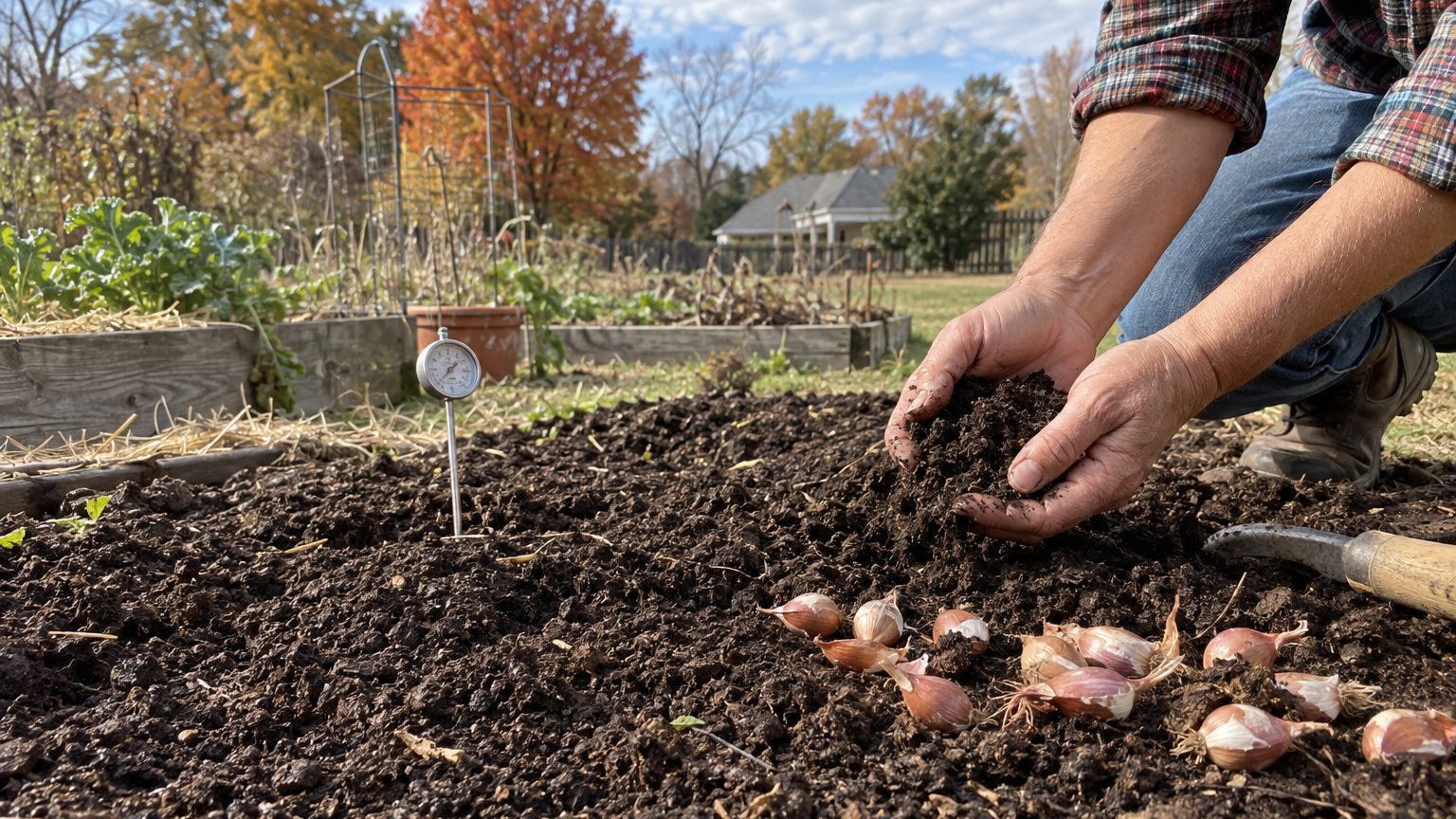

In Delaware, shallots go in during autumn or early spring, and the mild winter makes both workable. The calendar anchor is the last spring frost, which falls between April 3 and April 14 at the Wilmington-area reference station. Treat that as a starting line for watching your soil, not a planting date. Autumn gives earlier, larger bulbs when drainage is good. Spring is the safer call on soggy ground.
When the soil is warm enough in Delaware
April 3 to April 14: that is the last spring 32F freeze window in the NOAA NCEI 1991-2020 Climate Normals, from station USW00013781, in the 30-70% probability band. A frost date is a probability, not a promise, so a late cold snap after those dates is always possible. It is also an airport figure. Suburban and rural gardens usually see the last frost one to two weeks later, so check your own county before you pencil anything in.
Why frost is only a proxy
Shallots do not care about the calendar. They care about soil. Sets can shrug off a light frost, but a bulb sitting in cold, saturated ground makes almost no roots and may simply rot. Soil temperature lags the air, which means the ground warms after the frost risk ends, not alongside it. A garden that cleared its last frost on April 5 may still hold cold, heavy soil a couple of weeks later.
The practical test costs nothing. Squeeze a handful of soil from planting depth. If it crumbles when you poke it, the bed is ready. If it smears or drips, wait. A soil thermometer reading from your own bed beats any date printed in any article, this one included.
Autumn planting and how it differs from garlic
Autumn planting works the same way for shallots as for garlic: roots establish in cool soil, top growth stays modest through winter, and the plant takes off in spring. The garlic section of this site covers the shared mechanics of fall planting, mulching and allium rotation, so there is no reason to repeat them here. What changes for shallots is mainly scale. The sets are smaller and sit shallower, usually with the tip at or just under the surface, which makes them more exposed to heaving when the soil freezes and thaws. Check the bed after hard freezes and press any lifted bulbs back into the ground.
For spring planting, the same logic applies in reverse. Get sets in as soon as the bed is workable and no longer sodden, rather than waiting for a date. For the varieties trialed in your area, the University of Delaware Cooperative Extension is the source that matters. Shallots are a crop where local performance varies, so what has actually been tested in Delaware beats anything a general guide can offer. The Growing Shallots: One Bulb In, a Handful Out overview covers the basics that apply everywhere.
How long the season lasts here
The same station gives the fall side of the window: the first 32F freeze arrives between October 26 and November 7, again in the 30-70% band. Put both ends together and the arithmetic is straightforward.
| Measure | Dates (station USW00013781) |
|---|---|
| Last spring frost | April 3 to April 14 |
| First fall frost | October 26 to November 7 |
| Shortest window (April 14 to October 26) | 195 days |
| Longest window (April 3 to November 7) | 218 days |
So the frost-free stretch runs roughly 195 to 218 days at the reference station. Gardens away from the airport should subtract. If your site sees the last frost a week or two later and the first one a week or two earlier, you can lose two to four weeks off both numbers. Elevation takes more.
What a long window allows
Delaware’s window is on the generous side, and that changes the decisions. A first planting does not have to carry the whole season. You can stagger a second planting of sets a few weeks after the first, which spreads the harvest and gives you a fallback if a wet stretch ruins the early bed. Later plantings tend to produce smaller bulbs, so treat them as a hedge and a source of green shallot tops for the kitchen, not as an equal to the first sowing. The succession sowing guide on this site walks through spacing the plantings.
The long window also makes transplanting a reasonable choice. In a short season, a transplant that stalls from root damage costs you the crop. Here you have room to be careful. Before planting, slide a transplant out of its cell and look at the roots. White, loose roots mean go ahead. A tight, circling mat should be teased apart first, and a brown, slimy mass means discard it. Compare that with a cool northern region such as Growing Shallots in Nova Scotia, where the first sowing is often the only one and a stalled transplant is hard to recover from.
Heat and water in Delaware
This page does not have a verified count of days above 90 F or a summer rainfall total for Delaware, and it will not guess. For the real numbers, pull the NOAA normals for the station nearest you, or ask extension. What the page does have is the winter side, and for the autumn-versus-spring question that is the figure that decides it.
The winter low settles autumn against spring
At Wilmington, the mean daily minimum of the coldest month is 25.6 F (NOAA NCEI Climate Normals 1991-2020). That is a below-freezing night most winter nights, but nowhere near the long deep freeze of a northern state. The USDA Plant Hardiness Zone Map 2023 puts Delaware at zones 7a to 8a. Note that zones rest on the average annual extreme minimum, and that this is a territory-wide range, so the coastal south and the northern piedmont can differ.
Where the ground freezes hard and stays wet, autumn-planted sets rot or heave, and spring is the safer call. Delaware’s milder winters make autumn planting a real option, and it is what gives the larger, earlier bulbs that fall planting is grown for. The risk has not vanished, though. It sits in the low spots and heavy clay beds where water stands in winter. Plant those in spring, or build raised beds. Compare Growing Shallots in Indiana, where a harder winter pushes the same decision toward spring.
Summer humidity, drainage and the dry-down
Shallots finish best when the tops fall over and the bulbs dry down in settled weather. In a humid state, wet weather at that stage is the danger: slow drying, fungal disease and bulbs that are harder to cure. The defenses are ordinary ones. Give each bulb space for airflow, avoid overhead watering late in the season, and stop irrigating once the tops begin to yellow. A thin mulch keeps soil cooler at the root in a hot spell, but pull it back from the bulb necks as the crop matures so moisture does not sit against them.
Which shallots suit Delaware
Start with the climate, and the choice narrows by type. Delaware’s window is long, so you are not forced into the very earliest types the way a short-season grower is. Earlier-maturing types still have an edge here, since they finish before the wettest, most disease-prone stretch of summer. A hot, humid summer makes airflow and shade at the root the practical priorities. Disease resistance comes first of all, because humidity is the reliable pressure in this state, and because a susceptible type in a wet year can fail even when everything else is done right.
Why this page names no varieties
You will not find a cultivar list here, and that is deliberate. A recommendation only means something if the variety was grown and compared in Delaware conditions, and this page does not have those trial results. Shallot varieties differ a lot in bolting, storage and disease tolerance, and a name that thrives in another state can fail in yours. The University of Delaware Cooperative Extension is where to ask which varieties have been trialed locally. Your county office may also know what has done well in your soil.
Check the bulbs before you trust them
Curing and storage are where food safety enters. Cure bulbs in a dry, ventilated spot out of direct sun until the necks are fully dry, and handle them as you would garlic (the garlic section of this site covers the shared method). A bulb is not sound just because it looks sound. Press the neck: if it is soft, or if the base shows mold, discard the bulb. This page will not promise a keeping time, because it depends on the variety, the cure and your storage conditions. Inspect stored bulbs regularly and remove any that soften or mold before they affect their neighbors.
Common questions
Can I plant shallots in fall in Delaware?
Yes, in most places. A coldest-month mean daily minimum of 25.6 F at Wilmington and a hardiness range of zones 7a to 8a make autumn planting workable. Choose well-drained ground, watch for heaving after freeze-thaw cycles, and plant in spring instead if the bed stays wet in winter.
Is April 3 the date to plant spring shallots?
No. April 3 to April 14 is the last spring frost window at the reference airport station, and it is a probability. Gardens outside the airport often see the last frost one to two weeks later. Plant when your own soil is workable and no longer waterlogged.
Can shallots follow garlic or onions in the same bed?
It is better not to. They are all alliums and share diseases and pests that build up in the soil. The garlic section of this site covers rotation, and the same spacing of years applies to shallots.
Where do I find varieties that suit my county?
Ask your state extension service. The University of Delaware Cooperative Extension can point you to varieties trialed in the state and to any local disease pressures worth knowing before you buy sets.