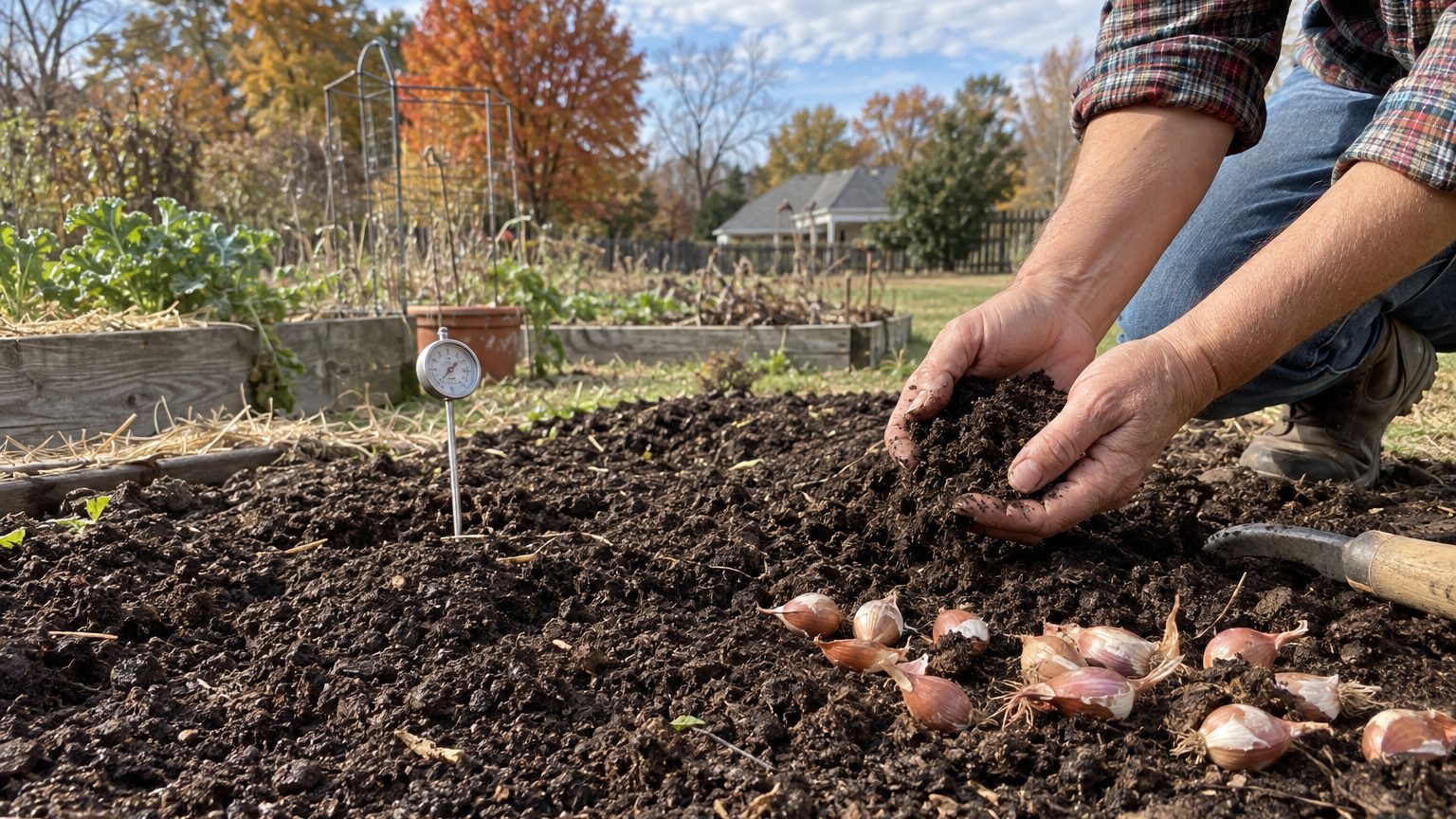

Shallots grow well in Indiana, and the calendar matters less than the ground. Central Indiana’s last spring freeze falls between April 9 and April 21, but sets go in when the soil is workable, not when a date arrives. Spring planting is the safer default statewide. Autumn planting is a bet that pays off mainly in the milder south.
When the soil is warm enough in Indiana
The last spring freeze at the Indianapolis station (USW00093819) falls between April 9 and April 21, per the NOAA NCEI 1991-2020 Climate Normals, using the 30-70% band of 32°F freeze probabilities. That is a probability, not a promise: Purdue notes roughly a 10% chance of a 32°F event after the published spring date.
Frost, though, is only a proxy. A rooted shallot set is a hardy bulb and shrugs off a light freeze. What it cannot tolerate is cold, saturated ground, where the set sits and rots before it grows a root. Soil warms and drains after the frost risk ends, so the frost band tells you roughly when to start checking your own bed. Squeeze a handful. If it crumbles, plant. If it smears into a ribbon or leaves water on your fingers, wait a few days. A cheap soil thermometer pushed in at planting depth beats any date printed on a seed packet.
Indianapolis is a reference point, not the whole state. Southern Indiana runs earlier in spring and later in autumn than the north by a fortnight or more, so a gardener near the Ohio River can shift everything earlier, and one near the Michigan line should lean later. If you set out tender crops on the early edge of the band, keep row cover or buckets ready for the roughly 10% chance Purdue flags. Shallots rarely need the rescue, but interplanted lettuce or early brassicas might.
Three forms of shallot reach a garden, and they behave differently with the calendar:
- Sets (small bulbs): the fastest route and the most forgiving, planted as soon as the soil allows.
- Seed-grown types: started indoors weeks ahead and set out as transplants, or sown directly. They give up the head start of sets but avoid carrying over certain bulb-borne problems.
- Divided clumps saved from last year: the old kitchen-garden habit, and the reason one bulb in becomes a handful out. The Growing Shallots: One Bulb In, a Handful Out guide covers that multiplication in detail.
Autumn planting, curing, storing and rotating alliums all overlap with garlic, and the garlic section of this site covers them in depth. What changes for shallots is scale and shape. The bulbs are smaller, they split into clusters rather than forming a single head, and they ask for a shallower, looser planting. A set shoved deep into heavy clay is more likely to rot than one planted with its tip near the surface.
This page names no varieties, on purpose. Which ones have been trialled for Indiana conditions is a question for Purdue Extension, and the last section explains why.
How long the season lasts here
Pair the two frost bands and the arithmetic is simple. From the late edge of the spring band (April 21) to the early edge of the autumn band (October 21) is 183 days. From the early edge of spring (April 9) to the late edge of autumn (October 30) is 204 days. Both come from the same Indianapolis normals, with the first autumn freeze falling between October 21 and October 30. Call it six months, give or take three weeks, with the north at the short end and the south at the long.
Shallots do not need all of it. They are a cool-season crop that wants to be growing in spring and finished by midsummer, so the frost-free stretch is more than they use. The surplus is where choices open up.
First, a second sowing is possible. A planting made a few weeks after the first will not mature into a cured bulb on the same schedule, but it can be harvested as green shallots, tops and all, long before the October band arrives. The succession sowing guide on this site walks through the spacing and timing. A second planting meant for dry, storable bulbs is a poorer bet, because the bulbs need time to size up, dry down and cure before autumn’s cool and damp return.
Second, transplanting becomes optional. In a short-season territory, starting seed-grown shallots indoors is often the only way to get a full-sized bulb before the first freeze. With a window of 183 to 204 days, you can start indoors to gain size, but direct sowing or sets can also finish comfortably. The trade-off is plain: transplants gain weeks and cost a root check. Seedlings pulled from a tray lose some fine roots, stall for several days, and are more prone to wilt in a warm spell. If you grow a seed-grown type, set the transplants out young, keep the roots intact and the soil evenly moist, and skip transplanting if the bed is ready early.
The two dates are bands rather than single days. A cold April in the north can shave a week or two off the front end, and a mild October in the south can add them at the back.
Heat and water in Indiana
This page does not carry a verified count of days above 90°F or a summer rainfall total for any Indiana station, and inventing one would be worse than leaving the gap. The verified figures show the cold side of the climate: the mean daily minimum of the coldest month at Indianapolis is 20.9°F, per NOAA’s 1991-2020 normals. The USDA Plant Hardiness Zone Map (2023 edition, built on the average annual extreme minimum temperature) places Indiana across zones 5b to 7a, with the colder end in the north and the milder end along the southern river counties.
That winter picture decides the autumn-versus-spring question more than summer heat does. A 20.9°F average low in the coldest month is not lethal to a rooted set. The danger is what the ground does around it. Where soil freezes hard, thaws, and sits wet, autumn-planted sets can rot in the cold mud or be pushed out of the ground by freeze-thaw cycles, leaving bulbs lying on the surface. In that case spring is the safer call. A milder winter gives larger, earlier bulbs, which is the whole reason autumn planting exists. The table sums up how that tends to sort by region.
| Region | Winter pattern | Safer default | Practice that helps |
|---|---|---|---|
| Northern Indiana | Colder, frost lasts later into spring | Spring planting | Raised beds or well-drained rows |
| Central Indiana | Cold enough to heave, wet enough to rot | Spring, with an autumn trial on a small scale | Mulch after the ground cools |
| Southern Indiana | Milder, earlier spring | Autumn is reasonable | Good drainage, mulch, plant on time |
Heavy clay, common in much of the state, tilts every row of that table toward caution. Clay holds winter water against the bulb, so the same hard freeze that a sandy bed handles can ruin a clay one. Raised rows or amended beds are the practice to reach for.
Indiana summers are humid, and shallots finish in early summer, so the stress is less about scorching heat and more about moisture around the bulbs as they mature. Wet, warm weather at the end of the season brings fungal disease, slows ripening, and makes the tops fall over unevenly. Airflow is the plain cure: wider spacing than you think you need, weeding so the row does not hold humidity, and watering at the base in the morning rather than overhead at night. Stop irrigating as the tops begin to yellow so the bulbs can dry down.
Curing in a humid state, and what to inspect
Curing is where humidity bites hardest, and it touches food safety. Lift the bulbs when the tops have fallen and browned, then dry them somewhere shaded with moving air, not in rain. Before you store any, look at each bulb:
- The neck should be dry and tight. A soft or damp neck ends the question, so discard the bulb or use it right away if the damage is limited.
- The base should be firm and clean. A moldy or mushy base ends the question too.
- The skins should be papery and intact, with no dark spreading patches.
A bulb that looks sound is not proof that it is sound, and no page can promise how long a given batch will keep. Check stored bulbs periodically and pull out any that soften. The garlic section of this site covers the shared curing method in more detail.
Which shallots suit Indiana
The choice here is by type. Indiana’s window of roughly 183 to 204 days between frost bands is workable but not generous, so the earliest-maturing types give the most margin, especially in the north. If your spring runs late, a type that finishes quickly beats one that needs the full season to size up.
Humidity makes disease resistance the first criterion, ahead of bulb size. A large bulb that rots in a wet June is worth less than a modest one that cures cleanly. Look for types described as hardy, sturdy-topped and tolerant of damp conditions, and give whatever you plant the airflow and spacing described above. Mulch laid once the soil has warmed keeps the bulb zone steadier.
For gardeners in the milder south who want to try autumn planting, choose types sold as suitable for fall setting, and keep a small spring-planted row as insurance. A hard, wet winter will tell you quickly which approach your site prefers.
This page names no cultivar, and that is the correct answer rather than an omission. Variety performance depends on trials run in local soil and weather, and this page does not have those results. A name pulled from a national catalog would be a guess dressed as advice. Purdue Extension is the place to ask, since its county offices hear from growers who have tried what thrives in each corner of the state. Ask which types have done well locally, whether it is better to buy sets or seed, and whether autumn planting works in your county.
To see how other climates shift the same decisions, Growing Shallots in Pennsylvania and Growing Shallots in Delaware each work through their own frost dates and winter risks.
Common questions
When should I plant shallots in Indiana?
Plant spring sets once the soil is workable and no longer waterlogged, in the days around the last-freeze band. At Indianapolis that band runs from April 9 to April 21 (NOAA 1991-2020 normals). Shift earlier in the south and later in the north, and let a handful of crumbly soil have the final say.
Can I plant shallots in the fall in Indiana?
You can, with better odds in the milder south. In the colder north, and on heavy clay that stays wet, autumn sets are more likely to rot or heave out of the ground, so spring is safer. Trying a small autumn row beside a spring one costs little and tells you what your site prefers.
Do I need to cover shallots if frost returns after planting?
Rooted shallots tolerate a light frost, but Purdue notes about a 10% chance of a 32°F event after the published spring date. Keep row cover handy for newly emerged tops and for any tender crop in the same bed.
How do I know my cured shallots are safe to store?
Inspect each bulb. A soft neck or a moldy base ends the question, and a bulb that merely looks sound is not proven sound. Check stored bulbs regularly and remove any that soften. No page can promise a keeping time, since it depends on how the crop grew, cured and is held.