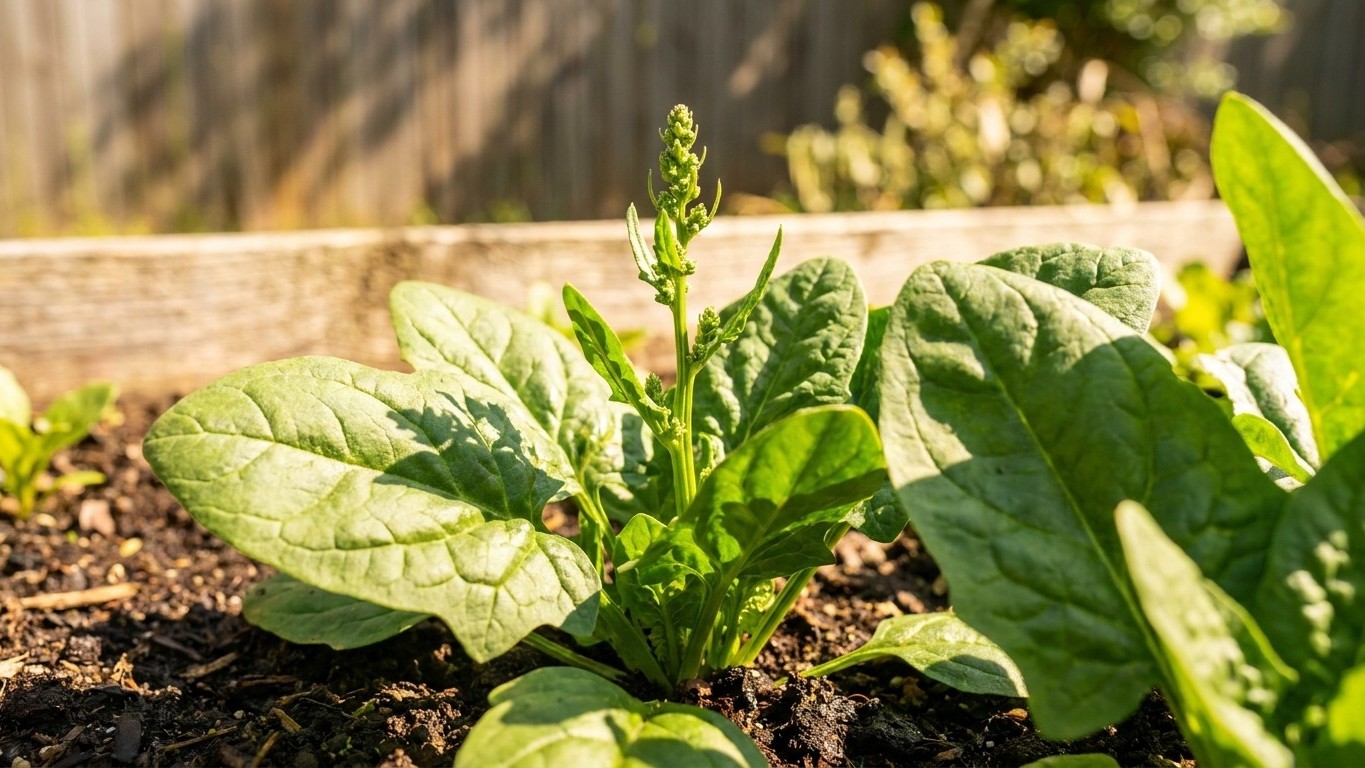

Spinach will bolt early in Delaware, and the trigger is day length as much as heat. The reference city here logs 14 hours and 49 minutes of daylight on the longest day of the year, well past the point where spinach starts pushing up a flower stalk instead of leaves. Add in 17.6 days a year that reach 90°F, and you get a spring window that closes fast and a fall window that opens late.
The short answer
Fourteen hours and forty-nine minutes of daylight on the longest day of the year is the number that matters most for spinach in Delaware, and it works against the crop, not for it. Spinach flowers, or bolts, in response to long days combined with warm temperatures. Once daylight stretches past a certain point in late spring, the plant reads that as a signal to reproduce, and it starts sending up a central stalk instead of putting energy into leaves. That happens whether the air feels mild or hot. A cool, cloudy June does nothing to stop it, because the day length itself is doing the triggering, not the thermometer.
That’s the piece gardeners in this state often miss. They assume that if summer stays mild, spinach will just keep growing. It won’t. The clock that starts bolting is set by the sun’s position, and Delaware sits far enough north that the longest days here run close to fifteen hours, comfortably inside the range that pushes spinach toward flowering. So the limiting factor in late spring is day length first, heat second.
Heat still matters, though, and it shows up twice. Spinach grows best where temperatures stay under 75°F, and this reference station averages 17.6 days a year at 90°F or hotter. Those hot stretches don’t just slow growth, they push leaves toward a bitter flavor at the same time the plant is bolting. So by late spring in Delaware, two things are happening together: the days are long enough to trigger flowering, and the air is warm enough to make the remaining leaves taste sharp and unpleasant. Neither problem is caused by the other. They just land in the same few weeks.
The practical takeaway is that Delaware gardeners are working against a calendar set by the sun, not just a thermometer. Spring spinach has to be sown early and harvested young, before the solstice pushes day length into bolting range. There’s no variety trick or watering schedule that cancels this out. The mechanism is built into the plant, and the fix is timing, not technique.
How long the spring window really is
- Start with the frost date. The reference station’s last spring frost falls between April 3 and April 14. Spinach seed goes in 2 to 3 weeks before that date, which puts sowing somewhere around mid-to-late March for most Delaware gardens near this station. Gardens farther from the coast, or at any elevation, should expect frost to linger a bit later and can nudge sowing back accordingly.
- Track the growth ceiling. Spinach grows well up to 75°F, and above that growth slows while flavor turns bitter. Delaware’s spring typically stays under that ceiling through most of April and into May, since the 17.6 annual days above 90°F are concentrated in summer, not spring. That gives the crop a real stretch of favorable weather right after sowing.
- Watch the day length climb. Every week between the March sowing date and the June solstice adds daylight, moving the crop closer to the 14-hour-49-minute peak that triggers bolting. By the time day length nears its maximum, in late May or so, most plantings are already flowering regardless of how the temperature is behaving.
- Add it up. From a mid-to-late March sowing to a bolt point somewhere around the solstice, Delaware gardeners get roughly eight to nine weeks of usable spring growth. That’s enough time for a full harvest of baby or semi-mature leaves, but not enough to treat spinach as a season-long crop the way lettuce or chard can sometimes be stretched.
Sowing later doesn’t buy extra time either. A planting that goes in three or four weeks after the frost date simply meets the long-day trigger sooner in its life cycle, often bolting before the leaves reach a useful size. The window is fixed by the calendar, not by when you personally get around to planting.
The autumn crop, and when the soil lets you sow
Fall spinach in Delaware runs into two separate obstacles, and they sit at opposite ends of the season. The first blocks sowing in late summer. The second ends the harvest once the leaves are up and growing.
Soil still too warm
Spinach seed germinates poorly once soil temperatures climb above 80°F, according to Utah State University Extension. In Delaware, soil holds summer heat well into August, especially with 17.6 days a year hitting 90°F in the air above it. That means an early-August sowing date, which might look reasonable on a calendar, often fails simply because the ground hasn’t cooled enough for seed to sprout reliably. The fix isn’t a different variety, it’s patience. Waiting until soil temperatures drop, typically as August gives way to cooler nights, gives the seed a real chance to germinate instead of sitting dormant or rotting in ground that’s still too warm.
The frost that ends the season
The reference station’s first fall frost lands between October 26 and November 7. Working backward from a realistic mid-October harvest, the recommended 50 to 75 days before harvest puts a reasonable sowing window somewhere between late July and late August. That overlaps with the soil-temperature problem above, which is exactly why the practical sowing window for fall spinach in Delaware tends to sit in the second half of August, once the ground has started to cool but still leaves 50 to 75 days of growth before the first hard frost shuts things down.
| Season | Main obstacle | Approximate sowing window | Usable growth length |
|---|---|---|---|
| Spring | Long days trigger bolting | Mid-to-late March | About 8 to 9 weeks |
| Fall | Warm soil blocks germination, then frost ends growth | Late July to late August | 50 to 75 days before harvest |
Four spinach varieties commonly grown by home gardeners, Bloomsdale, Melody, Teton, and Olympia, are worth knowing by name if you’re comparing seed packets. No days-to-maturity figures or bolt-resistance data for these varieties appear in the source used for this article, so none are claimed here. Treat any specific number you see on a seed packet as separate from the timing guidance above, which is built entirely around day length, soil temperature, and frost dates for this location.
Common questions
Does shade slow down spinach bolting in Delaware?
Shade can lower leaf temperature somewhat, which helps with the bitterness side of the 75°F ceiling, but it doesn’t change day length. Since bolting is triggered by long days as much as by warmth, shade alone won’t stop a spring planting from flowering once daylight passes the point that signals the plant to reproduce.
Can I sow spinach in Delaware in early summer instead of spring?
Early summer sowing runs straight into the problem the spring window is built to avoid. Days are at or near their longest, close to the 14-hour-49-minute peak, so young plants bolt almost immediately instead of building leaf mass first.
Why does the first fall frost date matter if spinach tolerates cold?
The frost date isn’t about killing the plant, it’s about marking the end of active growth. Counting back 50 to 75 days from a target harvest, using the October 26 to November 7 frost window at this reference station, tells you how late you can realistically sow and still get a usable crop before growth stalls.
Is a fall spinach crop more reliable than a spring one in Delaware?
It often is, mainly because fall-sown spinach grows into shortening days rather than lengthening ones, which removes the bolting trigger entirely. The main risk shifts from long-day flowering to simply timing the sowing date around soil that’s still too warm to germinate seed well.