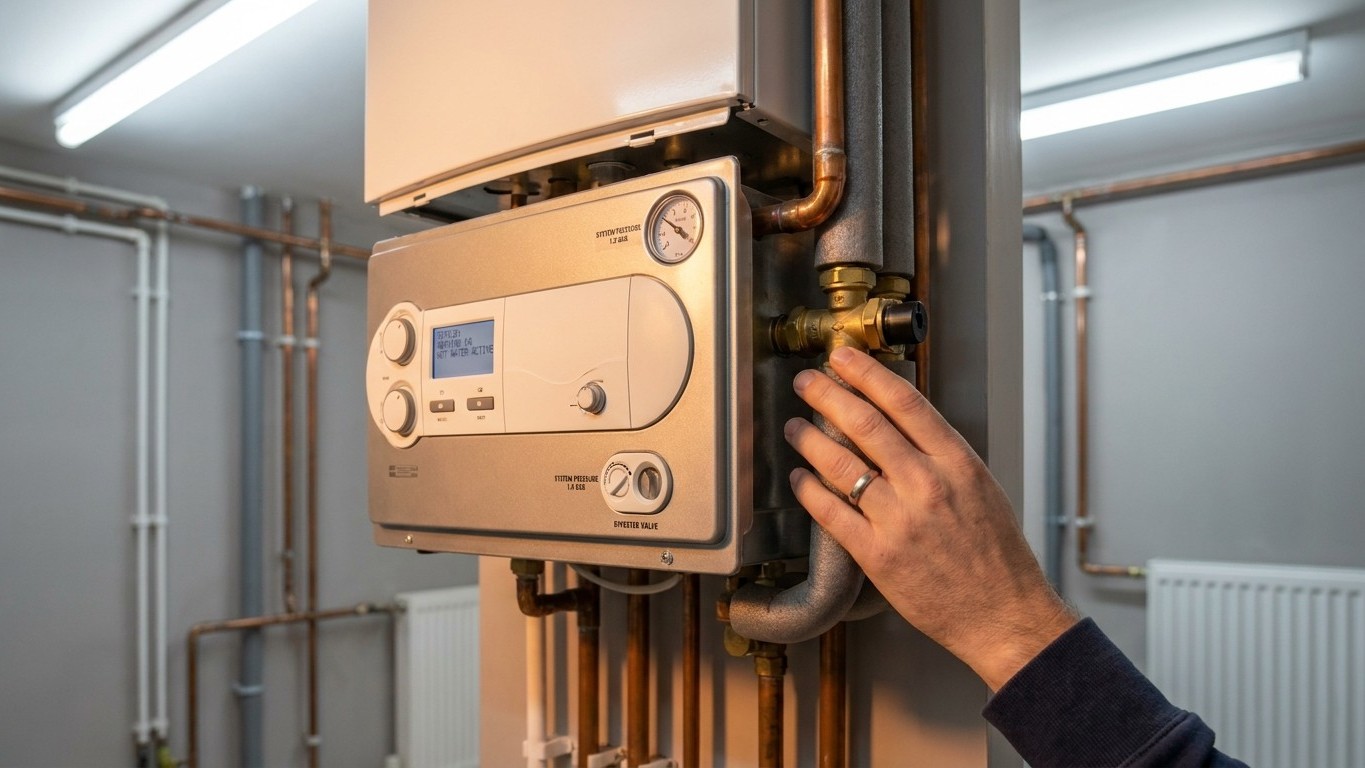

A boiler that fires up and warms every radiator in the house, then delivers nothing but cold water at the tap, isn’t broken in the way most people assume. The burner works. The pump works. The problem lives on one side of the boiler only, the hot-water side, and that narrows the search fast whether you own a combi or a system boiler with a separate cylinder.
Which half has failed

Think of a boiler as running two separate jobs off the same flame. Job one is central heating: ignite the burner, heat the water inside the heat exchanger, push it out to the radiators, and cycle it back. Job two is domestic hot water: take that same heated water (or a second stream of it) and route it to the taps and shower. When the radiators come up to temperature on schedule, you’ve already confirmed that ignition, the gas valve, the circulating pump, and the main control board are all doing their job correctly. That’s useful information, because it means the fault sits specifically in the mechanism that hands heat over to the water you actually use for washing.
On a combi boiler, that mechanism is almost always the diverter valve, a single moving part that decides whether heated water goes to the radiators or gets redirected to heat the domestic supply on demand. On a system boiler paired with a hot-water cylinder, the job is split across several components: a cylinder thermostat that senses tank temperature, a motorized zone valve dedicated to the hot-water circuit, a coil inside the cylinder that transfers heat into the stored water, and a timer or programmer that schedules when hot water gets made at all. A fault in any one of these can produce the exact same symptom, radiators fine, taps cold, without touching the heating side.
Why the burner working matters
Because a boiler is a fuel-burning appliance, any fault that touched ignition or combustion would also raise a carbon monoxide concern, and CO is colorless and odorless, which is exactly why a working CO alarm in the home is non-negotiable regardless of what’s causing this particular fault. The fact that heating runs normally is one piece of evidence the burner and flue are doing their basic job, but it isn’t a substitute for a functioning detector, and it’s not a diagnosis. An electric boiler, by contrast, burns nothing and carries no CO risk at all, which is worth knowing if you’re comparing appliance types rather than troubleshooting the one you have.
| Component | Combi boiler | System boiler with cylinder |
|---|---|---|
| Routes heat to hot water | Diverter valve | Zone valve + coil |
| Sets hot-water temperature | Boiler’s own control | Cylinder thermostat |
| Schedules when hot water is made | On demand, no schedule | Timer/programmer |
| Stores hot water | No, made instantly | Yes, in the cylinder |
The diverter valve
On a combi, this one part is responsible for more no-hot-water calls than anything else in the appliance. The valve sits inside the boiler casing and physically redirects the flow of heated water, sending it to the radiator circuit most of the time and switching over to the domestic hot-water plate exchanger the instant a tap opens. It’s a mechanical gatekeeper doing double duty, and when it works correctly you never notice it’s there.
The tell that points straight at this valve is almost always the same: heating performs exactly as it should, every radiator warms up on schedule, but hot water comes out lukewarm at best or stone cold at worst. The reverse pattern happens too, hot water runs fine while the radiators stay cold, which points to the valve stuck in the opposite position. Either version is the same part failing in a different direction, and both are consistent with a burner and pump that are otherwise healthy.
What actually causes it to stick
Two things wear this valve out over time. Limescale buildup inside the valve body is the more common culprit in areas with hard water, gradually gumming up the small moving components until the valve can’t fully complete its stroke. The second cause is a worn or failing actuator, the small motor that physically moves the valve, which can weaken with age and stop pushing the valve all the way over. Either failure mode produces the same symptom from the homeowner’s side of things: one function of the boiler simply stops responding.
This isn’t a part to open up without the right training. Diverter valves sit inside a sealed, pressurized gas appliance, and the diagnostic sequence a technician uses (isolating the valve, testing the actuator separately, checking for water bypassing the seal) requires tools and knowledge most homeowners don’t have on hand. What you can reasonably do yourself is describe the symptom precisely: which function fails, whether it’s total or partial, and whether it changed suddenly or gradually. That description alone often lets a technician walk in already knowing what they’re likely to find.
On a system with a cylinder
A system boiler feeding a separate hot-water cylinder has more parts in the chain, which means more places for a single fault to hide, but it also means there’s a logical order to check them before calling anyone out. Start with the timer or programmer, since a hot-water schedule that’s been changed, reset after a power outage, or simply set incorrectly will produce exactly this symptom with nothing mechanically wrong at all. It’s the cheapest possible explanation and the easiest to rule out first.
Next comes the cylinder thermostat, the sensor strapped to the tank that tells the system when the stored water has reached temperature and when it needs more heat. If that thermostat has failed or drifted, it can tell the system the water is already hot when it isn’t, which stops the heating call from ever reaching the cylinder. After that, the motorized zone valve dedicated to the hot-water circuit deserves a look, specifically whether it’s opening at all when a hot-water call comes through; a valve stuck shut here behaves a lot like a diverter valve fault on a combi, just with an extra component in the loop.
What belongs to a technician
The coil inside the cylinder is where DIY checking should stop. It’s the internal heat exchanger that transfers heat from the boiler’s water loop into the stored domestic water without the two ever mixing, and it can fail through scale buildup, corrosion, or a slow internal leak that lets the two circuits cross. Diagnosing a coil problem means draining or inspecting the cylinder itself, work that belongs to a qualified technician, not a weekend project.
Timer and thermostat settings on hydronic systems get less attention than they deserve, and not just in single-family homes. A U.S. Department of Energy study on hydronic heating performance in multifamily buildings put it plainly: “Unfortunately, control settings are often best guesses and are not typically optimized.” That finding covers central hydronic systems in multifamily buildings specifically, and its savings figures don’t transfer to a single house, but the underlying point still applies here: a programmer that was never revisited after installation is a common, boring, and entirely fixable reason for a hot-water schedule that no longer matches what the household actually needs.
Common questions
Does a boiler with no hot water mean it’s running less efficiently?
Not directly. Efficiency is measured by AFUE, the ratio of a boiler’s annual heat output to the total annual fuel energy it consumes; a rating of 90% means 90% of the fuel’s energy becomes usable heat while the rest exits through the flue. The U.S. Department of Energy’s Federal Energy Management Program notes that an ENERGY STAR-qualified residential gas boiler meets 0.90 AFUE, comparing that figure against models rated at 0.84 and 0.97 in its own worked examples. That guidance is written for federal purchasers deciding between equipment, not for a homeowner troubleshooting a fault, and a stuck diverter valve or bad thermostat doesn’t change your boiler’s AFUE rating either way.
Is it safe to keep using the heating while hot water is down?
If the heating side is functioning normally with no unusual smells, sounds, or shutdowns, there’s no inherent reason the hot-water fault forces you to stop using it. That said, because any gas boiler is a fuel-burning appliance, a working carbon monoxide alarm in the home is essential regardless of which function is misbehaving; CO has no color and no odor, so the alarm is the only real early warning available.
Should this fault push me to book an annual service instead of just fixing the immediate problem?
It’s a reasonable moment to do both. The U.S. Fire Administration advises to “maintain heating equipment and chimneys by having them cleaned and inspected each year by a professional,” and a no-hot-water call is a natural opportunity to have that inspection done at the same time a technician is already on site diagnosing the valve or thermostat fault.
Can the fault fix itself, or will it definitely need a part replaced?
A programmer or timer that’s simply set wrong can be corrected with no parts needed. A valve or thermostat that’s actually failed mechanically, whether from limescale, a worn actuator, or coil corrosion, generally won’t resolve on its own and will keep producing the same symptom until the failed component is replaced.