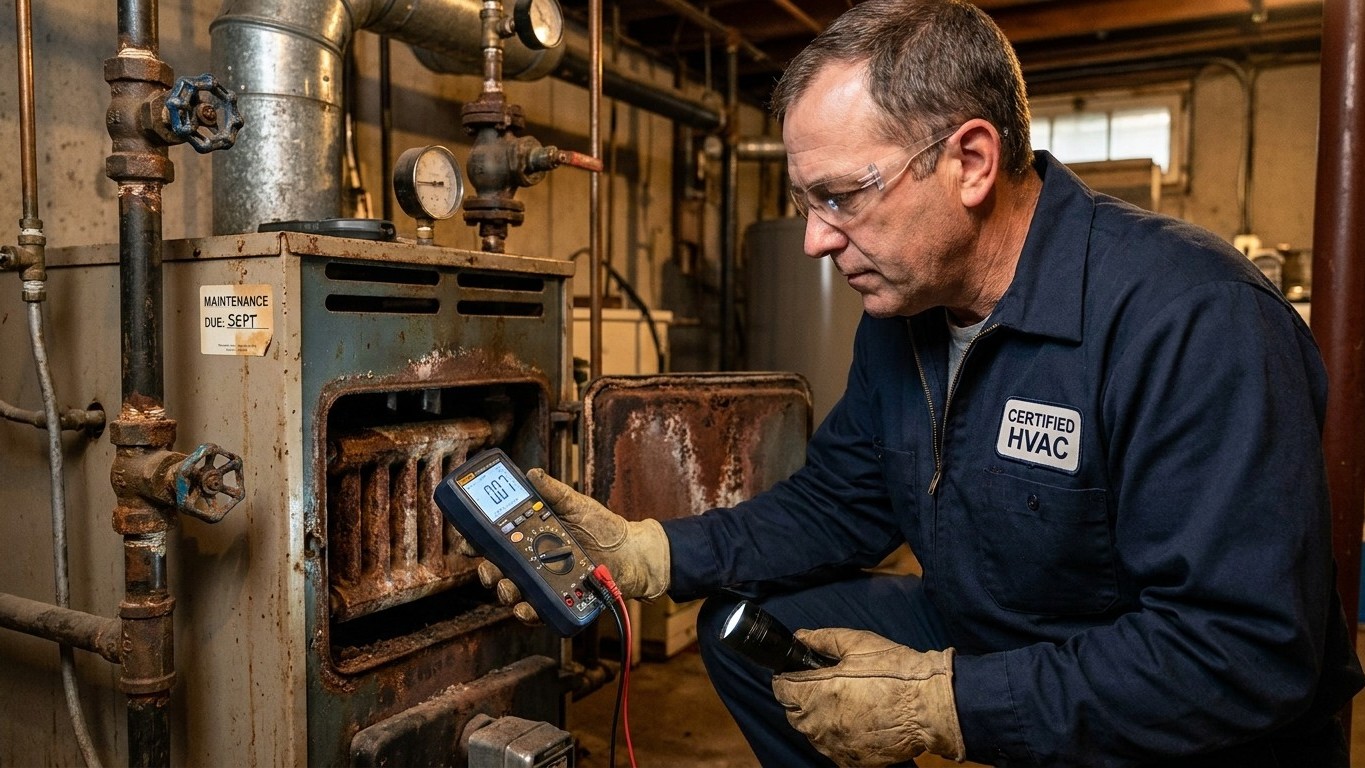

A boiler is worth replacing when a specific signal shows up, not simply because a birthday passes. The decision usually turns on one of four things: a cracked heat exchanger, a pattern of different parts failing one after another, a part that’s no longer made, or an efficiency gap wide enough that the fuel savings pay for the new unit within a reasonable stretch of ownership. Age by itself decides nothing.
The signals that decide it
Four situations push a household toward replacement instead of another repair call. They don’t carry equal weight.
- A cracked or leaking heat exchanger
- Repeated failures of different components over a short span
- Parts that are no longer available for the model
- An efficiency so far behind current appliances that fuel cost alone justifies the change
The first item is absolute. A cracked heat exchanger lets combustion byproducts mix with the air the boiler is supposed to heat, and because a boiler burns fuel, carbon monoxide is part of that byproduct stream. CO has no color and no smell, which is exactly why a working CO alarm in the home isn’t optional and why a technician who finds a cracked exchanger will typically red-tag the unit on the spot. There’s no repair path here. Once that component fails, the appliance comes out. An electric boiler is the one exception worth naming, since it burns nothing and produces no combustion gas at all.
The second and third items sit in a gray zone that leans toward replacement but isn’t automatic. A boiler that’s lost its igniter this year, its circulator pump last year, and its control board the year before is telling you something about the rest of its components you haven’t seen fail yet. Add up two or three repair bills inside 18 months and the math often favors a new appliance, especially once a part becomes hard to source and a tech has to hunt for a compatible substitute or wait on a special order. This is a judgment call built from receipts, not a hard rule.
The fourth item is pure arithmetic, and it’s the one homeowners most often get wrong by guessing instead of calculating. An older boiler running well below the efficiency of current models is still burning perfectly good fuel into a flue that carries a meaningful share of it outside. Whether that gap justifies a new unit depends on how much fuel that home actually burns each season, which is a number worth pulling from an actual bill rather than an assumption.
One more thing belongs in this section even though it isn’t a replacement trigger by itself. The U.S. Fire Administration advises homeowners to “maintain heating equipment and chimneys by having them cleaned and inspected each year by a professional.” That annual visit is often where the first three signals get caught before they become emergencies, which is the whole point of scheduling it instead of waiting for a breakdown.
What efficiency actually buys
AFUE, or Annual Fuel Utilization Efficiency, is the ratio of a boiler’s annual heat output to the total annual fossil fuel energy it consumes. An AFUE of 90% means 90% of the fuel’s energy becomes heat inside the home, while the remaining 10% leaves up the flue and through other losses. It’s the single number that lets two boilers running on the same fuel be compared on a level field.
The U.S. Department of Energy’s Federal Energy Management Program (FEMP) sets a benchmark for its own purchasing decisions: an ENERGY STAR-qualified residential gas boiler meets 0.90 AFUE, and FEMP’s own worked example compares models at 0.84, 0.90, and 0.97 AFUE to illustrate the tradeoff. That comparison, and any dollar figures attached to it, is written for federal agencies buying equipment under federal procurement rules. It isn’t household advice, and the cost thresholds FEMP uses to justify a purchase for a government building don’t translate to what a homeowner should expect to pay back a new boiler in a private residence.
The caveat that matters more than the number
A high AFUE rating describes what a boiler can do under the conditions it was tested against, not what it will do bolted into an existing system. A condensing boiler earns its efficiency by cooling flue gas enough that water vapor condenses out, releasing extra heat in the process. That only happens when the water returning to the boiler is cool enough, typically well below what many older heat emitters and control setups deliver. Install a condensing boiler onto radiators sized for high water temperatures, leave the controls on their factory guess, and the unit may run in its non-condensing mode most of the season, never collecting the efficiency gain its rating promises. The mechanics of that threshold are covered in more depth on the condensing boiler page, and the control side of the same problem, how a heating curve is set and why it so often stays wrong, is covered on the reset curve page. Neither page is optional reading if efficiency is the reason for the upgrade, because the appliance and the settings around it decide the outcome together.
What the job includes
Two quotes for the same boiler brand and model can differ by a wide margin, and the scope of work is almost always why. A boiler replacement is rarely just swapping one appliance for another; it’s a short list of connected jobs that either get done properly or get skipped to win a lower bid.
- The appliance itself, sized to the home’s actual heat loss rather than matched to the old unit’s output
- The flue or venting, which may need to change entirely if the new boiler’s exhaust temperature or type differs from the old one
- The gas or oil supply line, checked for adequate sizing and condition rather than assumed to be fine
- A system flush, to clear sludge and debris that a new heat exchanger’s tighter waterways won’t tolerate as well as the old one did
- The controls, since a new boiler paired with an outdated thermostat or an unset heating curve won’t deliver the efficiency on its label
Whether the existing radiators or baseboard emitters stay is its own decision. Reusing them keeps cost down, but as the efficiency section above lays out, keeping high-temperature emitters can cap what the new boiler is able to achieve. A contractor who raises that tradeoff up front, instead of quietly reusing everything to keep the number low, is doing the job right.
The single question worth insisting on before signing anything is whether a heat-loss calculation was actually performed, room by room, rather than a boiler chosen to match the old one’s BTU output. An oversized boiler cycles on and off more than it should, wearing components faster and rarely running long enough to reach steady efficiency. An undersized one runs constantly and still can’t keep the coldest room comfortable on the worst day of the year. The sizing page walks through how that calculation works and what it should look like on paper. Any quote that skips this step is a quote worth questioning, regardless of how competitive the price looks.
Permits and inspection are part of the scope too, though the specific requirements vary by jurisdiction. The local code office is the authority on what’s required for gas supply work, venting changes, and final sign-off, and the appliance’s own label and installation manual govern its clearances and settings. A contractor’s quote should account for that inspection step, not treat it as an afterthought.
Common questions
Does a boiler need to be replaced at a certain age?
No fixed age triggers replacement. What matters is which of the four signals above shows up: a cracked heat exchanger, a pattern of repeated repairs, unavailable parts, or an efficiency gap wide enough to justify the cost through fuel savings.
Can an old boiler be repaired instead of replaced?
Often, yes, as long as the heat exchanger itself is intact. A failed igniter, pump, or control board is usually a repair, not a replacement trigger, unless the repairs are stacking up faster than makes financial sense.
Will a new condensing boiler automatically lower fuel bills?
Not automatically. The efficiency gain depends on the boiler actually condensing, which requires return water temperatures low enough for that to happen. Unchanged high-temperature emitters and an unset heating curve can keep a condensing boiler running in non-condensing mode for most of the season.
Who decides how a new boiler is sized?
It should be based on a room-by-room heat-loss calculation for the home, not on matching the output of the old boiler. Ask the contractor directly whether that calculation was performed and ask to see it.