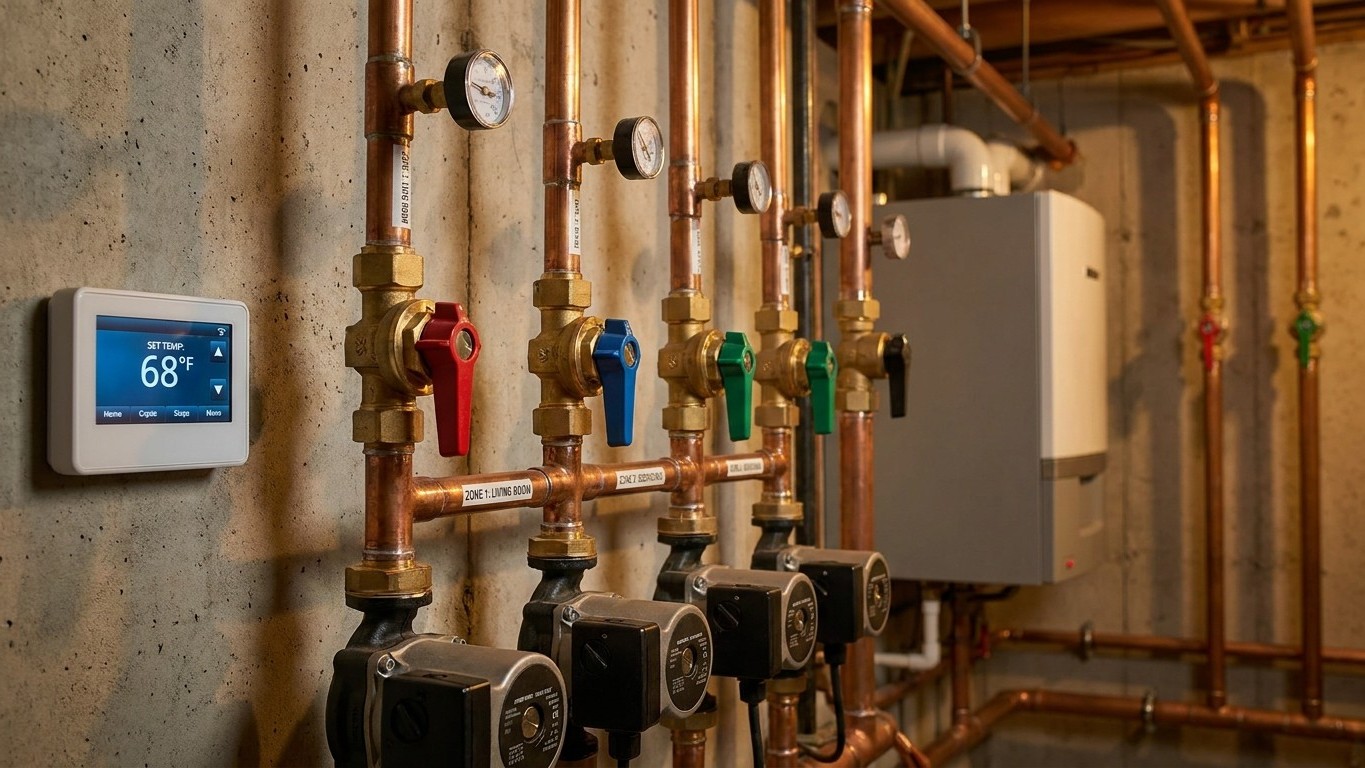

One room stays cold while the rest of the house is fine because that room belongs to its own loop, and something specific to that loop, a stuck valve, a dead thermostat, a bubble of trapped air, is blocking heat. The boiler itself is almost never the cause when the problem is isolated to a single zone. Fixing it means checking that one circuit’s hardware, not the whole heating system.
Several thermostats, one boiler

Zoning exists so that one boiler can heat different parts of a house to different temperatures at different times. A bedroom wing might stay at 62°F overnight while the main living space holds steady in the evening, each governed by its own thermostat, each fed by its own piping loop. The boiler produces the hot water; zoning decides where that water goes and when.
There are two common ways houses do this. The first uses zone valves: a single circulator pump pushes water through the system continuously, or on a call from any zone, and small electric valves at each zone open or close to let water into that particular loop. A house with this setup usually has one pump near the boiler and a cluster of small valve bodies, often with a colored indicator or lever, mounted on the pipes where each zone branches off.
The second approach skips the shared valves entirely and gives each zone its own circulator pump. Instead of one pump and several valves, you’ll find two, three, or more pumps mounted in a row near the boiler, each wired to its own thermostat and each responsible for moving water through one loop only. Neither design is better in principle; they’re just different ways of solving the same problem, and manufacturers and installers choose based on the piping layout, the number of zones, and personal preference.
Telling the two apart
Look at the near-boiler piping. If you see one pump and several smaller valve actuators (small boxes about the size of a deck of cards, each with two or three wires) mounted on separate pipe branches, that’s a zone-valve system. If you count multiple pumps, each about the same size, wired independently, that’s a zone-circulator system. This distinction matters when something goes wrong, because it tells you whether to suspect a valve or a pump when one zone underperforms while the others work fine.
One zone cold, the others fine
This is the diagnosis this page exists for. If every other zone in the house heats normally and only one stays cold, the boiler is doing its job. The heat is being produced; it’s just not reaching that particular loop. That narrows the search considerably, because the problem lives in four possible places: the zone valve or circulator serving that loop, the thermostat calling for it, the wiring connecting the two, or air trapped inside that specific loop of pipe.
A sensible check order
- Thermostat first. Confirm it has power (batteries or wiring), that it’s set to call for heat, and that it isn’t simply miscalibrated. A thermostat that never sends a signal will leave its zone cold no matter what else is working.
- Wiring and connections next. Loose or corroded wire nuts at the zone valve or circulator, especially in a basement or crawlspace where moisture is common, are a frequent and inexpensive-to-fix culprit.
- The zone valve or circulator itself. Zone valve actuators fail mechanically over time, they’re a wear part, and after years of repeated opening and closing they can stick shut or fail to open. A zone circulator can seize or fail electrically in the same way a boiler’s main pump can.
- Air in that loop. Trapped air collects at high points in the piping and blocks water flow, producing a zone that stays cold or only partly heats even when everything electrical checks out. Bleeding that specific loop, not the whole system, is usually the fix.
Wear parts, meaning components expected to fail eventually from ordinary use rather than from a defect, include the zone valve actuator, the zone circulator’s motor and bearings, and thermostat batteries or internal switches. None of these failures point back to the boiler. If the other zones are heating normally, the boiler is producing and delivering hot water exactly as it should; the fault sits downstream, in the one loop that isn’t getting its share.
When zoning was never right
Not every cold zone is a repair problem. Some were never going to work well, because the piping or the sizing was wrong from the day it was installed. A classic case is the long loop fed last: on a system with several zones branching off the same supply line, the zone farthest from the boiler, especially if its piping run is longer or narrower than the others, can end up starved of flow even when its valve and thermostat are functioning perfectly. The water simply has to work harder to get there, and the other zones closer to the boiler take the path of least resistance first.
Another common origin story: a room or addition tacked onto an existing zone rather than given its own loop. A finished basement, a converted garage, or a new bedroom over an attached garage often gets tied into whichever zone’s pipe happens to run nearby, instead of being planned as its own circuit. The result is a zone now asked to heat more square footage and more radiators or baseboard length than it was ever sized for, and no amount of bleeding air or replacing a valve actuator will fix a loop that’s fundamentally undersized for the load it’s carrying.
These situations are piping and design problems, not maintenance problems, and they usually call for rebalancing the system rather than replacing parts. Balancing valves, flow adjustments, and, in some cases, splitting an overloaded zone into two separate loops are the tools for this, and that work is covered in more depth on this site’s radiator balancing pages, which walk through how to even out heat distribution across rooms fed by the same loop. Repeated bleeding of the same zone every season, or a room that’s always been the cold one no matter what’s replaced, is usually the sign that the problem is design, not wear.
A boiler is a fuel-burning appliance, and that means the same carbon monoxide precautions that apply to any combustion heating system apply here: CO is colorless and odorless, and a working alarm is required. This doesn’t change based on how many zones a system has or how they’re piped; it applies to the boiler itself. An electric boiler, which burns no fuel, doesn’t carry this risk. Whatever fuel type is involved, the U.S. Fire Administration is direct on upkeep: “Maintain heating equipment and chimneys by having them cleaned and inspected each year by a professional.”
Common questions
Can I bleed a single zone without draining the whole heating system?
Yes. Each zone loop typically has its own bleed point, often near the zone valve or circulator, or at a radiator within that loop. Bleeding it addresses air trapped in that specific circuit without needing to touch the other zones or drain the boiler itself.
Does a stuck zone valve mean I need a new boiler?
No. A zone valve is a separate component from the boiler, and its failure doesn’t reflect on the boiler’s condition or efficiency. If the other zones heat normally, the boiler is producing heat correctly; only the valve or circulator serving the affected zone needs attention.
How do I know if my zone problem is wiring instead of the valve itself?
Wiring problems tend to be intermittent (a zone that works sometimes) while a failed valve actuator or circulator motor tends to be consistent, the zone stays cold every time it calls for heat. A licensed technician can test the wiring and the actuator separately to confirm which one is at fault.
Why does the same zone go cold every winter even after repairs?
Recurring problems in the same zone, despite parts being replaced, usually point to a design issue rather than a wear issue: a loop that’s too long, too narrow, or overloaded by a room added after the fact. Rebalancing the system, rather than repeating the same repair, is the more durable fix.