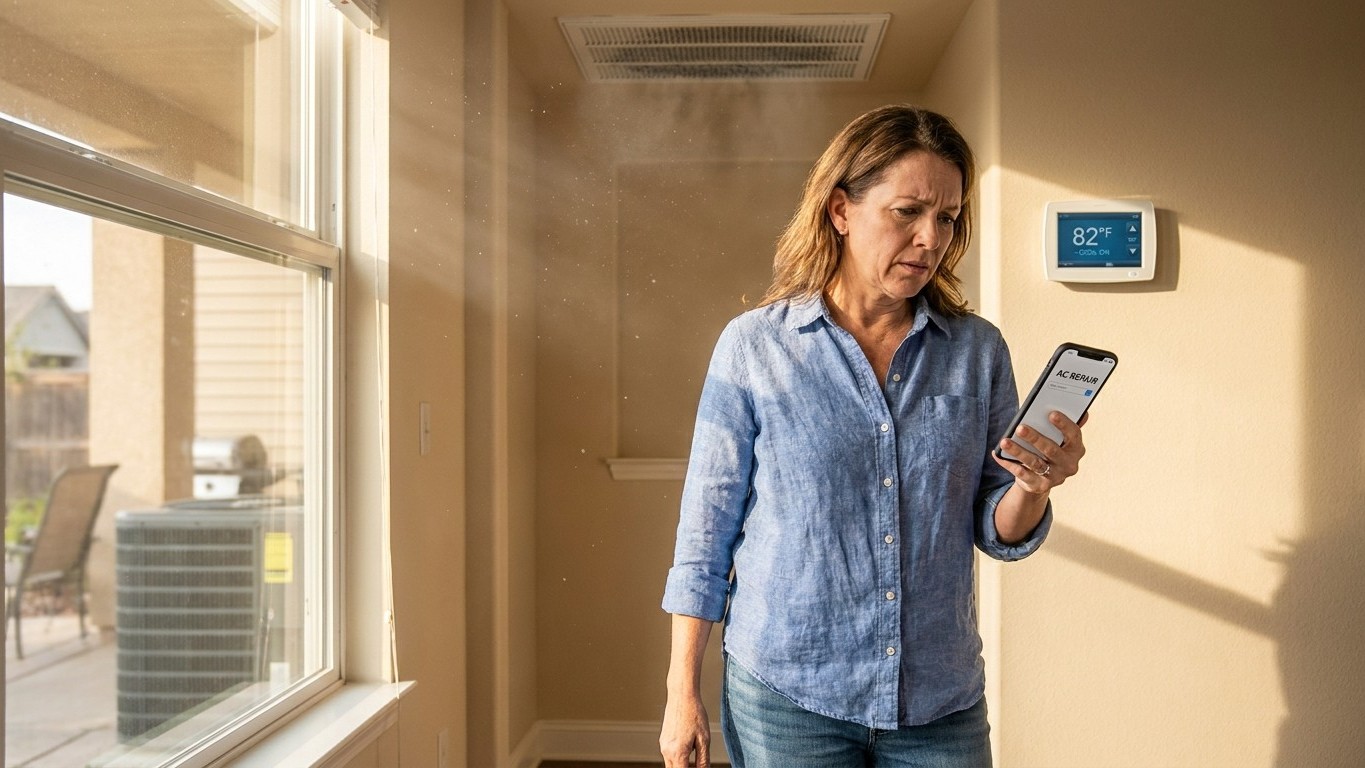

Central air blows but the house stays warm for two different reasons: either the air coming out of the vents isn’t cold, or cold air is coming out and just isn’t reaching the room. The fix depends on which one you’re dealing with. Most causes are cheap and homeowner-fixable, a dirty filter, a blocked vent, a smothered outdoor unit. The one you can’t fix yourself is refrigerant, and that’s worth knowing before you call anyone.
It runs but the house does not cool
Central air is the majority system in this country, which is exactly why so many searches for this problem end up on the same checklist. The U.S. Energy Information Administration’s 2020 Residential Energy Consumption Survey found that 89% of U.S. homes use some kind of air-conditioning equipment, and 67% of all homes run a central unit specifically. The remaining 26% get by on individual equipment: a ductless mini-split, a window or wall unit, or a portable. That split shifts a lot depending on where you live.
| Location | Any air conditioning | Central air specifically |
|---|---|---|
| Connecticut | 90% | 34% |
| Florida | 96% | 90% |
| Hawaii | 57% | not reported (individual units run 48% of homes) |
| Alaska | not reported | not published, sample too small to report |
| U.S. overall | 89% | 67% |
Connecticut has air conditioning in 90% of homes but a central system in only 34% of them, so individual units are doing the cooling in roughly 60% of the state. Florida is almost the mirror image: 96% of homes have some form of cooling and 90% run central air, meaning ductwork is the norm there. Hawaii’s numbers run low across the board, and Alaska’s central-air share simply isn’t published because the survey sample was too small, which isn’t the same thing as zero.
Separate the two complaints first
Two different problems get typed into the same search bar. In the first, the system runs and blows air, but the air itself isn’t cold. Hold a hand near the supply vent and it feels close to room temperature. In the second, the air coming out of the vent is genuinely cold, but the room never catches up, the thermostat reads 78°F an hour after being set to 72°F. The first points at the equipment. The second points at what happens to the air after it leaves the vent, which gets its own section further down.
Work through these checks in order, cheapest and fastest first:
- Check the filter. A clogged filter is the most common reason a central system struggles, and U.S. ENERGY STAR calls it out by name: “Inspect, clean, or change air filters once a month in your central air conditioner, furnace, and/or heat pump.” Once a month, for all three pieces of equipment.
- Confirm the thermostat is set to COOL, not just fan, with the set point below the current room temperature. It sounds obvious until you find it set to 74°F in a house already sitting at 71°F, doing nothing.
- Check the thermostat’s power (batteries or breaker) if the display is blank or unresponsive.
- Walk the house and check every return and supply vent. Furniture blocking a return, a rug over a floor vent, a closed damper in a room nobody uses, any of these starve the system of airflow.
- Look at the outdoor condenser unit. Leaves packed against the coil, a fence built too close, a shrub leaning into the cabinet, anything blocking air from moving through it stops the unit from shedding the heat it just pulled out of the house.
- Clear at least two feet of space around the outdoor unit and rinse visible debris off the coil fins with a garden hose (no pressure washer).
Airflow problems aren’t a minor detail. U.S. ENERGY STAR states that “airflow problems can reduce your system’s efficiency by up to 15 percent,” and restricted airflow is also the trigger for the more dramatic failure covered next, where the coil turns to ice.
If everything on that list checks out and the air is still warm, the system may be low on refrigerant. This is where a homeowner’s checklist ends. Refrigerant lines are sealed and pressurized, and this isn’t a fluid topped off like motor oil. A sealed system doesn’t lose refrigerant unless something is leaking, so a system that’s “low” has a leak somewhere in the lines or coil. Adding refrigerant without finding and fixing that leak means paying for the same visit again within a year, sometimes sooner. That diagnosis calls for a licensed HVAC technician with gauges and leak-detection equipment.
Ice on the unit
An air conditioner freezing up sounds like the opposite of a problem, but it’s one of the more urgent ones. The mechanism runs in a tight loop: the evaporator coil is supposed to sit a little colder than the air moving past it, so moisture condenses on the surface and drains away. When airflow across that coil drops, from a clogged filter, closed vents, or a failing blower, the coil runs colder than it should. The moisture on it freezes instead of draining, and that layer of ice then blocks even more airflow. The system’s own response to the first problem creates a bigger one, and once ice starts forming, it builds fast.
Low refrigerant produces the same symptom through a different path. With less refrigerant moving through the coil, pressure drops, the coil runs colder than designed, and ice forms even with normal airflow moving across it. That’s one reason ice on the unit isn’t automatically a filter problem.
The immediate move is to stop making it worse. Switch the thermostat to fan only, or off, and let the ice melt completely before touching anything else, running the compressor against a frozen coil can damage it. A full thaw can take several hours. Once the coil is clear, check the filter and walk the vents the same way described above; a blocked filter or a stack of closed registers is often the whole story.
If the ice clears and comes back within a day or two of restarting the system, stop troubleshooting on your own and call a technician. Recurring ice after a genuine thaw and a clean filter points at a refrigerant leak or a failing blower motor, and neither one gets better with another round of melting and hoping.
When to switch over, where you live
The changeover between heating and cooling isn’t a clean line on the calendar. It’s a stretch of weeks where neither system does much work, followed by a stretch where the house genuinely wants both on the same day. Utilities and building-science researchers track this with degree days: a rough measure of how far the outdoor temperature strays from a comfortable baseline, added up over a month. A month heavy on heating degree days is asking the furnace to work; a month heavy on cooling degree days is asking the air conditioner to work. The quietest months, usually in spring and again in fall, post low numbers on both counts, and the house barely needs either system.
What catches people off guard is the month in between, where both numbers show up at once instead of one simply replacing the other. Mornings run cold enough that the furnace kicks on before sunrise, and by mid-afternoon the same house is warm enough that the air conditioner cycles on too, sometimes just a few hours apart. One rough way to flag that overlap is a month posting somewhere around 50 heating degree days and 50 cooling degree days at the same time. That’s not an official published category, just a working marker for “the house wants both this month.”
Where that overlap month lands shifts by region and by year, which is exactly why there’s no single national date for flipping the system over. In much of the country with humid summers and mild winters, that double-demand month tends to fall in April or in October. Farther north, it can show up later in spring or earlier in fall, compressed into a narrower window. None of that changes how the equipment itself works, but it explains why a schedule fixed to “cooling season starts in June” is a guess, while a system reading the actual pattern for a given location adjusts on its own.
The practical takeaway for troubleshooting is smaller than it sounds: don’t assume a system that struggled during one of those overlap weeks is broken. A furnace and an air conditioner sharing duty inside the same 24 hours puts more short cycles on both, and short cycling is its own source of wear separate from anything covered above.
The room that never cools
Every other room in the house holds 72°F, and one back bedroom sits at 78°F no matter what the thermostat says. Before assuming the air conditioner is undersized or failing, look at what happens to the cold air between the unit and that one vent. U.S. ENERGY STAR puts a number on how much never arrives: “In a typical house, however, about 20 to 30 percent of the air that moves through the duct system is lost due to leaks, holes, and poorly connected ducts.” That’s air paid for, cooled, and then pushed into ductwork that leaks it into an attic or a crawlspace before it reaches a single register.
A duct run feeding one far room is disproportionately exposed to that kind of loss. If the run travels through an unconditioned attic, every foot of leaky or poorly insulated duct bleeds cold air into attic space that can run well over 120°F in summer, so what finally arrives at the vent is warmer and weaker than what left the air handler. A crushed flex duct, stepped on during a renovation or squeezed behind stored boxes, a joint that came apart above a ceiling, or a disconnected section hidden in a wall cavity all produce the same symptom: air that’s cold at the source and lukewarm at the destination.
There’s also a layout explanation that has nothing to do with damage. Systems get balanced, dampers adjusted, registers sized, for the house as it existed when the ductwork was installed. A finished attic room, a converted garage, or an addition tacked onto the end of a duct run often ends up under-supplied simply because nobody rebalanced the system for the added square footage.
A homeowner can reasonably check accessible duct sections in an attic or basement for obvious disconnections, feel for airflow at the vent with the system running, and confirm the room’s damper, if there is one, is open. Sealing hidden leaks inside walls, rebalancing an entire system, or resizing an undersized run is duct-repair work for a technician with the right tools, not a weekend project with a roll of tape.