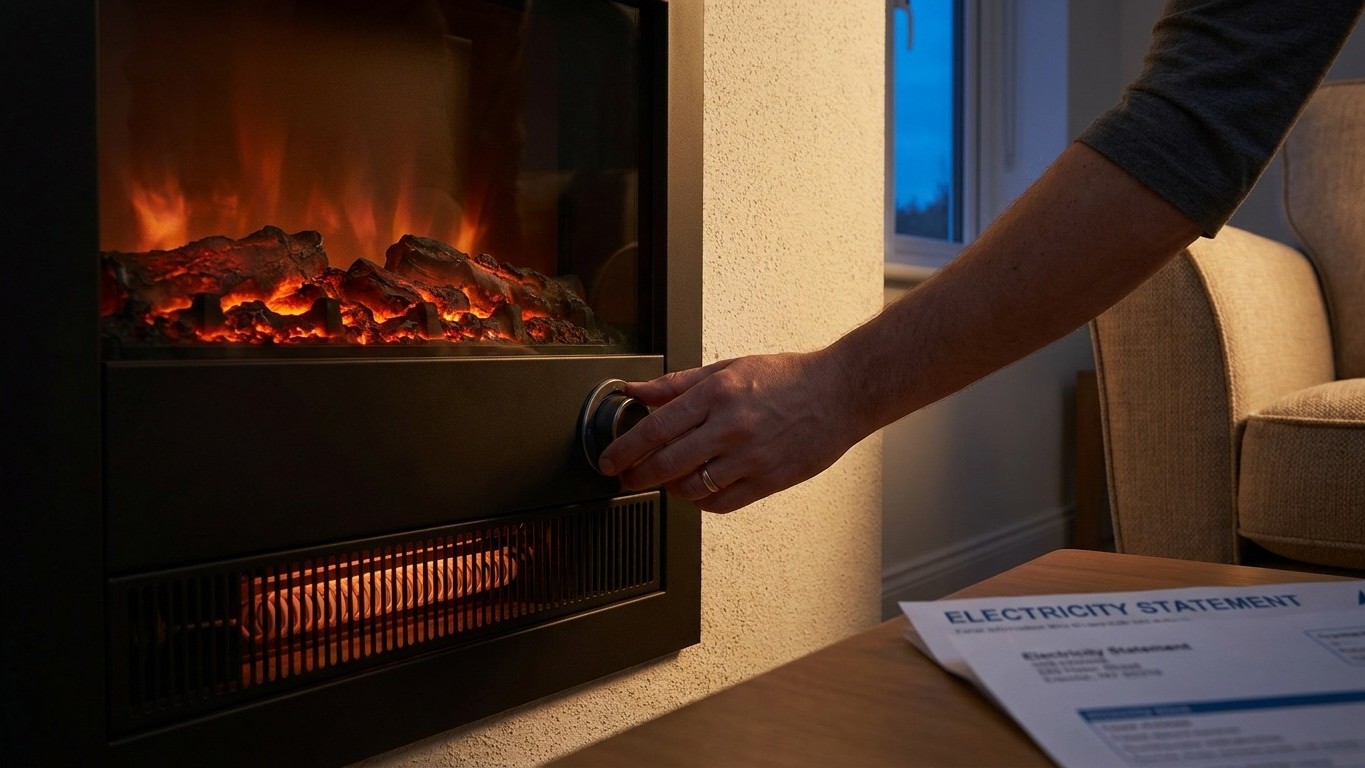

Running an electric fireplace costs almost nothing when it’s just glowing, and roughly the same as running a portable space heater when the heat is turned on. The two functions are billed separately by your utility, even though they live in the same box, and that separation is the single fact that determines whether your monthly bill barely moves or climbs by real dollars.
The calculation, done once

Most plug-in electric fireplaces are built to draw at or below 1,500 watts on a standard 120-volt household circuit, the same ceiling as any plug-in space heater. That’s 1.5 kilowatts. To find what an hour of full-heat operation costs, you multiply 1.5 kW by your own electricity rate, in dollars per kilowatt-hour, which appears directly on your utility bill under a line usually labeled “supply” or “generation” charge, sometimes bundled with delivery fees.
Say your rate is 15 cents per kWh, just as a working number to walk through the math, not a claim about what anyone actually pays. One hour at full heat: 1.5 kW × $0.15 = $0.225, so about 22 cents. Run it four hours a night for a month, thirty nights, and you land near $27. Double the rate to 30 cents, common in parts of the Northeast and California, and the same four-hour habit costs closer to $54 a month. Halve it to 7 or 8 cents, which shows up in parts of the Pacific Northwest and the South, and you’re down around $13.
That’s the entire exercise. Grab your own bill, find your per-kWh rate for the current billing period, and run the same multiplication: 1.5 kW, times the hours you actually plan to run the heater, times your rate. Nobody else’s number applies to your outlet, because residential electricity prices differ by more than a factor of three between states, driven by how power is generated regionally, transmission distances, and state-level regulatory structures. A homeowner in a state with cheap hydro power and a homeowner in a state that imports most of its electricity are not looking at the same appliance cost, even with the identical fireplace plugged into the identical wall.
Why your bill, not a chart, is the right source
Utility rates also shift by season and sometimes by time of day under tiered or peak pricing plans, so a number that was accurate last winter may not match this winter’s rate. The only reliable inputs are the wattage printed on your fireplace’s rating label, usually near the power cord or on a sticker inside the base, and the rate printed on your most recent bill. Everything else is a guess dressed up as a fact.
Flame without heat costs almost nothing
Here’s what most buyers don’t realize until they’ve owned one for a season: the flickering flame effect is a lighting feature, not a heating feature, and it draws only a few tens of watts to run. That’s closer to the draw of a couple of household light bulbs than to a heater. You can leave the flame glowing across a whole evening, for ambiance while you read or watch television, and the electricity cost barely registers against a monthly bill.
The heat is a completely separate circuit, switched on independently, usually with its own button or dial on the remote or control panel. Flip it off and the flames keep dancing while the fan and heating element go dark. Flip it on and you’re now pulling toward that 1,500-watt ceiling, the number that actually moves your bill. This two-switch design is the honest answer to “is an electric fireplace expensive to run”: it depends entirely on which switch you leave on, and for how long.
It’s worth being clear about what’s actually producing warmth in the room. There’s no fire inside an electric fireplace, so the visible flame is not radiating heat the way a wood fire or gas flame does. The warmth comes from a resistive heating element and a fan pushing air across it, mechanically identical to what happens inside a portable space heater. That doesn’t make the flame effect a gimmick worth skipping; a convincing flame display is a legitimate, reasonable purchase on its own, especially in a room where you want atmosphere more than heat, like a bedroom or a home office. Just don’t expect the glow itself to be doing any thermal work.
The safety upside of no real fire
Because nothing is burning, an electric fireplace produces no combustion byproducts at all. No flue is needed, no carbon monoxide is generated, no combustion air has to be drawn from the room, and no water vapor gets released into your indoor air the way it does with some fuel-burning appliances. Every safety concern tied to venting, flue clearance, and gas leak detection, which dominates discussions of gas and wood-burning units, simply doesn’t apply here.
That said, the heating element still gets hot enough to matter around flammable material, exactly like any electric space heater. The U.S. Fire Administration’s guidance applies directly: “Keep anything that can burn at least 3 feet from all heat sources including fireplaces, wood stoves, radiators, space heaters or candles.” Curtains, stacked mail, a pet bed pushed too close, all worth a second glance before you turn the heat switch on.
Against gas and wood
Set an electric fireplace next to a gas insert or a wood stove and the honest verdict is this: electricity is usually a more expensive way to generate a given amount of heat than natural gas is, unit for unit. That’s a function of how the two fuels are priced and delivered, not a flaw in the appliance itself. Anyone shopping purely to cut a heating bill in a home already piped for gas will typically find the gas option cheaper to run over a full winter.
The actual size of that gap depends on two numbers that move independently of each other and vary by state: the local price of natural gas per therm and the local price of electricity per kWh. In a state with unusually cheap electricity and expensive gas, the math can tilt closer together, or even flip. There’s no single percentage that applies everywhere, and any article that hands you one is oversimplifying a comparison that’s genuinely regional.
Where the electric fireplace wins anyway
Running cost isn’t the only line item, and it’s not why most people buy one. An electric fireplace wins decisively on installation: no gas line, no flue, no masonry, no permit tied to a combustion appliance in most jurisdictions. It goes into a room a wood stove or gas insert never could, an upstairs bedroom, a rented apartment, a condo with no chimney access, simply by plugging into an outlet. Placement is flexible in a way combustion appliances can’t match, since there’s no need to sit near an exterior wall for venting.
- Gas or wood: typically cheaper per unit of heat, but tied to a fixed installation location and combustion safety requirements
- Electric fireplace: typically costlier per unit of heat, but installs almost anywhere and needs no flue
For anyone using a fireplace as supplemental warmth in one room, rather than as the primary heat source for a whole house, the running-cost gap against gas often matters less than the freedom of not needing a chimney at all.
Common questions
Does turning off the flame effect save money?
Barely. The flame draws only a few tens of watts, a small fraction of what the heater draws. Turning off the heater, not the flame, is what actually changes your bill.
Can an electric fireplace heat a whole house?
Not on its own. At roughly 5,000 Btu per hour, a standard 1,500-watt unit is sized for one room, not a whole home, and it’s built around a 120-volt household circuit rather than a whole-house heating system.
Why does my rate look different from what I paid last winter?
Utility rates shift seasonally and sometimes by time of day under tiered pricing plans. Always check your current bill for the rate that applies to the billing period you’re calculating.
Is it safe to leave an electric fireplace running unattended?
Check the manufacturer’s instructions, since practices vary by model. Regardless, keep anything flammable at least 3 feet away from the unit whenever the heater is on, per U.S. Fire Administration guidance for all heat sources.