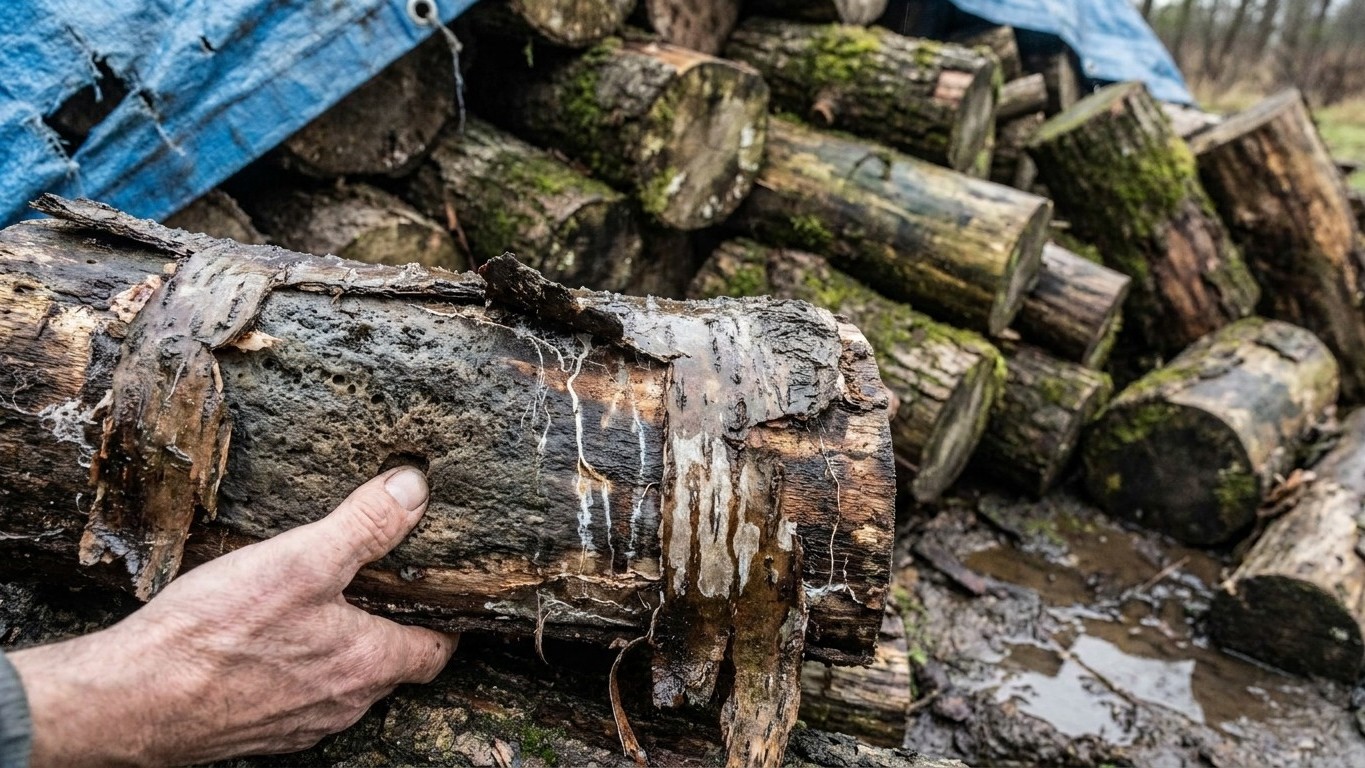

That soft, spongy bark and the sour, mushroomy smell coming off your stack aren’t your imagination. Rot is real, and it’s already eating into the wood you were counting on this winter. The good news: it’s rarely a lost cause. Catch it early and most of the pile is still salvageable, but the way you built that stack is almost certainly the reason it’s happening.
What you are seeing

Look closer at the logs near the bottom or the ones pressed against a tarp, and you’ll probably find bark that peels off in wet sheets instead of dry curls. Underneath, the wood might look darker than the rest of the pile, sometimes gray, sometimes streaked with black or white fungal threads. Press a thumb into it. If it gives like cork instead of resisting like solid wood, that log has already started breaking down.
None of this is dangerous the way a chimney fire is dangerous. Rotting firewood won’t hurt your stove or your flue if you’re smart about what you burn. But it is a real loss. Wood that’s decaying has already lost a chunk of its heat value, and the softer it gets, the more of it turns to punky, crumbly waste instead of fuel. Burn it and you’ll notice it hisses, smokes more, and puts out less heat than the dry, solid pieces sitting six inches away.
The urgency depends on how far it’s gone. A little surface mold on the outer bark, the kind that shows up as fuzzy green or white patches, is mostly cosmetic. Brush it off, let that piece dry a bit more in the sun, and it’ll burn fine. But wood that’s gone soft all the way through, especially at the bottom of the stack, is past saving. That’s not firewood anymore. It’s compost.
Here’s the part worth paying attention to: this is a slow problem, not a sudden one. Nobody’s woodpile rots overnight. If you’re seeing it now, it’s been building for weeks or months, which means the fix isn’t urgent in the sense of an emergency, but it is urgent in the sense that every week you wait, more wood crosses the line from “still good” to “gone.” Sort it now, while most of the pile is still worth saving.
Why it happens
Rot needs two things to get going: moisture and still air. A poorly built stack hands over both without you realizing it. Here’s what typically causes it, starting with the most common culprit and working down.
- A tarp wrapped down the sides. This is the usual cause, by far. It feels like good instinct, wrap the whole pile to keep rain off, but a tarp that hangs down the sides does the opposite of what you want. It sheds rain off the top, sure, but it also seals in every bit of moisture the wood itself gives off as it dries, plus whatever humidity rises up from the ground. Air can’t move through, so that moisture just sits against the bark, day after day, and rot sets in exactly where the tarp touches the wood.
- No gap between the wood and the ground. Logs stacked directly on dirt, grass, or concrete pull up moisture constantly. Rain runs underneath the pile, the ground stays damp longer than the air above it, and the bottom row sits in that dampness around the clock. This is why rot at the bottom of an otherwise good pile is a ground contact problem, not a species problem. Doesn’t matter if it’s oak or pine, ash or maple, wood sitting on wet ground will rot from the bottom up regardless of species.
- Location with no airflow. A stack pushed up against a house wall, a fence, or tucked under dense trees never gets the air movement it needs to carry moisture away. Wind is what dries wood, more than sun in a lot of cases. Block the wind and you’ve built a slow-motion compost pile instead of a wood store.
Notice what’s missing from that list: species and age. People assume rot means they picked a “bad” type of wood, or that it’s just old and past its prime. Almost never true. Rot is a moisture-and-airflow problem, full stop. A stack of dense hardwood built badly will rot just as fast, sometimes faster because the wood holds more water, as a stack of softwood built well. The obvious explanation, “the wood was already going bad,” is almost always the wrong one. The real story is what’s happening around the wood, not inside it.
What to do about it
Once you’ve spotted rot, work through it in this order. Most of it is doable in an evening.
- Sort the pile. Pull every log and check it by hand. Anything soft all the way through, or with fungal growth that’s spread past the outer bark, goes into a separate pile for disposal or, if you have the space, a compost heap. It’s genuinely done as firewood.
- Salvage what’s just damp. Logs with surface mold but a solid, resistant core just need to dry out. Set them apart from the rest, ideally somewhere with better airflow than where they were, and give them time before you burn them.
- Fix the ground contact. Get the bottom row up off the dirt. Pallets, rails, even a couple of 2x4s laid down first, anything that creates an inch or two of air gap between the wood and the ground. This one change stops the bottom-row rot from restarting.
- Rebuild the cover. Cover the top only, and leave the sides open. A rigid piece of roofing metal, a solid lean-to, or a tarp that only drapes over the top row and doesn’t come down past the first few inches of the sides all work. The goal is rain off the top, air through the sides.
- Relocate if you have to. If the stack is jammed against a wall or sitting under thick tree cover, move it, even a few feet into a more open spot, to a place where wind can actually reach it.
This is a job for you, not a professional. Nothing here calls for a chimney sweep or a technician. The one exception: if you’re unsure whether wood that’s been sitting near a rotting pile is safe to burn, or if you’re seeing heavy, established fungal growth you’re not comfortable handling, it’s reasonable to just discard that section and start fresh rather than gamble on it.
How to keep it from coming back
The habit that prevents this from the start is simple: stack for airflow, not just for looks. Off the ground, sides open, top covered. That’s it. But there’s a second layer worth thinking about, and that’s how you’re seasoning the wood in the first place.
Rot thrives fastest on wood that’s freshly cut or only partly seasoned, because there’s already so much internal moisture for fungi to work with. Wood that’s properly dried down before it goes into long-term storage is naturally more resistant, since there’s simply less water available for rot to take hold of. If you’ve been finding rot repeatedly, even after fixing the stack itself, it’s worth looking at how long that wood sat and how it was drying before it ever got stacked for winter, that’s a separate question from stacking, and it’s covered in depth on our page about seasoning firewood properly.
Location matters just as much as construction. A spot that gets a few hours of direct sun and open wind will keep a woodpile drier than a shaded, sheltered corner, even with identical stacking. If your only option is a spot against a wall or under trees, compensate by leaving extra space between rows and being stricter about the top-only cover, since you’re already fighting reduced airflow.
Check the pile every few weeks through the wetter months, not just once in fall. A quick look at the bottom row and the sides catches early mold before it turns into structural rot, and it takes a lot less effort to brush off a little surface mildew than to lose a third of your woodpile to soft, punky logs by January.