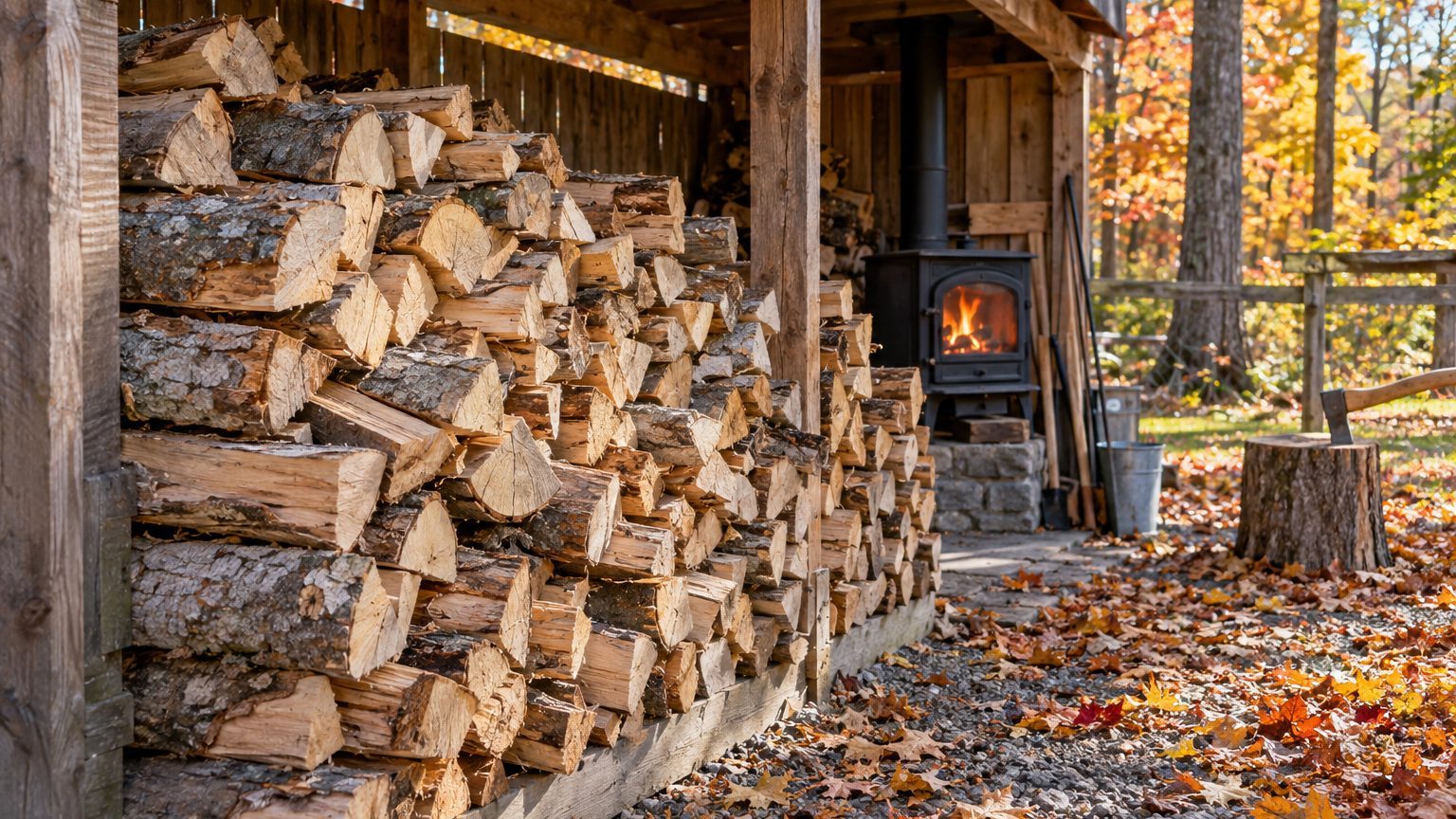

Silver maple firewood delivers 19 million BTU per cord of seasoned wood, according to Utah State University Extension (“Wood Heating”, Table 1 Firewood Facts). That puts it mid-range on this site, neither a top-tier heater nor a weak one. The same source does not publish smoke or spark behavior for this species, so this page says so plainly rather than guessing. Moisture matters more than the species: dry wood is what makes the number real.
How much heat Silver maple gives
The figure used here is 19 million BTU per cord of seasoned wood, taken from Utah State University Extension, Table 1 Firewood Facts in its “Wood Heating” publication. A single number says little by itself. It only means something against the spread between species, and that spread is wide. Oak gives nearly twice the heat of cottonwood from the same cord. Silver maple lands between those two ends, which is what “mid-range” means in practice: a solid, ordinary fuel that will not match the dense hardwoods but will not leave you shivering either.
The mechanism behind that spread surprises most people. Pound for pound, nearly every species of wood gives roughly the same heat. What changes is density. A cord is a fixed volume (a stack 4 feet high, 4 feet wide and 8 feet long, or 128 cubic feet), and a dense wood packs more pounds into that space than a light one. You buy volume, but you burn weight. A cord of a heavy hardwood is simply more fuel than a cord of a lighter wood, even though a single pound of each would warm the room about the same.
For a household, the consequence is concrete. With a mid-range wood you load the stove a bit more often, and you go through more of the woodpile by February than a neighbor burning oak would. Neither is a flaw. It is arithmetic you can plan around: if your stack is silver maple, estimate your winter need a little generously.
Why other charts show different numbers
If you check a second source, you may see a different figure for the same species. That is normal. Published values vary because moisture content, density and testing method differ from one lab and one tree to the next. This page uses the Utah State University Extension figure and nothing else. It does not average two sources into a number that nobody actually published, and you should be wary of any chart that does.
One more point outranks the whole table: seasoning. Green wood spends its heat boiling off its own water before it can warm a room, so a green oak burns worse than a seasoned aspen. A reader who chases the hottest species and burns it wet gets less heat than one who seasons a modest wood properly. The Firewood by Species hub lets you compare other woods, but treat every number there as the best case for dry wood.
Smoke, sparks, and which stove suits it
Here is the gap in the record. The source that gives silver maple its heat value does not publish smoke or spark ratings for it. The honest summary is a short table.
| Property | What is published for silver maple |
|---|---|
| Heat per cord, seasoned | 19 million BTU (Utah State University Extension) |
| Smoke | Not documented in that source |
| Sparks | Not documented in that source |
It would be easy to fill the blanks by reasoning from density or from a related maple. That would be guesswork dressed up as fact, so this page does not do it. What can be offered is a way to decide, because smoke and sparks are never a property of the wood alone. They come from the crossing of a species and an appliance, and you already own the appliance.
Consider how the two behaviors play out. A wood that throws many sparks is a hazard in an open fireplace, where embers can pop onto a rug, and it is close to harmless behind the glass of a closed stove. A wood that smokes heavily can still heat as well as the best species, yet it is unpleasant indoors if the draft is weak. Neither trait makes a species “bad firewood.” Each makes it bad at something specific, in a specific appliance.
Since silver maple’s behavior is unpublished, start cautiously with whatever you have:
- Open fireplace: keep a fitted screen closed, clear flammable items from the hearth, and burn a small test load while you watch for popping.
- Closed stove or insert: keep the door shut while it burns and watch how the chimney smokes during the first fifteen minutes after lighting.
- Any appliance: start with well-seasoned splits, since wet wood smokes in every species.
Your own observation beats any chart here. If a few logs behave well in your setup, you have the real answer for your chimney. If you want a documented comparison, the pages for American sycamore and Eastern white pine each cover Heat, Smoke and Sparks for those species, and it helps to read them before assuming anything carries over.
How long it takes to season

Wood has to fall below about 20 percent moisture before it gives you real heat. Above that, the fire must first boil off the water, and that consumes the very energy you wanted to warm the house. It is also why damp logs hiss, sulfurous smoke rolls out, and creosote builds up in the flue.
The source behind this page’s heat figure does not publish a seasoning time for silver maple. Some species dry slowly because of their cell structure, and others dry fast, but nothing documented here says which group silver maple belongs to, so no month count is offered. A general rule is safer: split the wood, stack it off the ground in a spot with sun and wind, and cover only the top. Splitting matters because bark is a barrier to moisture, and a whole round loses water mostly through its cut ends.
You do not need a meter to check progress, though a cheap one helps. Two tests work with just your hands and eyes:
- End-grain cracks: well-seasoned splits show checks running across the cut face, often radiating from the center, and the ends look gray rather than creamy.
- Bark that lifts: if the bark pulls away easily by hand, or has already started peeling, the wood has been drying for a while.
Add one more check. Knock two splits together. Dry wood makes a hollow, sharp clack, while wet wood gives a dull thud. If you are unsure, split a log and put a meter probe into the fresh face, not the outside, since the surface dries first and misleads.
Getting hold of it
Whether you can find silver maple locally depends on where you live, and the sources here do not map its supply. Silver maple is a tree of the eastern half of the country, so tree services, storm-cleanup crews and rural neighbors in that region are the usual leads. Ask when you call whether the wood is already split and how long it has been stacked. If it was cut last month, treat it as green regardless of the seller’s word.
Whatever the species, insist on wood from close to where you will burn it. Transported firewood is how the emerald ash borer reached the Midwest, and the insect went on to kill more than fifty million ash trees. A load of logs can carry insects or disease from one county to the next, hidden under the bark. Buying locally costs you nothing in BTUs and protects the trees around your own house.
If a seller will not say where the wood was cut, that is the moment to walk away. Some states restrict moving firewood across county or state lines, so check your state’s agriculture or forestry department before you haul a trailer load home from a distant relative’s farm. A cord that travels fifty miles is worth less than one cut down the road.
Common questions
Is silver maple good firewood?
It is a mid-range heater at 19 million BTU per cord of seasoned wood (Utah State University Extension). It is good at giving steady, ordinary heat when properly dried. Its smoke and spark behavior is not documented in that source.
Can I burn silver maple in an open fireplace?
Spark behavior is not published for this species, so use a closed screen and a small test load first. Sparks matter most in an open hearth and far less behind a stove door.
Does a cord of silver maple heat as much as a cord of oak?
No. Oak gives nearly twice what cottonwood gives, and silver maple sits in between. Pound for pound the heat is similar, but denser woods pack more pounds into a cord.
Can I burn it right after cutting?
Not if you want heat. Green wood spends its energy boiling off water, and a green oak burns worse than a seasoned aspen. Wait until the end grain cracks and the bark lifts easily, or until a meter reads below about 20 percent.