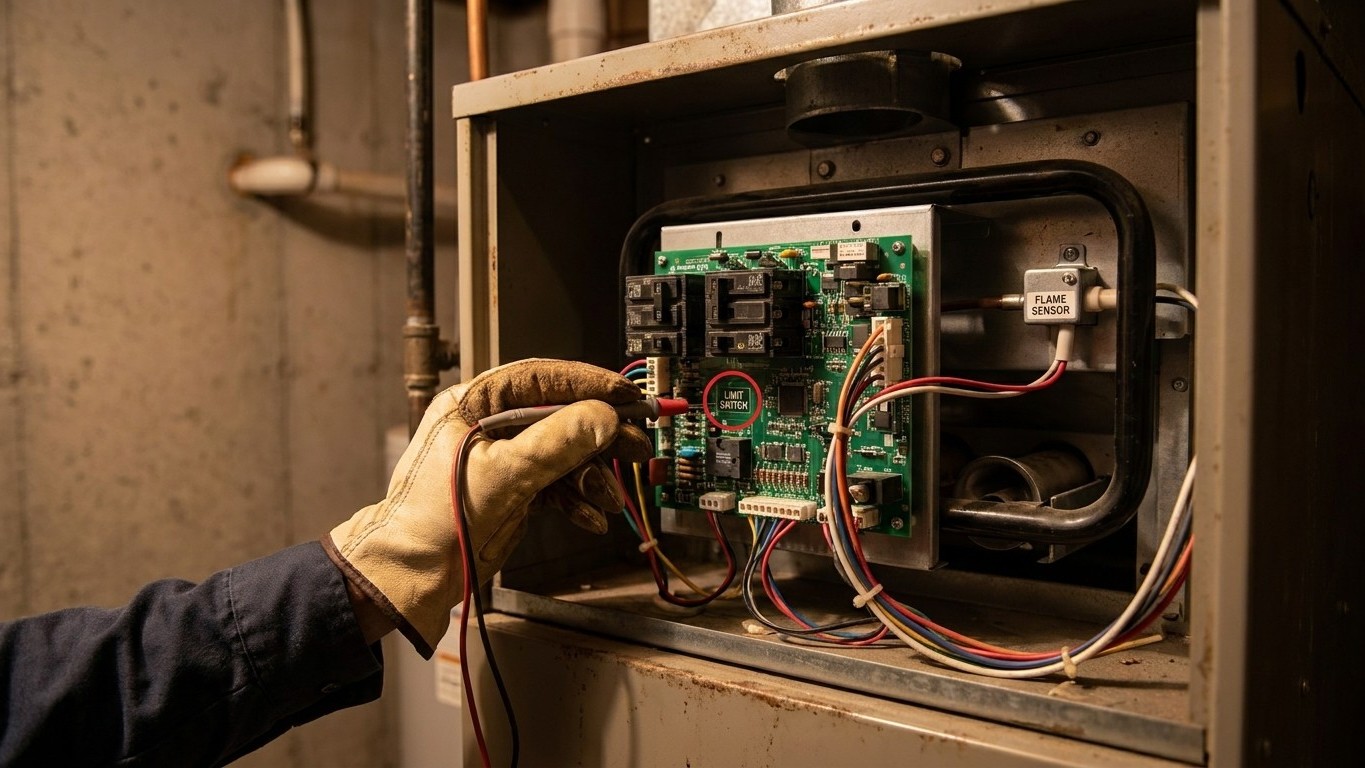

A furnace that shuts off early isn’t malfunctioning in the way most people picture it. It’s not sputtering, not failing, not on its way out. It’s a machine that noticed something didn’t match its own safety rules, and it stopped itself before anything got worse. Reading the shutdown correctly means figuring out which rule got tripped, not just restarting the system and hoping it holds.
The furnace is deciding to stop
Think of a modern furnace as a decision-making device, not a passive heater. It has a control board wired to a handful of safety switches, and each one exists to answer a single question over and over while the burner runs: is this still safe to continue? The moment one of them answers no, the board cuts the gas valve, stops the blower on its own schedule, and locks out further attempts until the condition clears or a person intervenes. That’s not a defect. That’s the system doing exactly what it was built to do.
This distinction matters because it changes what you’re troubleshooting. You’re not hunting for a broken part the way you’d hunt for a dead battery. You’re hunting for a condition, something environmental or mechanical that’s making one particular switch nervous. Fix the condition, and the furnace stops complaining. Ignore it and force a restart, and the same switch will trip again, often faster the second time.
Nearly every early shutdown traces back to one of three families of trouble, and they rarely overlap in the same repair.
- Not enough air moving across the heat exchanger, which lets things run hotter than the limit switch allows.
- Not enough flame signal being detected, which makes the control assume the burner didn’t actually light or stay lit.
- Not enough draught, meaning combustion gases aren’t leaving the system the way the pressure switch expects.
Each has its own signature. Airflow trouble tends to show up as a furnace that runs a while, gets warm, then shuts off, almost like it overheated, which is exactly what happened. Flame signal trouble tends to show up as short cycling right at ignition, a few seconds of burner noise and then silence. Draught trouble often shows up as a furnace that won’t even attempt to fire, sitting in a pre-purge state and then locking out.
None of these three families is inherently more serious than the others in terms of what caused it. A dirty filter and a cracked heat exchanger can both trip the same limit switch, one from ten dollars of neglect and one from a genuine hazard. The switch doesn’t know the difference and doesn’t need to. Your job is to work through the cheap, common causes first, because that’s where most shutdowns start, and to recognize the point where the problem clearly isn’t something a filter change or a vacuum will fix.
That’s also why the next section matters more than most homeowner guides admit. Before you start guessing which family you’re dealing with, the furnace itself is usually already telling you.
The light that tells you which one
Most furnaces built in the last couple of decades have a small window on the control board, sometimes on the blower door, sometimes behind an access panel, with a single LED behind it. That light isn’t decorative. It blinks in a pattern, a specific number of flashes, sometimes followed by a pause and a second set of flashes, and that pattern corresponds to a specific fault code stored in the board’s memory. This is, by a wide margin, the fastest way to know what actually happened, and it’s a step most general guides skip in favor of vague advice to “check the filter and call a technician.”
Here’s the part that trips people up: the meaning of that blink pattern is not universal. Every manufacturer assigns its own codes, and sometimes different product lines from the same manufacturer use different legends entirely. There is no single chart that applies to all furnaces, and any article that hands you a generic list of “2 blinks means this, 4 blinks means that” is guessing, because it can’t know what’s sitting in your utility closet. What every furnace does have, though, is its own legend, and it’s almost always printed somewhere accessible: on a sticker inside the blower access panel, on the inside of the door you remove to service the unit, or occasionally on a fold-out card zip-tied near the control board. That legend translates the blinks for your specific furnace, and it’s the only translation worth trusting.
Before you touch anything, before you flip the breaker or the switch on the furnace itself, count the blinks and write the pattern down. This matters because cutting power to the furnace clears the fault code stored in the board’s memory. If you kill power first and then go looking for the panel, you may come back to a blank light with no pattern left to read, and you’ll be back to guessing which family is in play.
Once you have the pattern written down, open the access panel, find the printed legend, and match the code to its description. Some boards spell things out plainly (“pressure switch open,” “limit circuit fault”). Others use more compact language that still points you toward one of the three families: airflow, flame sensing, or draught. That ten-second act of counting flashes before you reset anything will save you far more guessing than any general troubleshooting list, including this one.
Not enough air
Airflow problems are the most common reason a furnace shuts down early, and they’re also the cheapest to check, which makes them the sensible starting point regardless of what the blink code suggested. The mechanism is straightforward: the heat exchanger is designed to have a certain volume of air moving across it constantly, carrying heat away as fast as the burner produces it. When that volume drops, the metal gets hotter than its rated limit, and the limit switch, whose job is to prevent exactly that, opens and shuts the system down. It’s not a coincidence. It’s the switch working correctly in response to a real condition.
Work through the possible causes in order of how cheap and quick they are to check.
- The air filter. A clogged filter is the single most common cause of restricted airflow, and it’s the first thing to check, every time, before anything else.
- Blocked return air grilles. Furniture pushed against a return, a rug covering a floor-level intake, boxes stacked in front of a wall grille, any of these choke off the air the system needs to pull in.
- Closed supply registers. Rooms shut off to “save energy” reduce the total air the system can push out, which backs up the whole system the same way a blocked return does.
- A blower wheel coated in dust. Even with a clean filter upstream, a blower wheel caked in fine debris moves noticeably less air than a clean one, and that buildup happens gradually enough to be easy to miss.
- Undersized or restrictive ductwork. Sometimes the equipment is fine and the ducts simply can’t carry what the blower is capable of moving, a design issue rather than a maintenance one, and it typically needs a professional evaluation.
The filter deserves particular attention because it’s also the piece of maintenance most people underestimate. According to the U.S. Environmental Protection Agency’s ENERGY STAR program, “Airflow problems can reduce your system’s efficiency by up to 15 percent.” That’s not a minor efficiency footnote, and it lines up directly with why a dirty filter is so often the reason a furnace trips its limit switch. ENERGY STAR’s own guidance is just as direct: “Inspect, clean, or change air filters once a month in your central air conditioner, furnace, and/or heat pump.” Once a month, not once a season, and it applies across all three types of equipment.
If you’ve checked the filter, cleared the returns and registers, and the furnace still shuts down on what looks like an airflow-related code, the blower wheel and duct sizing move up the list, and at that point a technician with the right tools to measure actual airflow is worth involving.
Not enough flame signal, or not enough draught
The other two families split roughly along the line of what a homeowner can reasonably fix and what genuinely needs a professional. A weak or absent flame signal usually traces back to a flame sensor that’s picked up a thin layer of oxidation or soot, enough to interfere with the tiny electrical signal it sends back to the control board confirming that combustion is actually happening. No signal, or too weak a signal, and the board assumes ignition failed even if you can hear the burner running, so it shuts the gas valve and locks out. This is a genuinely common cause with a genuinely common remedy, common enough that it has its own dedicated guide on this site covering how the sensor gets checked and cleaned.
Draught problems sit on the other side of that line. If the blink code or the symptoms point toward a blocked flue, a failed pressure switch, or an induced-draught motor that isn’t spinning up properly, that’s not a homeowner repair. These components exist specifically to confirm that combustion gases are leaving the building the way they’re supposed to, and testing or replacing them requires equipment and training beyond what’s reasonable to attempt without experience. A blocked flue in particular is not something to work around; it’s the entire reason the pressure switch exists, and forcing the system to keep running past that safeguard removes the one thing standing between normal operation and a real hazard.
Say this plainly, because it matters more than any troubleshooting step: a furnace that keeps shutting itself down is not something to bypass, jumper, or reset over and over until it happens to stay lit. Each of those controls exists because engineers decided that specific failure mode was dangerous enough to design a switch around. Repeated shutdowns are the system asking, again and again, for the underlying condition to be addressed rather than argued with.
Common questions
Is it normal for a furnace to shut off and restart on its own during a single heating cycle?
Occasional cycling as a thermostat satisfies and calls again is normal. What’s not normal is a furnace that fires, runs briefly, and locks out repeatedly within the same call for heat. That pattern points to one of the three fault families rather than ordinary thermostat behavior.
Can a thermostat problem look like a furnace shutting itself off?
Yes, though it’s less common than the mechanical causes covered above. A miswired or failing thermostat can send inconsistent signals that make a furnace start and stop in ways that resemble a safety lockout. If the diagnostic light shows no fault code during these events, the thermostat and its wiring are worth checking before assuming a control-board issue.
Does clearing the fault code by cutting power actually fix the underlying problem?
No. Cutting power resets the control board’s memory and clears the blink pattern, but does nothing to the condition that caused the fault. If the underlying issue, whether airflow, flame sensing, or draught, hasn’t been addressed, the same code will typically reappear on the next heating cycle.
Should I try resetting the furnace multiple times to see if it stays on?
Repeated resetting without identifying the fault code first isn’t a diagnostic method, it’s a way of ignoring the safety system’s purpose. Read the blink pattern, check the printed legend for your furnace, and address the actual condition rather than hoping persistence alone will make the lockout stop happening.