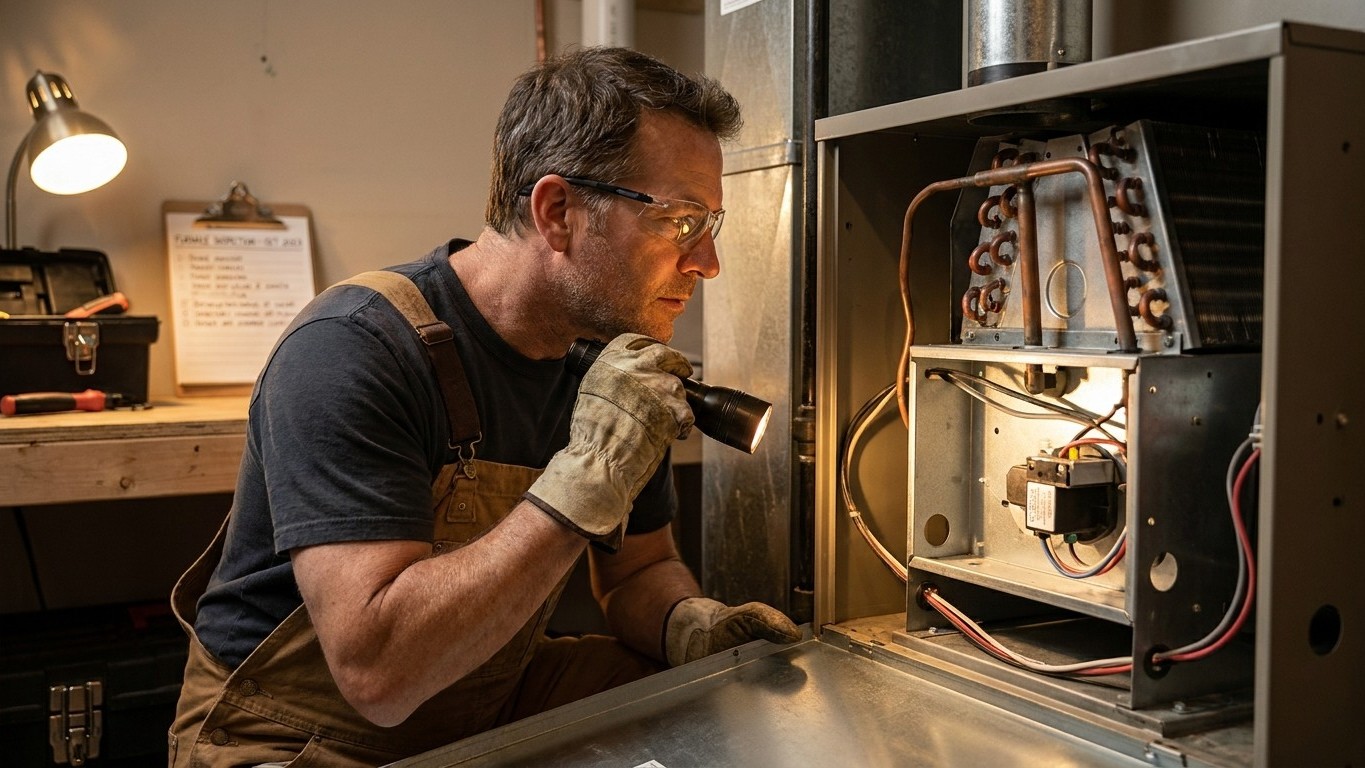

The decision comes down to what broke and what that failure reveals about everything else in the cabinet. A cracked igniter on an otherwise sound unit is a repair, full stop. A cracked heat exchanger changes the entire conversation, not because of its price tag, but because of what it’s made of and what sits on the other side of it. The rest is arithmetic you do with a technician, not a rule you can look up.
Age is the wrong first question

Homeowners almost always ask the same thing first: how old is this thing, and is that too old? It’s an understandable question, and it’s nearly useless. A furnace that’s been serviced every year, kept clean, and never run with a clogged filter can still be doing its job long after a neglected unit of the same age has failed twice. Maintenance history changes outcomes more than a birth year printed on a rating plate ever will.
There’s no reliable figure for “how long a furnace lasts,” and that’s not an oversight, it’s the honest answer. Every number floating around for typical lifespan is a generalization built on wildly different climates, duty cycles, install quality, and maintenance habits. A furnace in coastal Washington running short cycles for mild winters is doing a different job than one in Maine running hard from November through April. Treating either one as a data point in a universal average tells you nothing useful about the unit sitting in your basement or closet right now.
What actually predicts the outcome
The question that predicts what happens next isn’t “how old” but “what failed.” Some failures are wear items, expected to need replacement at some point in a system’s working life, the way brake pads wear on a car regardless of how well the car was built. Other failures point at something structural, something that suggests the unit’s core components are reaching the end of reliable operation together, not just one part giving out in isolation.
That distinction is where a repair-or-replace decision actually starts. A technician who tells you “the igniter failed” is describing a wear item. A technician who tells you “the heat exchanger is cracked” is describing something else entirely, and the two sentences should not be weighed the same way just because they both start with a repair estimate.
What failed, and what that implies
Not every component inside a furnace carries the same weight when it fails. Some are routine wear items with straightforward replacement. Others are structural to the whole system, and their failure raises questions that go well beyond the part itself. Here’s how the common failure points break down.
| Component | Wear item? | Parts typically available? | What its failure implies |
|---|---|---|---|
| Igniter or flame sensor | Yes | Yes, widely stocked | Isolated wear failure; rest of the unit is usually unaffected |
| Blower motor or capacitor | Yes | Yes, though model-specific | Common failure; doesn’t by itself suggest other components are compromised |
| Control board | Sometimes | Varies by age and manufacturer | Can be isolated, or can signal broader electrical stress; worth asking why it failed |
| Inducer motor | Sometimes | Varies, harder to source on older units | Failure can be standalone or tied to venting problems elsewhere in the system |
| Heat exchanger | No, structural | Rarely, and rarely economical even when available | Changes the conversation entirely; see below |
The heat exchanger is the one that changes everything, and it’s worth being plain about why. It’s the wall between the combustion happening inside the furnace and the air that circulates through the ductwork into your living space. When it’s intact, combustion byproducts, including carbon monoxide, stay on one side and go out the flue. When it cracks, that separation is no longer reliable. That’s a safety finding, not a convenience issue, and it’s why a cracked heat exchanger is treated differently from every other part on this list. It isn’t just an expensive component to replace. It’s the boundary the entire safety design depends on.
None of this comes with a dollar figure attached, and any repair estimate that gets waved around as a percentage of replacement cost, “if the repair is more than X% of a new unit,” is a rule of thumb without a source behind it. What actually matters is the answer to one question: is this a part that wears out on its own, or is this a sign that the core of the system has reached the end of reliable function.
The factors that are not about the failure
Even when the failed part itself is straightforward, several things sitting outside the repair estimate can push the decision toward replacement, or make repair the obviously right call. These aren’t about what broke. They’re about the system as a whole and the house it’s heating.
Whether parts are still supported matters more the older a unit gets, independent of anything currently wrong with it. A control board failure on a unit whose manufacturer stopped stocking parts years ago is a different situation than the identical failure on a current model line. Efficiency standards have also moved substantially over the decades furnaces have been installed in American homes, so a unit installed under an older baseline may be running well behind what’s routine in new equipment today, a fact worth knowing even if nothing is currently broken.
Ductwork condition is its own question, separate from the furnace itself. A new unit sized and matched to ducts that are undersized, leaky, or designed for a different type of equipment won’t perform the way the sales literature suggests, regardless of how good the furnace is. And the fuel available to a house isn’t fixed forever either. What’s run to a property, and what’s cost-effective to run, shifts over time in ways that can make a fuel switch worth evaluating alongside a repair-or-replace call.
How differently this plays out by location is worth seeing in real numbers. According to the U.S. Energy Information Administration’s 2020 Residential Energy Consumption Survey, Maryland households heat 64% with a furnace and 19% with a central heat pump, running mostly on natural gas at 49%. Washington State splits 47% furnace and 9% central heat pump, with electricity as the dominant fuel at 55%. Maine looks different again: 46% furnace alongside 31% on a steam or hot-water boiler, with fuel oil or kerosene the main fuel at 49%. A household moving between these states, or simply comparing notes with a relative in another one, is often comparing systems that aren’t equivalent to begin with.
Finally, the house itself changes. An addition, new windows, added insulation, a finished basement, any of these can mean the furnace sized for the original structure is no longer sized correctly for the one standing today, oversized in some cases, undersized in others. Before getting quotes, it’s worth having answers to a short list of questions:
- Are replacement parts still stocked for this specific unit, or has the manufacturer moved on from this model line?
- How does this unit’s efficiency compare with what’s standard in new equipment today?
- Would the existing ductwork need modification to work well with a replacement?
- Has the fuel available to the house changed, or become more or less cost-effective, since the current unit was installed?
- Has the house itself changed in size, insulation, or layout since the furnace was sized and installed?
Getting an answer you can trust
A repair-or-replace decision is only as good as the diagnosis underneath it, and that’s the part homeowners have the most control over, even without any technical background. The goal isn’t to become an expert in furnace components. It’s to insist on a process that produces an answer you can actually verify.
- Get the diagnosis in writing, not just a verbal summary at the door. A written finding names the specific part and the specific problem, which is what lets you get a second opinion on the same failure rather than a fresh guess.
- Ask what specifically failed and how it was determined. “The heat exchanger is bad” should come with an explanation, a visual crack, a failed pressure test, a specific reading, not just a technician’s word.
- Get more than one opinion whenever the recommendation is replacement, especially when the reasoning involves a component you can’t easily inspect yourself, like a heat exchanger buried inside the cabinet.
- Ask whether a load calculation is included in any replacement quote. A quote that skips this step is sizing a new unit off guesswork or off the old unit’s rating plate, not off your house.
A heat exchanger condemned verbally, with no photo, no test result, and no explanation offered, is a reason to get a second opinion. It is not a reason to panic, and it is not a reason to sign a replacement contract on the spot.
This is exactly where an inspection record turns a decision from a guess into a judgment. The U.S. Consumer Product Safety Commission puts it directly: “CPSC urges consumers to schedule a yearly professional inspection of all fuel-burning home heating systems, including furnaces, boilers, fireplaces, wood stoves, water heaters, chimneys, flues and vents.” The U.S. Environmental Protection Agency, in guidance dated October 1997 (EPA 402-K-97-002), adds a seasonal angle: “EPA does, however, recommend that if you have a fuel burning furnace, stove, or fireplace, they be inspected for proper functioning and serviced before each heating season to protect against carbon monoxide poisoning.” Read together, one says yearly and lists more equipment than most people think to check, the other says before each heating season specifically. A homeowner who’s had the furnace looked at has often never had the chimney, the water heater, or the flue checked in the same visit, and both agencies are describing fuel-burning equipment specifically. None of this applies to an electric furnace or a heat pump, which don’t produce combustion byproducts to begin with. For a system that does burn fuel, an inspection record built up over several years is what lets a technician say “this is new” or “this has been developing” with actual confidence, instead of reading tea leaves off a single visit.
Common questions
Is a cracked heat exchanger always a safety emergency?
It’s a safety finding that needs to be confirmed and acted on, but confirmation matters. A technician should be able to show a crack, a failed pressure test, or a specific reading rather than a verbal statement alone. If that documentation isn’t offered, ask for it or get a second inspection before authorizing any work.
Does a furnace repair-or-replace decision apply to a heat pump the same way?
The mechanical logic, wear item versus structural failure, still applies broadly to any heating system. But the carbon monoxide and combustion-safety concerns discussed here, including the CPSC and EPA guidance, are specific to fuel-burning equipment. A heat pump or electric furnace doesn’t produce combustion byproducts, so that particular risk doesn’t apply.
Should I smell for gas before deciding anything about repair or replacement?
If you smell gas at any point, the answer isn’t to diagnose anything yourself. Leave the house and call your gas utility or emergency services from outside. That’s the one situation in this entire decision where the right move is to walk away first and ask questions later.
What if the technician’s estimate mentions a code on the furnace’s control panel?
Fault codes differ by manufacturer, and there’s no universal chart that translates them reliably across brands. The right move is to read what the panel or manual for your specific unit says the code means, and ask the technician to explain that reading in plain terms rather than relying on a generic code list.