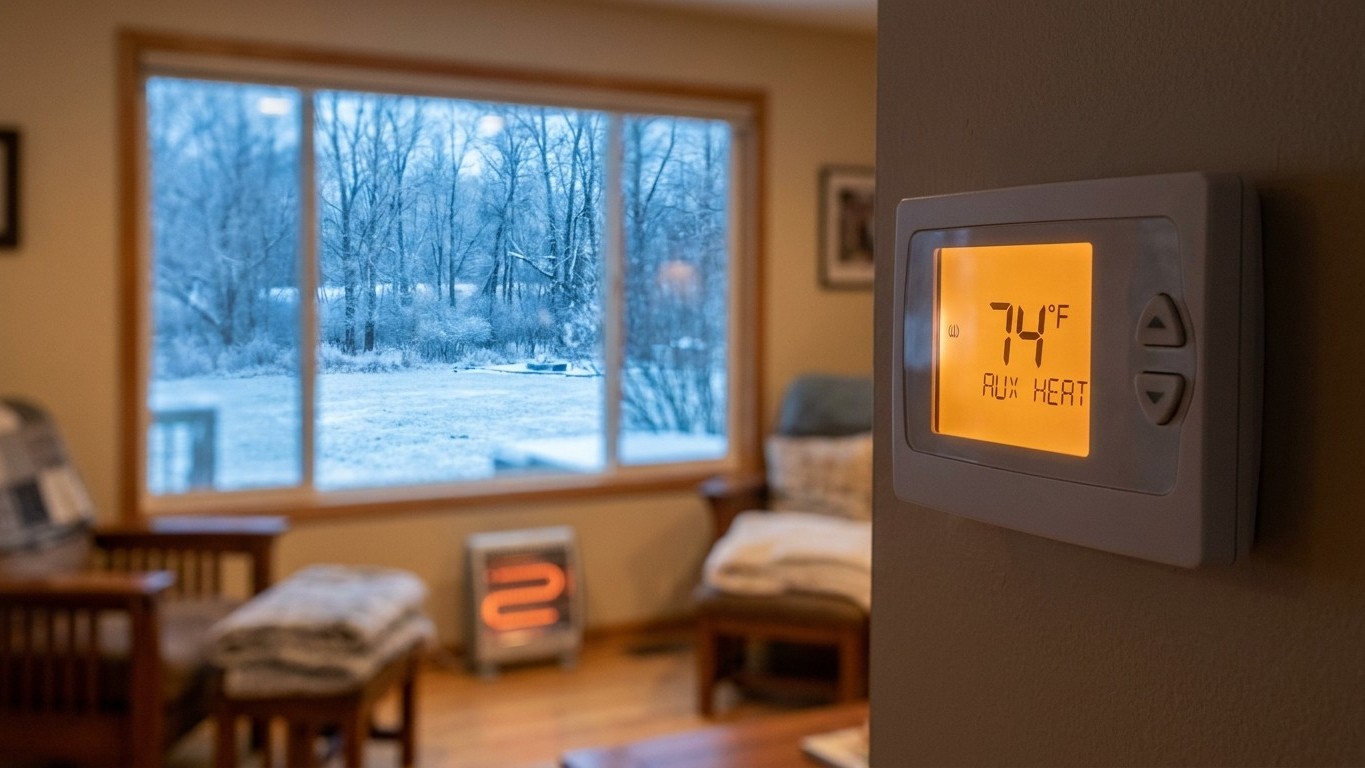

If your electric bill jumped in January and you have a heat pump, auxiliary heat is almost certainly the reason. It’s the backup electric resistance heating strip that kicks in when the outdoor unit alone can’t keep up with the cold, and it draws far more power than the compressor does on its own.
Auxiliary Heat and the January Bill
A heat pump moves heat from outside air into your house using a refrigerant cycle, the same basic principle as a refrigerator running in reverse. That process is efficient because it’s transferring existing heat rather than manufacturing it. Auxiliary heat works differently. It’s a set of electric resistance coils, similar to what’s inside a toaster or a space heater, that generate heat directly from electricity with no transfer trick involved.
The system leans on those coils in a few specific situations. Cold outdoor temperatures reduce how much heat the outdoor unit can pull from the air, so below a certain point the compressor alone can’t produce enough warmth to match what the house is losing. The thermostat calls for auxiliary heat to close that gap. It also fires during defrost cycles, when the outdoor coil ices over and the system briefly reverses to melt the frost, leaving the indoor air handler blowing cool air unless the aux strips step in to keep the vents from feeling chilly. And it kicks in during rapid temperature recovery, like when someone bumps the thermostat up several degrees at once and the system tries to catch up fast.
Here’s the part that actually explains the bill spike: electric resistance heat has nowhere near the output-per-dollar of a properly running heat pump compressor. Every hour those strips run costs measurably more than an hour of normal compressor operation. A January cold snap that keeps the system in auxiliary mode for hours at a stretch, night after night, adds up in a way that a mild November or a warm February simply doesn’t. That’s why the bill that arrives in early February, covering January’s usage, tends to be the one that makes homeowners call their utility company or their HVAC contractor asking what went wrong.
None of this means something is broken. A heat pump built for a moderate climate is designed to use auxiliary heat during genuine cold snaps. The question worth asking isn’t whether aux heat ran, it’s whether it ran more than the outdoor temperature actually required.
How to tell, in your own house
You don’t need a technician on day one. Work through these checks in order, because each one rules out a cheaper explanation before you move to the next.
- Check the thermostat display. Most heat pump thermostats show an indicator, often labeled “AUX,” “EM HEAT,” or “second stage,” whenever the backup coils are active. If that light is on constantly, even on days that aren’t especially cold, that’s your first real clue something’s off.
- Look at your thermostat habits. If someone in the house drops the temperature at night and cranks it back up in the morning, that swing forces the system into recovery mode, and recovery is one of the situations that triggers aux heat. The Department of Energy notes you can save as much as 10% a year on heating and cooling by turning the thermostat back 7-10°F for 8 hours a day. With a heat pump, though, a deep setback can backfire if the system responds to the wide gap by leaning on auxiliary heat to catch up quickly. A smaller, steadier setback, or a programmable thermostat built for heat pumps, gets you the saving without feeding the strips.
- Walk around outside and check the outdoor unit. A coil caked in ice or buried in snow forces more frequent defrost cycles, and every defrost cycle is an opportunity for aux heat to fire. Clearing snow and debris away from the unit costs nothing and takes ten minutes.
- Check the air filter. A clogged filter restricts airflow across the indoor coil, making the compressor work harder to hit the same temperature and pushing the system toward auxiliary backup sooner than it should need to. This is homeowner territory, and it’s the single most common fix behind a heat pump that “runs the strips too much.”
- Note how often the system seems to run auxiliary heat relative to the actual outdoor temperature. If the aux indicator lights up on a 40°F afternoon, not just during a hard freeze, that’s a sign the compressor itself isn’t performing the way it should.
That last point is where homeowner work ends. Diagnosing why a compressor underperforms, whether it’s low refrigerant charge, a failing sensor, a miscalibrated thermostat setting, or a control board issue, requires gauges, training, and in most states a refrigerant handling license. Opening the outdoor unit’s refrigerant lines yourself isn’t just risky, it’s illegal without EPA certification. Once the free checks are done and the aux light is still coming on too often, that’s the point to call a licensed HVAC technician rather than keep guessing.
What it costs you to ignore it
Leaving the problem alone doesn’t just mean a higher bill this one month. It sets up a pattern that repeats every cold snap for the rest of the season, because whatever is forcing the system into auxiliary mode, a dirty filter, an iced coil, a compressor that’s lost some of its capacity, doesn’t fix itself when the temperature climbs back up. It just goes quiet until the next freeze, then triggers the same expensive backup heat all over again.
There’s also a comfort cost that’s easy to miss. A heat pump leaning on auxiliary heat more than it should is often a heat pump that’s struggling to keep up generally, which shows up as longer run times, a harder time holding the set temperature on windy days, and vents that feel less consistently warm than they should. Homeowners sometimes respond by nudging the thermostat even higher, which only invites more auxiliary heat rather than solving the underlying issue.
Left unaddressed long enough, the same root causes, restricted airflow, ice buildup, a compressor working below capacity, tend to shorten the life of the equipment. A system that runs harder and longer to do the same job wears its components faster than one operating the way it was designed to. The January bill is the visible symptom. The mechanical strain building underneath it is the part that costs more down the road.