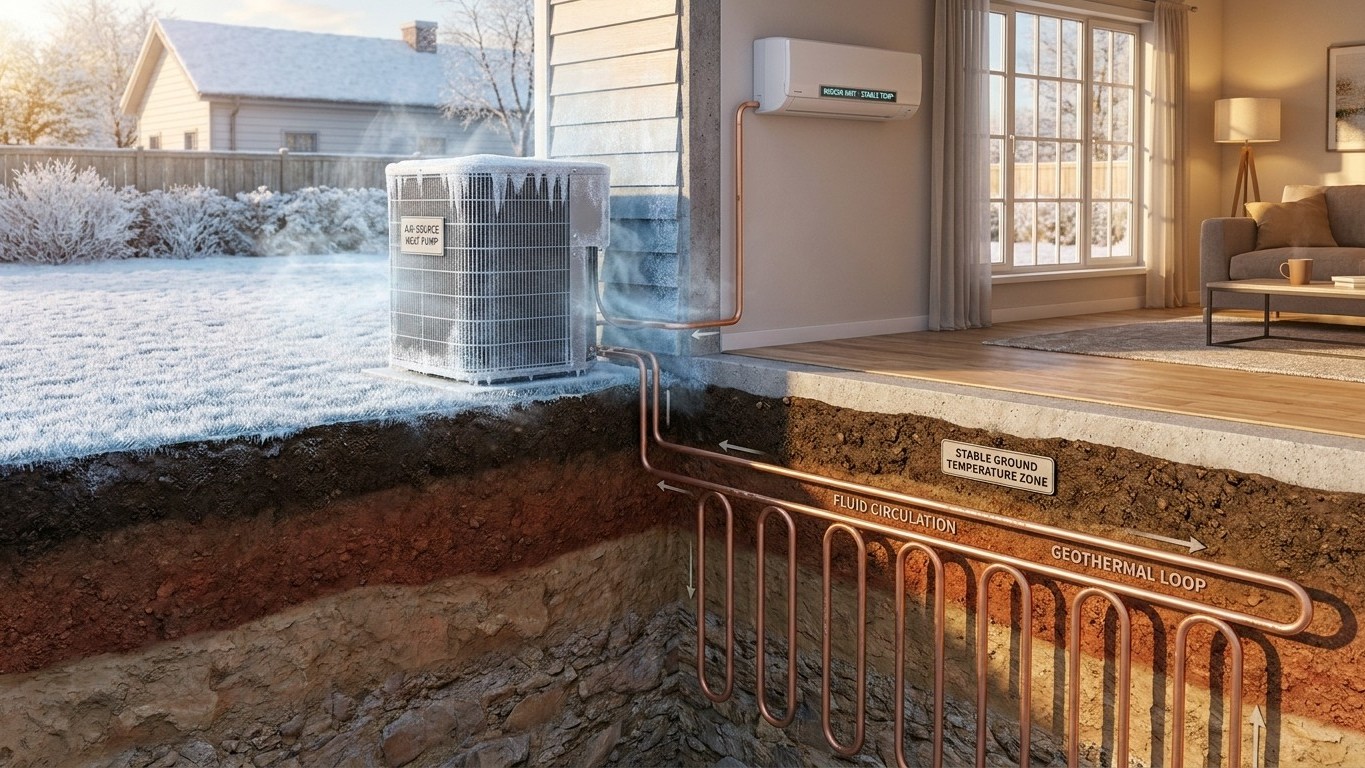

A geothermal heat pump, also called a ground-source heat pump, runs the same refrigerant cycle as the heat pump mounted outside a typical house. The difference is what it trades heat with. Instead of pulling from or dumping into outdoor air, it exchanges with the ground or with groundwater through a buried loop, a reservoir that holds a steadier temperature across the seasons than the air ever does.
The same machine, drawing on the ground

Anyone who has lived with an air-source heat pump already understands the basic trick: a refrigerant cycle moves heat from one place to another, and the compressor is what makes that possible in either direction. A ground-source system uses the identical indoor equipment and the identical cycle. What changes is the far end of the loop. Instead of a fan coil sitting in the yard exchanging heat with whatever the weather happens to be doing, a ground-source unit exchanges heat with pipes buried in soil or submerged in water.
That swap matters because of how differently the ground behaves compared to air. Air temperature swings by dozens of degrees between a January morning and a July afternoon. A few feet down, soil does not follow that swing. It lags behind the surface and flattens out, staying within a narrower band year-round once you’re past the depth where frost and surface heating reach. Groundwater is even steadier, since it sits at roughly the same temperature that persists locally underground regardless of the season above it.
The practical consequence is that a ground-source heat pump is always working against a smaller, steadier gap. On the coldest morning of the year, an air-source unit is drawing on air that has gotten scarce in usable heat. A ground-source unit, on the same morning, is still drawing on ground that hasn’t moved much from where it sat in October. On the hottest afternoon, the same logic runs in reverse: the ground is a cooler place to dump heat into than the superheated air above it.
None of this means the machine is a different animal. It’s still a compressor, a reversing valve, a refrigerant charge, and a set of coils. The specification sheet for the actual equipment, not a rule of thumb about ground versus air, is what tells you how it performs at any given condition, and this page isn’t going to substitute a number for that sheet. What can be said plainly is the mechanism: a steadier reservoir gives the machine a steadier job, whatever the outdoor thermometer happens to read that day.
The part that costs and complicates
The indoor unit in a ground-source system is, frankly, unremarkable. It looks and behaves like other central heat pump equipment, tucked into a mechanical room or basement. The complication, and the reason these systems are discussed separately at all, is entirely outside: the ground loop itself. That loop is a construction project, and which kind of loop a given property can have depends on land, water access, and geology more than on anything happening indoors.
There are three broad arrangements in use, and they ask very different things of a site.
| Arrangement | What it needs from the land or water | Disruption involved |
|---|---|---|
| Horizontal trench loop | A large open area of yard, since pipe is laid in shallow trenches across a wide footprint | Significant excavation across most of the usable yard; landscaping is disturbed for the length of the project |
| Vertical bore loop | A small footprint but access for drilling equipment, plus soil or rock suited to boring to depth | Drilling rigs on site, a narrower disturbed area, but heavier equipment access than a trench |
| Pond, lake, or open-loop groundwater system | A nearby body of water of adequate size and depth, or a well and aquifer capable of supplying and accepting water | Less excavation on the property itself, but dependent on water rights, permitting, and the water source actually being available and suitable |
A horizontal trench asks for room. If the property has the acreage and the yard can absorb a season of trenching, it’s often the most straightforward option to install, though the finished lawn or garden bears the visible cost of that work. A vertical bore trades yard space for depth, which suits smaller lots, but it depends on ground that can be drilled economically and on access for a drilling rig, which not every driveway or side yard can accommodate. A pond or open-loop system sidesteps most of the digging on the property itself, but it only exists as an option where a suitable body of water or aquifer is actually present and where local rules allow drawing from or discharging into it.
None of these arrangements is universally better. Each is a response to what a particular site has to offer, and the right one for a given house is a site-specific question that a qualified installer answers after looking at the land, not a default that applies everywhere.
What it changes for the occupant
Some of the differences a homeowner notices with a ground-source system are genuine, not marketing. There’s no outdoor condensing unit sitting against the house, so there’s no outdoor unit noise, and no fan cycling on and off within earshot of a bedroom window. There’s also no defrost cycle to notice, because there’s no outdoor coil exposed to humid air cold enough to frost over. An air-source heat pump periodically has to pause and briefly reverse to melt that frost off its outdoor coil; a ground-source system, exchanging with the ground instead, doesn’t accumulate frost there in the first place.
The other real difference is how performance holds up on the coldest days. Because the ground stays close to where it sat in fall, a ground-source system isn’t drawing against a reservoir that’s gotten progressively harder to extract heat from the way outdoor air does in a deep cold snap. That doesn’t mean a number can be attached to it here; how much that steadiness matters for a specific house is answered by that equipment’s own performance data, not by a general claim.
The counterweights are just as real. Installing a ground loop is a construction project, not a swap of one box for another, and it happens once. The loop itself is buried and effectively inaccessible for repair afterward, which is why the arrangement chosen and the workmanship of the installation matter more here than with equipment you can service or replace by opening a cabinet outdoors. And not every site suits every loop type, which is exactly why the site assessment described earlier comes before, not after, a decision.
How common heat pumps already are, regionally
Heat pump adoption generally varies enormously by state, which gives some sense of how differently regions have approached heating equipment overall. According to the U.S. Energy Information Administration’s 2020 Residential Energy Consumption Survey, Maryland households run 64% on a furnace and 19% on a central heat pump. In Washington, the split is 47% furnace and 9% central heat pump. In Maine, 46% of households use a furnace, another 31% use a steam or hot-water boiler, and the central heat pump figure for the state isn’t reported at all in that survey, which reflects a sample too small or an estimate too unreliable to publish rather than an actual zero. Ground-source systems sit inside those broader heat pump figures, and the regional pattern is a reminder that equipment choice is shaped as much by climate, housing stock, and local practice as by any single technology’s merits.
The questions that come before a quote
This brief carries no cost figures, and it isn’t going to manufacture a payback period or a price range that would only be a guess dressed up as a fact. The honest comparison with an air-source heat pump isn’t a number this page can supply either; it’s a question of what the site allows and what time horizon the homeowner is planning around, both of which are answered by an installer walking the property, not by a table on a website. What can be laid out is the sequence of questions worth having answered before any of that quoting happens.
- Which loop type does the site actually allow, given yard size, soil or rock conditions, and access for drilling or trenching equipment?
- Who is responsible for the ground works specifically, since loop installation and equipment installation are sometimes handled by different contractors or subcontractors?
- What happens to the yard or garden during and after the work, and is there a plan for restoring landscaping disturbed by trenching or drilling?
- What does the loop warranty actually cover, and for how long, given that the buried piping isn’t something that gets opened up for a routine repair later?
- Was a proper load calculation performed for the house, rather than a size assumed from square footage or from the previous system alone?
Answers to those five questions, from someone who has actually inspected the property, are worth more than any generic figure a page like this could offer instead.
Common questions
Does a ground-source heat pump need a backup heating system?
Whether backup heat is warranted depends on the specific equipment’s capacity and the house’s load, exactly the kind of question a load calculation and the unit’s own specification sheet are built to answer. This brief carries no threshold or capacity figure to apply as a rule.
Is the ground loop something that can leak or fail?
Buried piping is designed to be a long-term, sealed system precisely because it isn’t accessible for routine repair once installed, which is why loop warranty terms and installation quality are worth scrutinizing before the trenching starts, not after.
Can an existing yard or garden be reused after loop installation?
Horizontal loops disturb a wide area and vertical bores disturb a narrower one, but both involve restoration work afterward; whether the same landscaping can go back depends on how the installer plans and executes that restoration, which is a fair thing to ask about directly.
Is a pond or open-loop system available to every property?
No. It depends entirely on having a suitable body of water or aquifer nearby, along with the permitting and water rights that allow drawing from or discharging into it, so it’s an option for some sites and simply not present as a choice for others.