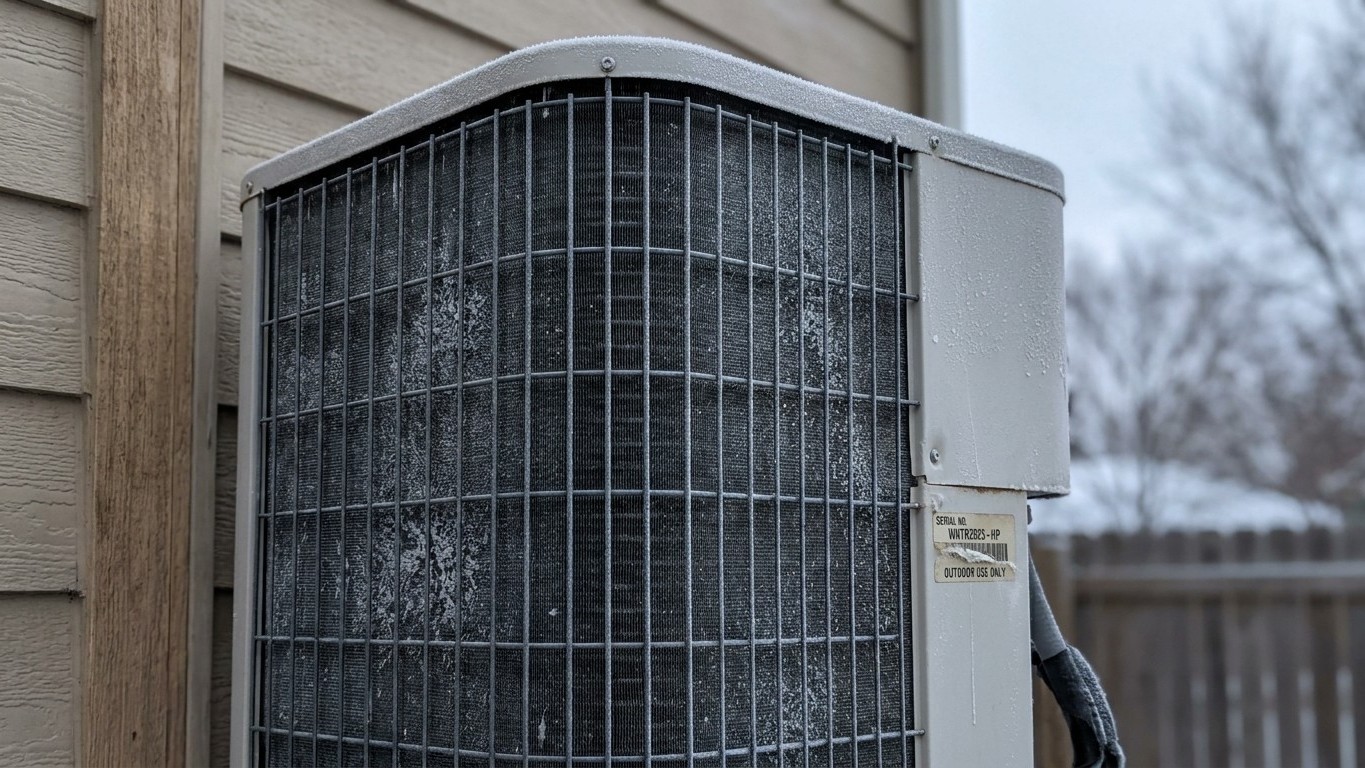

A layer of frost on the outdoor unit during winter is normal. It comes and goes as the system runs its own defrost cycle, usually clearing within an hour. What is not normal: ice that never melts, ice covering the whole cabinet, or ice building up at the base of the unit. Those point to a drainage problem, an airflow restriction, or a defrost control that has stopped doing its job, and they call for a service call rather than a chisel.
Frost is part of the job

A heat pump in heating mode works by pulling heat out of the outdoor air, even cold air, and moving it inside. To do that, the refrigerant running through the outdoor coil has to be colder than the air around it. That temperature difference is the whole trick. But it comes with a side effect: the outdoor coil is often below freezing, and the moisture riding in the outdoor air condenses on that cold metal and turns to frost, the same way a cold glass of water fogs up and drips on a humid day.
This is why the worst frost shows up on damp, hovering-near-freezing days rather than on the coldest, driest days of the year. Cold dry air holds little moisture, so there is less to condense. A raw, foggy 34-degree afternoon after rain or snow melt gives the coil far more to work with than a clear, bitter night. Homeowners who assume ice means “it’s really cold out” often have the physics backward.
The manufacturer built an answer into the machine. Periodically, the system reverses itself: it runs briefly like an air conditioner, sending hot refrigerant out to the coil to melt the frost off, while a backup heat source (electric resistance strips or a furnace, depending on the setup) covers the house so the indoor air doesn’t go cold during that switch. You may notice the outdoor fan stop, steam or vapor rising off the unit, or a brief change in sound. That’s the defrost cycle doing exactly what it’s supposed to do.
A cycle like this typically runs for a matter of minutes, then the system goes back to normal heating and the frost is gone until it builds up enough to trigger the next one. Depending on the model, this might happen a few times over the course of a cold, humid day, or barely at all during a dry cold snap. None of that is a malfunction. It’s a system managing a physical reality that comes with the way heat pumps move heat in the first place.
Telling the two apart
The hard part for most homeowners isn’t understanding that frost happens. It’s knowing when to stop watching and start worrying. The pattern of the ice, and where it sits on the unit, tells you almost everything.
| What you see | What it means | What to do |
|---|---|---|
| Light, even frost across the coil that disappears within a defrost cycle | Normal operation | Nothing. Let the system run its cycle. |
| A thick coating on the coil that never seems to clear, even after several cycles | The defrost cycle isn’t finishing the job, or isn’t triggering often enough | Have the defrost control and sensor checked |
| Ice encasing the entire outdoor cabinet, including the housing and panels | A serious defrost failure, often combined with restricted airflow | Shut down heating mode and call for service |
| Ice building up on the fan blades themselves | The fan may be struggling to turn, or water is dripping and refreezing directly on it | Do not run the unit; a frozen fan can strain or damage the motor |
| Ice building up at the base of the unit, around the feet or the ground beneath it | Meltwater from defrost cycles has nowhere to drain and is refreezing where it collects | Check and clear the base drain and surrounding grading; this rarely fixes itself |
Why the base ice matters most
Of everything on that list, ice at the base is the one homeowners tend to dismiss, and it’s the one most likely to snowball into real damage. Every defrost cycle produces meltwater. That water is supposed to drain away from the unit through a base pan and drain opening. If that path is blocked, by debris, by ice that formed there earlier, or by the unit sitting in a spot where water pools instead of running off, the meltwater has nowhere to go. It sits, refreezes, and the ice sheet at the base grows with every single defrost cycle instead of melting away after each one.
Left alone, that growing ice can eventually creep up into the cabinet, interfere with the fan, or refreeze parts of the drain system entirely, turning a small drainage annoyance into a unit that can’t shed water at all. It’s a slow problem, which is exactly why it gets missed until the ice is substantial.
What turns normal frost into a block of ice
Several distinct problems can turn ordinary, self-clearing frost into the kind of ice that just keeps building. They don’t all have the same fix, and they don’t all fall to the homeowner to solve.
- A blocked base drain. Leaves, dirt, or ice fragments clog the opening that’s supposed to let defrost meltwater escape, so it backs up and refreezes at the base instead.
- The unit sitting too low. If the outdoor unit sits directly on the ground, or lower than the surrounding grade, snow drifts and meltwater run toward it instead of away, and it ends up standing in slush that refreezes overnight.
- Gutters or a roof valley dripping onto it. A downspout or a roofline with no gutter that empties directly above the unit will feed it a steady drip of water all winter, regardless of how well the unit’s own drain works.
- Restricted airflow through or around the coil. Snow piled against the sides, shrubs grown in too close, or a coil caked with dirt and debris all block the airflow the coil depends on to shed heat efficiently and to defrost evenly.
- A defrost control that isn’t working. The sensor or timer that decides when to trigger a defrost cycle can fail, leaving the coil to frost over cycle after cycle with no reversal to clear it.
- A low refrigerant charge. Refrigerant that has leaked out lowers the coil temperature further than it should run, which encourages more frost to form and can throw off how well the defrost cycle clears it.
Airflow deserves particular attention because it’s the one item on this list a homeowner can genuinely stay ahead of. The U.S. ENERGY STAR program notes that “airflow problems can reduce your system’s efficiency by up to 15 percent,” and a coil that’s fighting snowdrifts, overgrown shrubs, or a summer’s worth of dust is not moving air the way it was designed to. Keeping a clear space around the unit and having the coil cleaned periodically is maintenance any homeowner can handle.
The base drain and grading around the unit are usually fixable too, sometimes as simply as clearing debris or having a technician adjust the unit’s footing so it doesn’t sit in standing water. A dripping gutter is a roofing fix, not an HVAC one, but it’s worth tracing if ice keeps forming in the same spot every year. A failed defrost control and a low refrigerant charge, on the other hand, are technician work. Diagnosing a bad sensor or finding a refrigerant leak requires gauges, electrical testing, and, for the refrigerant charge, EPA-certified handling, none of which a homeowner can safely do themselves.
What not to do about it
The instinct to speed things along is understandable, standing in the cold looking at a frozen unit. Resist it. A few common reactions do more harm than the ice itself.
Don’t chip or scrape ice off the coil. The fins are thin aluminum and the tubing behind them is thinner still; a screwdriver, ice scraper, or even a firm tap can puncture the coil or bend fins flat, and a punctured coil means a sealed refrigerant system repair, not a quick fix. Don’t pour hot water over the unit in freezing weather either. It seems logical, but the water that doesn’t immediately run off will refreeze within minutes in cold air, often making the ice problem worse and adding water intrusion into the cabinet and electrical components on top of it. And don’t run the system in cooling mode to try to melt the ice off unless the manufacturer’s documentation specifically says to do so. Cooling mode run in freezing outdoor temperatures can stress components that were never meant to operate that way, and it isn’t how the defrost cycle is designed to work.
What actually helps is simpler. Switch the Thermostat to emergency heat or backup heat, whatever the system provides, and let the outdoor unit alone. Given time and above-freezing temperatures, or its own defrost cycles, the ice will clear on its own far more safely than any manual intervention. While it’s shut down, clear away anything blocking the base drain or restricting airflow around the coil. If the same heavy ice comes back cycle after cycle rather than clearing, that’s the signal to call a technician and have the defrost control checked, rather than repeating the same workaround all winter.
One more thing worth knowing before an extended cold snap: cutting power to a heat pump for several days, say, to save energy while away, has a consequence most people don’t expect. Many units use a small crankcase heater to keep refrigerant from pooling as liquid in the compressor during cold weather, and that heater only works when the unit has power. If you do shut power off for an extended period in cold weather, restore it well before you plan to restart the system, giving the crankcase heater time to do its job before the compressor fires up again.
Common questions
Is it normal for a heat pump to run almost constantly in winter?
Yes. Unlike a furnace that cycles on and off to reach a set temperature, a heat pump often runs longer, steadier cycles in cold weather because it’s moving a smaller amount of heat at a time from cold outdoor air. Long runtimes on their own aren’t a sign of trouble.
Should I cover the outdoor unit in winter to keep ice off?
No. Covering the unit blocks the airflow the coil needs to operate and defrost properly, and can trap moisture against the cabinet. The unit is built to sit outside uncovered through winter.
Does ice on the unit mean it’s too cold outside for the heat pump to work?
Not necessarily. There’s no single temperature where a heat pump stops working; capacity gradually declines as outdoor air gets colder because there’s less heat in that air to move, and how much a given model’s output falls at a given temperature is specific to that equipment. The manufacturer’s own performance data is the place to check that, not the presence of frost.
How long should I wait before calling for service if ice doesn’t clear?
If frost clears within a defrost cycle or two, no action is needed. If the same thick ice is still there after multiple heating cycles, or keeps reappearing at the base of the unit day after day, that’s the point to call a technician rather than keep waiting it out.