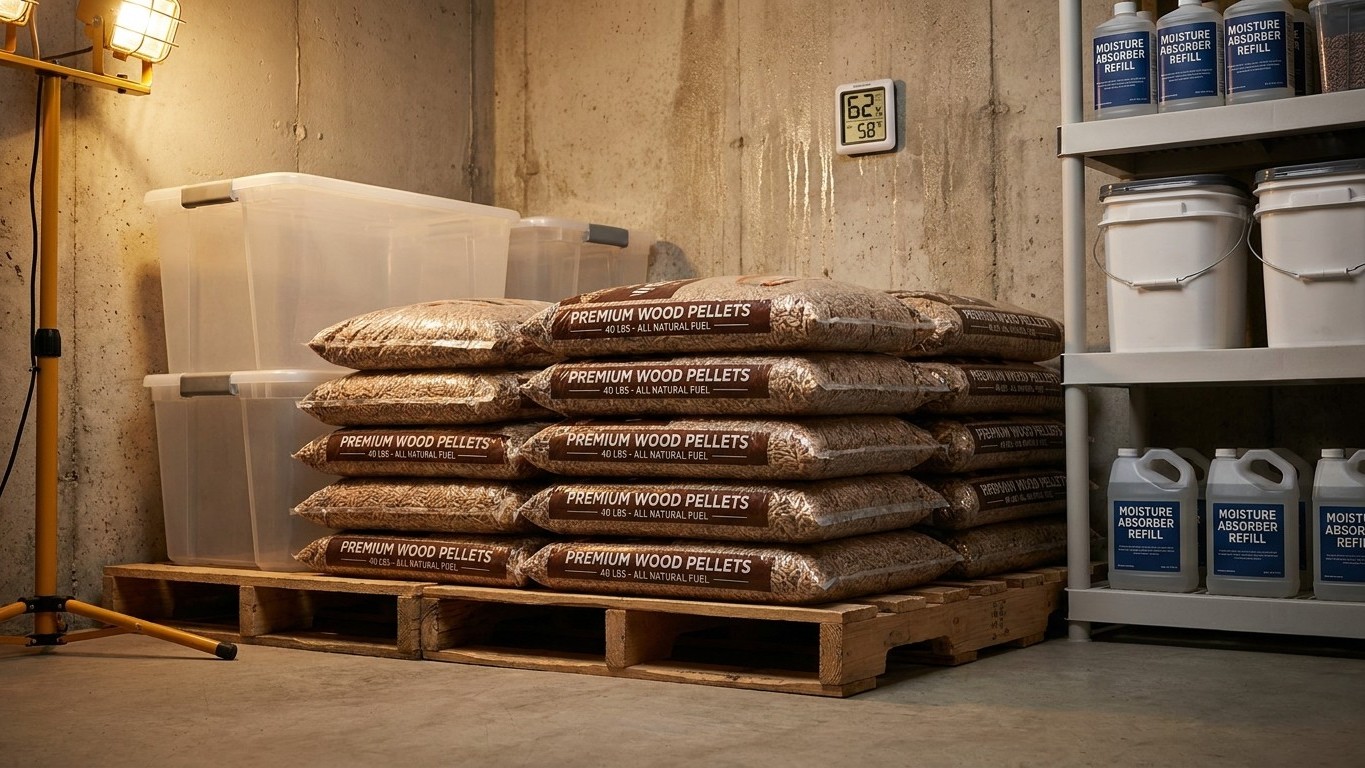

Pellets stay good through February the same way they leave the mill: bone dry, in bags that haven’t been torn or resealed, sitting off any surface that sweats. The stove itself won’t care if the pellets were bought in July or January, but it will choke on anything that’s absorbed moisture along the way. Get the storage spot right once, and you don’t think about it again until the bag’s empty.
Dry, or nothing else matters

Wood pellets are compressed sawdust, nothing more. There’s no glue holding them together, no binder, no coating. What holds a pellet in that tight little cylinder is pressure and the natural lignin in the wood fibers themselves. That’s a clever bit of engineering right up until water gets involved. A pellet that absorbs moisture swells, softens, and eventually falls apart into sawdust again, the exact material it started as before it went through the press.
That’s the whole failure mode, and it’s worth saying plainly because people assume the enemy is rain. Rain is the obvious threat, and a plastic bag handles it fine sitting under a porch roof or in a shed. The real enemy is quieter: condensation. A bag of pellets stored on a cold concrete floor, especially in a garage or basement that swings between temperatures, will sweat on the inside of that plastic just like a cold glass of water sweats on a summer table. The bag looks intact. The pellets underneath are absorbing moisture from the air trapped against that cold surface, and nobody notices until the stove starts jamming or the flame goes weak and smoky.
This is also where pellet quality starts to matter before the bag ever gets opened. The U.S. EPA notes that “pellets can differ significantly in how well they’re made and how well they burn. Lower quality pellets may provide less heat and create a fine dust. Higher quality pellets tend to burn cleaner and produce less ash.” A pellet that was inconsistently compressed to begin with has less structural margin. It doesn’t take much added moisture to push it from workable dust to unusable dust. That’s not a reason to panic over which bag you bought, but it is a reason to give every bag the same dry, ventilated, off-the-ground treatment rather than assuming a sturdier-looking pellet can tolerate a damp corner.
The practical test costs nothing: pick up a pellet from a bag you’re unsure about and squeeze it between two fingers. If it crumbles into powder without much pressure, moisture has already gotten in, whether or not the bag looks fine from the outside. That pellet won’t feed the hopper cleanly, and it won’t burn the way the appliance was designed to burn it.
Where they keep, and where they do not
The right storage spot isn’t complicated, but it does depend on details most people skip past: what’s under the pallet, what’s above it, and whether air can move around the stack. A few common spots work well, and a few common instincts don’t.
- Attached garage: works well if the pallet sits on a wood pallet base or rubber mat rather than directly on the slab, keeping the bags off the concrete where condensation forms. An unheated garage that stays cold and dry all winter is actually easier on pellets than a heated one that swings temperatures.
- Basement: fine as long as it’s a dry basement, not one prone to seasonal dampness or the occasional inch of water after heavy rain. Keep the stack away from any wall that shows moisture staining, and off the floor the same way as a garage.
- Shed: reliable if it’s built with some airflow, meaning it isn’t sealed tight like a plastic storage box. A shed with a gap under the door or vented eaves lets humidity escape rather than pool around the stack.
- Outdoor stack under cover: workable with a tarp or lean-to roof over the top, pallets underneath to lift the bags off the ground, and open sides so air moves through. Covering the top but sealing the sides traps humidity exactly like a bag on cold concrete does.
- Porch: good short-term option for a few bags kept handy, provided the porch roof actually blocks driving rain and the bags aren’t stacked against a masonry wall that stays cold and damp.
The pattern across every one of these is the same: elevation, airflow, and a roof that keeps rain off without turning the stack into a sealed box. A tarp pulled tight on all four sides defeats its own purpose. Air needs somewhere to go, or the moisture that’s naturally in the air condenses right back onto the pellets, cover or no cover.
Storage is a fire question too
Good storage isn’t only about keeping pellets dry. It’s about where that stack sits relative to the appliance burning them, and this is the part homeowners tend to treat as a convenience decision rather than a safety one. Stacking a few bags right beside the stove for easy reloading feels efficient in February when it’s fifteen degrees outside and nobody wants to make a trip to the garage. It’s also exactly the habit fire safety guidance warns against.
The U.S. Fire Administration puts it in plain terms: “Keep anything that can burn at least 3 feet from all heat sources including fireplaces, wood stoves, radiators, space heaters or candles.” A pallet of wood pellets is, by definition, anything that can burn, and a pellet stove is a heat source running for hours at a stretch. That three-foot clearance isn’t a suggestion aimed at furniture and curtains alone. It applies just as much to the bag of fuel sitting conveniently at arm’s reach.
There’s a mechanical reason storage location matters beyond the fuel pile itself. The EPA describes how these stoves actually work: “The pellets are poured into a hopper, which automatically feeds into the stove.” That hopper sits attached to or built into the stove, meaning the appliance already keeps a working supply close by. There’s rarely a real need to stack extra bags next to it, since the hopper is doing the job of holding what’s needed for the next several hours of burning. The rest of the season’s supply belongs in the garage, shed, or basement, not lined up along the wall behind the stove.
Annual maintenance ties back into this too. The USFA recommends homeowners “maintain heating equipment and chimneys by having them cleaned and inspected each year by a professional,” and the EPA echoes it specifically for pellet stoves, noting that owners “should have your stove professionally cleaned at least once a year.” A cluttered storage habit around the appliance makes that annual service harder to do properly, and it’s one more reason to keep the working stove area clear and the bulk fuel pile somewhere else entirely.
Common questions
Can pellets go bad if the bag is never opened?
Yes, if the bag itself gets compromised by moisture from underneath or from condensation forming inside the plastic. An unopened bag sitting on damp concrete or in a humid basement corner can still absorb enough moisture to soften the pellets, even though nobody ever broke the seal.
How do I know if my pellets are still good before loading the hopper?
Squeeze a pellet between two fingers. A good pellet holds its shape under moderate pressure. One that crumbles into fine powder easily has already picked up moisture and will likely burn poorly, producing more ash and less heat, consistent with the EPA’s note that lower quality or compromised pellets “provide less heat and create a fine dust.”
Does an unheated garage keep pellets fine all winter?
Generally yes, as long as the bags sit off the concrete floor on a pallet or mat and there’s some airflow around the stack. Cold air alone isn’t the problem; it’s contact with a cold, damp surface or a sealed environment that traps humidity against the plastic.
Why does my stove need electricity if it’s a wood-burning appliance?
Because a pellet stove isn’t a passive wood burner. The EPA explains that “pellet stoves need an electrical supply to work because they use motorized components to feed the fire and blow out hot air.” That’s also why the hopper can automatically feed pellets rather than requiring manual loading every hour, and why a power outage means the stove stops working even with a full hopper.