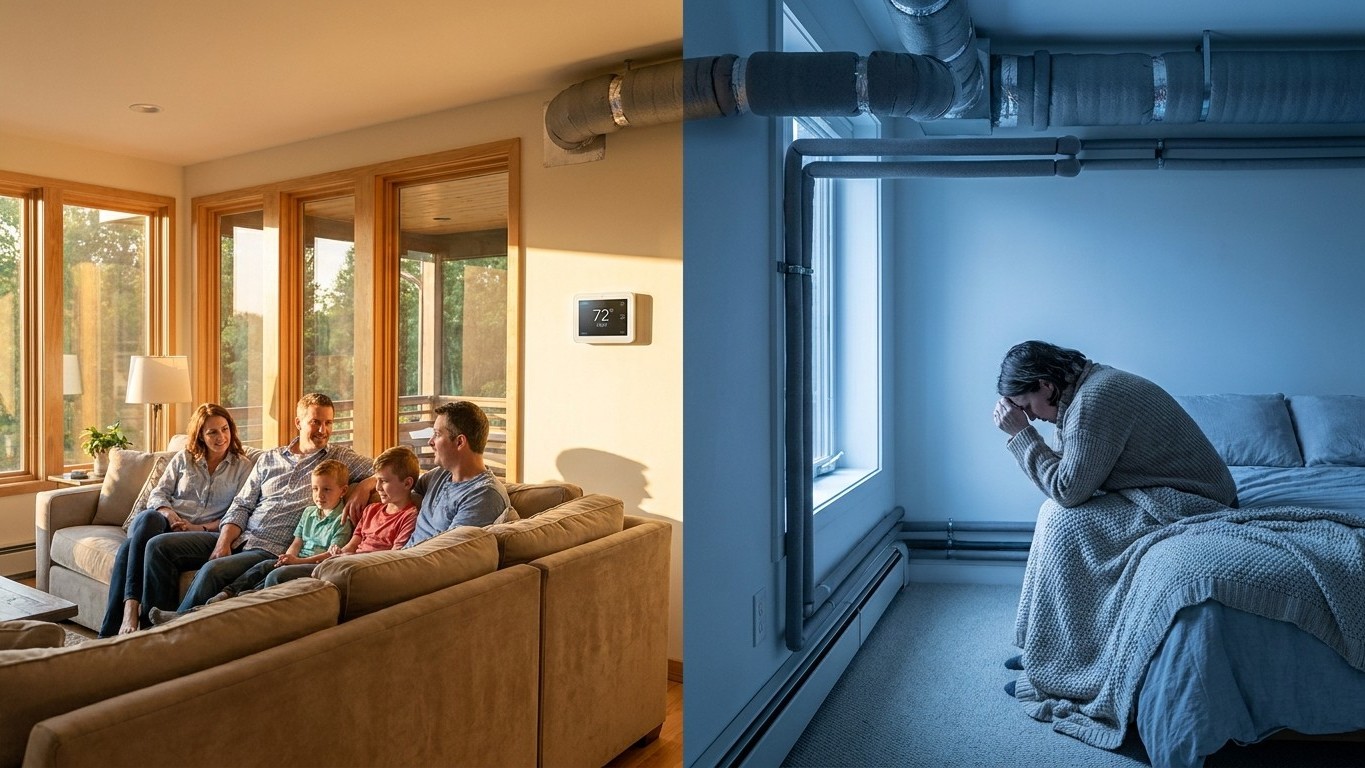

One room hot, another cold almost always means heat isn’t reaching every space at the same rate, not that your Thermostat or furnace is failing. The cause sits in how heat travels from the source to that room: through ductwork, through radiator piping, or through walls and windows that let it escape faster than it arrives.
One Room Hot, Another Cold
Heat doesn’t distribute itself evenly by default. It has to travel through a path, and every foot of that path is a chance for something to go wrong. In a forced-air system, that path is ductwork: long runs lose more heat before reaching the register, undersized ducts choke off airflow to rooms added after the original system was designed, and a closed damper hidden behind a wall register can starve a room without anyone knowing it’s there.
Hydronic systems, the kind that run hot water through radiators or baseboard units, have a different weak point. On a one-pipe loop, water flows from the boiler through each radiator in sequence, giving up heat as it goes. The radiator closest to the boiler gets the hottest water; the last one in line gets whatever heat is left over. That’s not a defect. It’s how the loop is built. Add a pocket of trapped air inside a radiator, which blocks water from filling the unit at all, and that room goes cold no matter what the Thermostat says.
A thermostatic radiator valve (TRV) that’s stuck closed or set too low creates the same effect on purpose, just in one specific room instead of at the end of a loop. And a single thermostat controlling the whole system only reads the temperature where it’s mounted, so if that’s in the warm room, the system shuts off before the cold room ever catches up.
Room-specific factors stack on top of all this. A room with a north-facing wall, a drafty older window, or an exterior corner loses heat faster than an interior room gets it, even when both are fed by the identical duct or radiator loop. Closed interior doors block the natural air mixing that would otherwise even things out between rooms. None of these causes are exotic. They’re mechanical, and they’re traceable, which is the useful part.
How to tell, in your own house
The fixes that cost nothing come first, because most uneven-temperature complaints get solved before anyone touches a tool. Work through these in order, and don’t skip ahead:
- Track the pattern. Is the cold room always cold, or only cold at certain times of day? A room that’s fine at noon and freezing at 7 p.m. points to sun exposure or an exterior wall, not the heating system itself.
- Check what’s blocking the room. Furniture in front of a register or radiator, a closed door, or a vent someone shut last summer and forgot about. This step alone resolves a surprising share of complaints.
- Feel for airflow or heat at the source. Hold your hand near the register or touch the radiator body (carefully, if it’s running hot). No airflow or a cold radiator that should be hot tells you the problem is upstream, not in the room.
- Bleed the radiator if it’s hydronic. A radiator that’s hot at the bottom and cold at the top has trapped air. Bleeding it with a radiator key is a five-minute homeowner job and often solves the problem outright.
- Check the thermostat’s location. If it’s in the warmest room in the house, it’s calling for less heat than the coldest room actually needs.
- Look for visible duct problems. In an accessible basement or attic, check for disconnected sections, crushed flex duct, or dampers set to the wrong position.
That’s where homeowner work ends. Balancing a multi-radiator hydronic system, which means adjusting lockshield valves so each radiator gets the right proportion of flow, requires draining and measuring the system in a way that’s easy to get wrong and hard to undo. Diagnosing duct leaks inside finished walls or floors, testing static pressure across the duct system, or evaluating whether the furnace or boiler itself is undersized for the square footage it’s serving all call for a heating technician with pressure gauges and airflow meters. Anything involving the boiler’s internal components, gas lines, or refrigerant on a heat pump system is off-limits without certification, both for safety and because miscalibrating those systems tends to make the imbalance worse, not better.
What it costs you to ignore it
An uneven system doesn’t sit still. It gets compensated for, and that compensation is where the cost shows up. A cold bedroom usually gets a space heater running for hours; a hot upstairs room gets a window cracked open in January. Both responses fight the very system you’re already paying to run, and both quietly cancel out the savings a well-run thermostat schedule is supposed to deliver.
That matters more than it sounds like, because the U.S. Department of Energy notes you can save as much as 10% a year on heating and cooling by simply turning your thermostat back 7-10°F for 8 hours a day from its normal setting. That strategy assumes the whole house responds evenly when the setback ends. If one room lags badly behind, the household ends up nudging the thermostat back up early, or running supplemental heat, to make that one space livable, which erodes the very savings the setback was supposed to produce.
The equipment pays a price too. A system fighting to satisfy the coldest room’s demand runs longer per cycle, which means more hours of wear on the blower motor, the circulator pump, or the burner. A radiator sitting with trapped air doesn’t just run cold, it also corrodes internally over time as the trapped air reacts with the metal, shortening the life of that unit. None of this shows up overnight. It shows up as a system that seems to need more attention, and more repair calls, than it did a few winters ago.