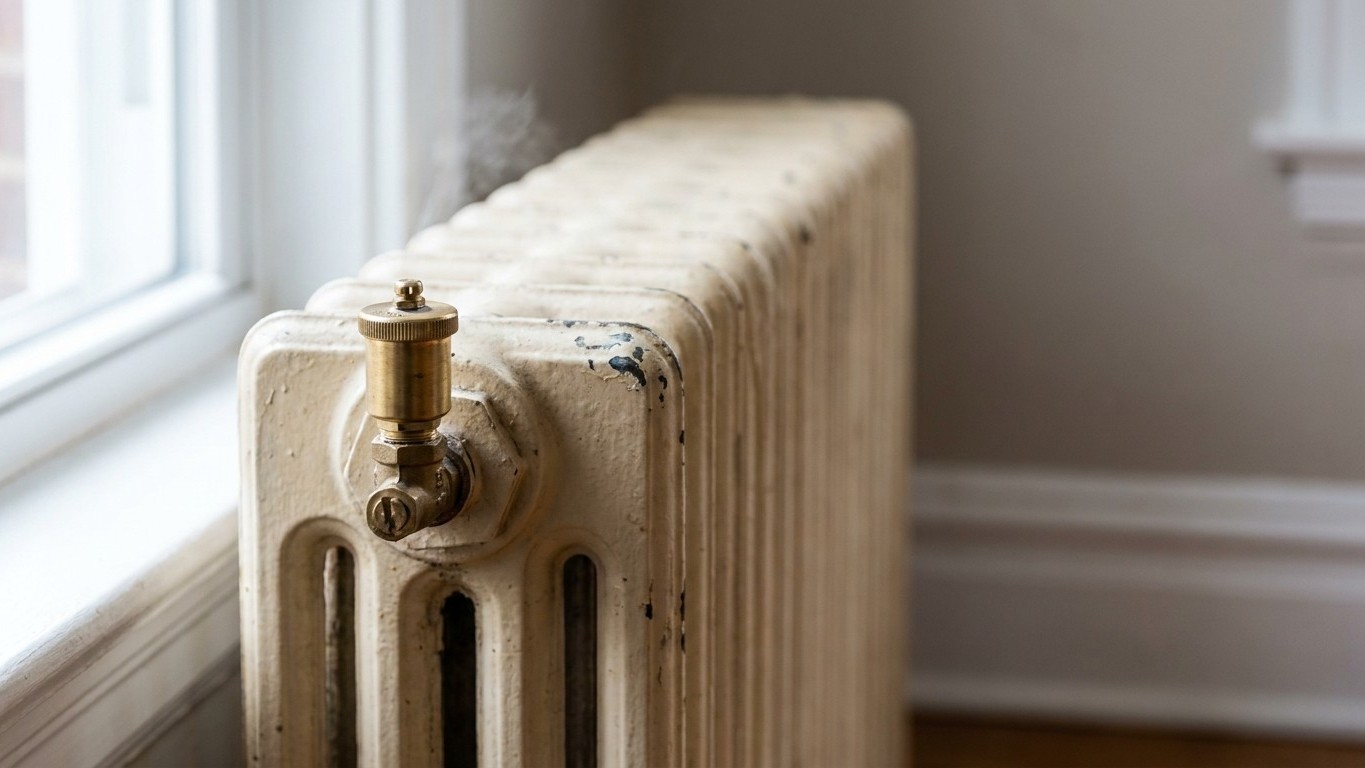

A hissing or whistling sound at a radiator almost always comes from the air vent, and in most cases it’s the system doing exactly what it’s supposed to do. The vent hisses while it pushes air out of the way so steam can move in. The problem starts when that hiss doesn’t stop, or when it comes back every cycle without ever quieting down. That’s the sign of a vent that isn’t closing.
This is a steam radiator’s noise
A radiator on its own doesn’t make heat. It’s the object a boiler pushes heat into, either as steam or as hot water, and that distinction matters here more than almost anywhere else in the house. The hissing sound described in most searches for “radiator hissing” belongs to one of those two families, and only one of them: steam. A hot-water radiator, heated by water circulating through a closed loop, has no air vent doing this job and no reason to hiss on its own. If a hot-water radiator in your house is making noise, it’s a different fault entirely, tied to trapped air in the loop or a pump issue, and it belongs on a different page in this guide, not this one.
On a steam system, the radiator fills with air between heating cycles. Before steam can enter and warm the metal, that air has to leave, and it leaves through a small brass or plastic device usually mounted on the side of the radiator, near the end farthest from where the supply pipe enters. That’s the air vent. Some are barely bigger than a thumb. Inside is a small chamber with a valve that responds to heat: cool, it stays open and lets air escape; hot, it closes and seals against the steam.
The hissing itself is just air being forced out through a narrow opening, the same physics as air escaping a tire valve, just slower and quieter in a working vent. It’s not a leak in the sense of losing water or steam long-term. It’s a valve doing its one job, over and over, at the start of every heating cycle.
What throws people off is the whistling variant. A whistle is the same air-release mechanism, just through an opening that’s slightly narrower or partly obstructed, which changes the pitch. Whistling and hissing are the same event described by two different ears. Neither one, on its own, tells you if the vent is working correctly or stuck open. That’s a separate question, and it depends entirely on timing.
When hissing is the system working
Here’s the test that actually answers the question, and it has nothing to do with volume or pitch. It’s about duration. A vent that’s doing its job hisses for a limited window at the start of a cycle, then goes silent as it seals against the arriving steam. A vent that’s failing hisses for the whole cycle, or close to it, because the internal valve never gets hot enough, or is mechanically stuck, to close.
Listen for exactly when the hiss starts and exactly when, if ever, it stops. A minute or two of hissing right as the radiator starts warming up is normal air purging. Continuous hissing that runs the length of the heating cycle, or that’s still going once the radiator is fully hot to the touch, means the vent isn’t sealing.
| What you hear | How long it lasts | What it means |
|---|---|---|
| Hiss at the very start of the cycle | A minute or two, then quiet | Normal air purge; vent is closing correctly |
| Hiss that continues after the radiator is hot | Ongoing, doesn’t stop | Vent isn’t sealing; steam is escaping past a valve that should be closed |
| Whistling instead of a plain hiss | Varies | Same air-release event, just through a narrower or partly obstructed opening |
| Sputtering or spitting sound, with visible moisture at the vent | Intermittent | Different fault: water reaching the vent, not just air, often tied to pitch or condensate |
That last row is worth separating out because it gets lumped in with hissing complaints and it isn’t the same problem. A vent that spits water, sometimes with a sputtering or gurgling sound layered under the hiss, is telling you that condensate (water formed as steam cools) is reaching the vent instead of draining back down the pipe the way it should. A vent that just hisses continuously, with no moisture, is a closing failure. Both point back to the vent, but the fix isn’t identical, and a vent that’s wet inside from condensate exposure may need replacing sooner than one that’s simply stuck from age.
The practical upshot: don’t judge a steam radiator by the fact that it hisses. Judge it by whether the hiss ever ends. A system that fills with steam, purges its air, and goes quiet is functioning as designed, even if the sound is loud enough to notice from another room.
What to do about a vent that will not close
A steam radiator has no bleed key and should never be opened the way a hot-water radiator is bled. That’s worth stating plainly before anything else here, because the instinct to “let some pressure out” with a wrench is a hot-water habit that doesn’t apply to a steam vent. Steam is not hot water, and none of the following should be attempted while the system is actively running or the radiator is hot.
- Let the system cool completely first. A vent that’s too hot to touch is not a vent you should be handling. Wait for a full cool-down between heating cycles before inspecting or removing anything.
- Check that the vent is upright, not painted over. This is genuinely common after a decorating job. A vent gets a coat of paint along with the rest of the radiator, and that paint seals the tiny opening the valve needs to release air through. A vent that looks fine from across the room can be completely blocked by a thin paint film nobody thought twice about at the time.
- Check the radiator’s pitch back toward the supply pipe. Steam radiators are meant to sit with a slight tilt, angled down toward the pipe, so condensate drains back instead of pooling. A radiator sitting flat, or tilted the wrong way, holds water against the vent from the inside, which is a common reason vents fail early or start spitting.
- Replace the vent if it’s stuck. Vents are inexpensive, self-contained parts that thread in and out without touching the rest of the system. If cleaning and checking pitch don’t resolve continuous hissing, a stuck valve inside the vent itself is the most likely remaining cause, and swapping the vent is the standard fix.
If your home has period-era paint and you’re dealing with an older radiator that’s never been stripped or repainted, have any paint tested for lead before scraping, sanding, or otherwise disturbing it. That’s a call for a qualified test, not a guess based on the age of the house.
Vents also decide which room heats first
There’s a part of steam heating that rarely gets explained, and it changes how you think about a radiator that’s always the last one warm. On a one-pipe steam system, where a single pipe both delivers steam and returns condensate to each radiator, the vent’s opening size on each radiator determines how quickly that radiator can purge its air and let steam in. A radiator with a fast-venting valve fills with steam quickly. One with a slower vent takes longer, every single cycle, regardless of how the boiler itself is performing.
That means the order in which rooms come up to Temperature isn’t random, and it isn’t necessarily about distance from the boiler either. It’s a venting question. A room that’s consistently the last to warm, cycle after cycle, often has a radiator with a smaller or slower vent relative to the others on the same system, not a boiler that’s underpowered or a pipe that’s undersized.
This is exactly why adjustable vents exist, ones that let you choose a faster or slower air-release rate on a given radiator. The idea is to even out the timing across a whole system: slow down the vents on radiators closest to the boiler so they don’t hog all the early steam, and speed up the vents on the ones farthest away so they’re not perpetually behind. Getting that balance right across a whole house is its own project, with its own logic about which radiator gets which setting, and it’s covered separately in the balancing guide for steam heating systems on this site.
None of that changes the diagnostic question this page set out to answer, though. Hissing that stops is a system clearing air the way it’s designed to. Hissing that doesn’t stop is a vent that needs attention, whether that means clearing paint, correcting pitch, or swapping the part outright.
Common questions
Is a hissing radiator dangerous?
A hissing air vent by itself isn’t a safety hazard; it’s air being released as designed. Continuous hissing wastes some energy and can be a nuisance, but it isn’t the same as a steam leak from a joint or valve, which would call for separate attention.
Why does my radiator whistle instead of hiss?
Whistling and hissing come from the same air-release process at the vent. A whistle usually just means the opening the air is passing through is slightly narrower or partly restricted, which raises the pitch of the sound.
Can I fix a hissing radiator myself?
Checking for paint over the vent and confirming the radiator’s pitch are both things a homeowner can do once the system has fully cooled. Replacing the vent itself is also a straightforward, self-contained repair. None of it should be attempted while the radiator is hot or the system is running.
Does hissing mean my heating bill is going up?
A vent that hisses briefly at the start of each cycle isn’t costing you anything unusual. A vent that hisses continuously and never seals is letting steam escape longer than it should each cycle, which does mean the boiler is working a bit harder than necessary to keep that radiator, and the room, at temperature.