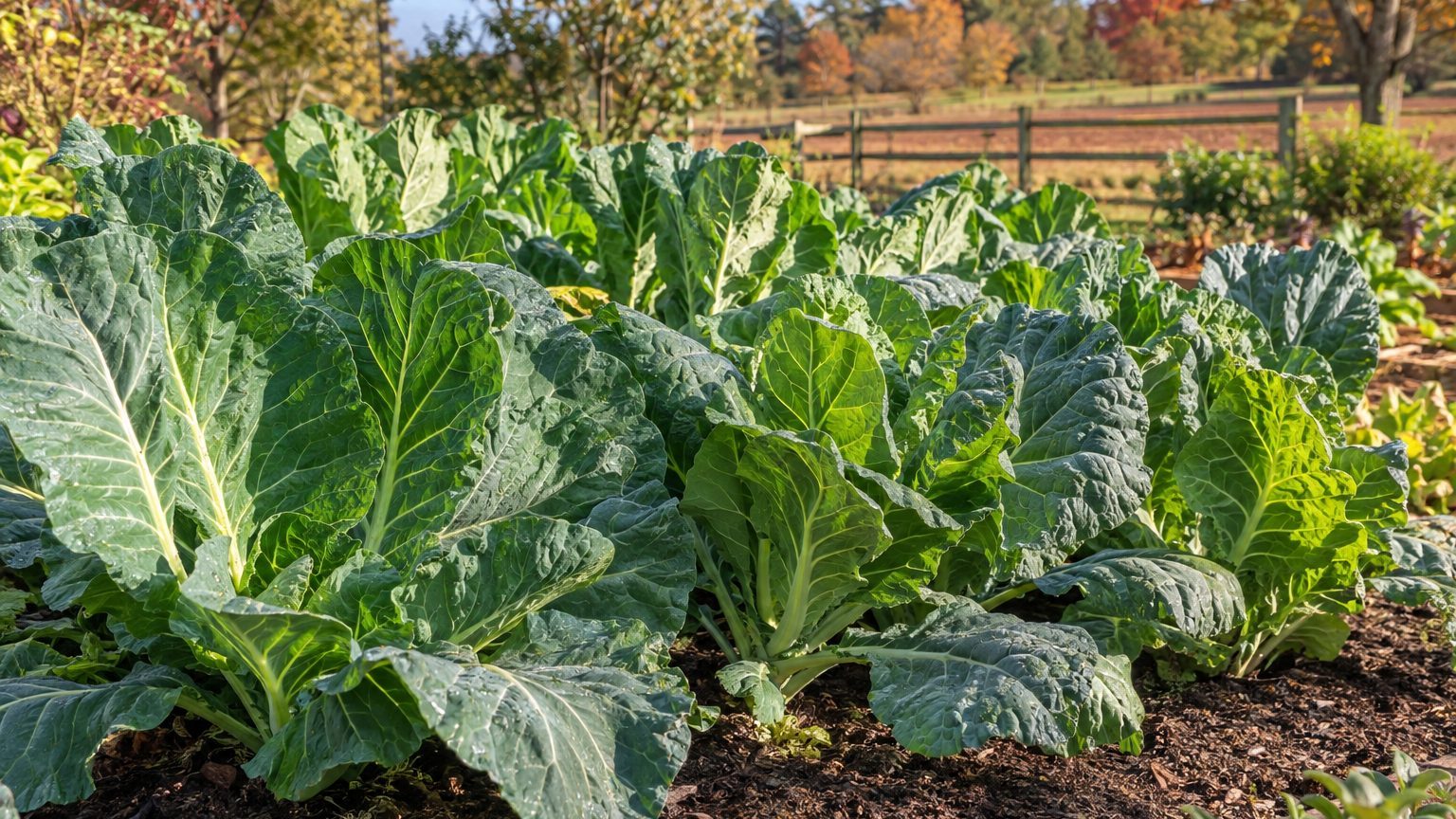

Florida’s growing conditions split so sharply from Jacksonville to Miami that there isn’t one “best” collard for the whole state. In the northern tier, cold-hardy, slower heading types thrive because winter is real and mild. In the central and southern peninsula, fast, heat-resistant loose-leaf types win because the growing season runs through winter and the enemy is summer heat, not frost.
The short answer for Florida
Start with where you sit on the map, because that decides the type, not the brand or the seed packet photo. In the Jacksonville area and the rest of the Panhandle-to-north-central corridor, winter still delivers a real freeze window, and the mean daily minimum of the coldest month sits at 42.9°F, cold enough that frost-tolerant, slower-maturing heading collards can sit in the ground through winter without rushing to bolt. That’s the region where the classic slow, cold-sweetened collard makes sense, because the plant gets weeks of cool weather to build sugar and size before spring heat arrives.
Move south into the central peninsula and the calculation flips. Frost becomes rare to nonexistent, and the growing calendar inverts: the main collard season runs through the cooler months of fall, winter, and early spring, while summer becomes the hard season to survive rather than the easy one. Here, the type to favor is a fast-growing, heat-tolerant loose-leaf collard that can be sown in shorter windows and harvested young, before humidity and heat push it toward flowering and bitterness.
In the deep south of the state, effectively frost-free for most winters, the same logic holds even more strongly. Growers there are choosing varieties bred for speed and heat resistance over the old-school slow headers, because there’s rarely a stretch of cold long enough to reward waiting. If you’re mapping this out for your own yard, the Growing Collards in Florida guide breaks down which growth habits (loose-leaf versus heading, quick versus slow) actually match each of these zones, and the When to Plant Collards in Florida calendar turns the type decision into actual sowing dates for your part of the state.
The short version: north means cold-hardy and patient, central and south mean fast and heat-tolerant. There isn’t a single statewide winner, and any list claiming one is skipping the part of Florida that doesn’t get frost at all.
What will not work here

The most common mistake in north Florida is planting a slow heading collard too late in the window. The region’s frost season runs from around November 26 to December 13 in fall through February 16 to March 7 in spring, and that gap is real but it isn’t endless. A variety that needs a long stretch of cool weather to head up properly needs to go in early enough to finish before spring heat rolls in fast, because Florida’s spring doesn’t linger the way it does farther north. Miss that window and you get a plant racing the thermometer instead of building flavor.
The second failure is applying north Florida’s frost dates to the rest of the state. Those dates come from a Jacksonville-area station, and three of the thirty years measured saw no freeze at all even there. Push that same calendar onto Orlando or Miami and it’s simply wrong, because central and south Florida run frost-free most winters and the growing calendar inverts completely. A gardener in Tampa following a Jacksonville frost date is planning around a freeze that, most years, never happens where they live.
Watering habits fail differently depending on where you are, too. In the humid central and south peninsula, packing plants close together to save space invites fungal disease in collard leaves almost immediately, since the moisture just sits in the canopy. Wider spacing and airflow matter more here than in a drier climate. Meanwhile, treating a Florida summer like a once-a-week watering chore is a losing bet almost everywhere in the state; heat and intermittent downpours followed by dry stretches stress shallow-rooted greens faster than a single weekly soak can fix.
None of these are exotic mistakes. They’re the predictable result of borrowing a calendar or a habit from a different climate and assuming Florida is one place. It isn’t, and the failures line up exactly where that assumption gets made.
What changes across Florida
Florida’s official hardiness range runs from zone 8b to 11b, and that spread is unusually wide for a single state, wider than most of the territories this kind of guide covers. That range isn’t a rounding error. It’s the difference between a real winter freeze event in the north and a climate in the far south where frost is close to a non-issue most years.
What that means practically is that a reader in the northern part of the state is gardening in conditions closer to inland Georgia, with a genuine dormant season and a defined frost-tolerant planting window, while a reader near the southern coast is gardening in something closer to a tropical winter garden calendar, where the growing challenge is heat management rather than cold protection. There is no single sowing date, no single “best” variety type, and no single frost date that covers both ends of that range honestly.
The USDA Plant Hardiness Zone Map, built on average annual extreme minimum temperatures, is the tool that actually separates those two worlds for a specific address, and it’s worth checking directly rather than guessing from a city name. Coastal effects, elevation (modest as it is in Florida), and even how close a property sits to a large body of water can shift the effective zone a notch in either direction. A gardener a few miles from the coast in the north can see milder winters than someone just inland at the same latitude.
This page can only speak to the range as a whole. It can’t tell an individual reader which zone their own yard falls into, and any guide that does that from a state-level view is guessing. The map exists precisely because that answer depends on the exact spot, not the state.
Where to check this for your own county
The state-level answer above is a starting point, not a finish line. Florida’s own agricultural extension service, reachable at https://sfyl.ifas.ufl.edu/, publishes county-level guidance that accounts for the differences a statewide page like this one can’t resolve on its own.
Two things are worth pulling up specifically once there. First, the local planting calendar for the county in question, since UF/IFAS county offices adjust sowing windows based on local frost history and soil conditions rather than a single statewide date. Second, the list of varieties actually trialled in that county’s demonstration gardens or extension test plots, because a variety that performs well in a Panhandle trial isn’t automatically the one recommended for a coastal south Florida county, and vice versa.
A county recommendation beats a state one every time there’s a conflict between them. This page is deliberately the state-level view, useful for understanding why north and south Florida diverge so much, but not a substitute for what a county agent has actually observed on local soil across multiple seasons. If the county office’s advice differs from anything written here, the county office wins, because their data comes from the actual ground a reader is planting into rather than a statewide average.
It’s also worth calling the office directly rather than relying only on the website, particularly for smaller or rural counties where published calendars may lag behind current-season conditions. Extension agents track things like unusual freeze events or drought stress in real time, information a static webpage can’t always reflect.
Checking this against your own garden
Every date and figure on this page is a probability built from decades of averages, and a reader’s own yard will occasionally disagree with it. Three direct observations outrank any calendar.
First, feel the soil itself rather than trusting the calendar date. Push a finger a couple of inches down; if it feels cold and damp rather than merely cool, the ground hasn’t warmed enough yet regardless of what the date says, and seed sown into it will sit and sulk instead of germinating on schedule.
Second, watch for the first flush of flower buds forming at the center of the plant, sometimes called bolting. That’s the plant telling a gardener the cool window has closed, whether or not the calendar agreed it should have. Once that shows up, remaining leaves get tougher and more bitter fast, so it’s the signal to harvest what’s left rather than wait.
Third, track how quickly seedlings push out their first true leaves after the initial sprout. A fast emergence suggests the microclimate in that particular bed runs warmer than the county average, useful information for adjusting the next planting a few days earlier or later than the general guidance suggests. A slow, stalled emergence suggests the opposite, a colder pocket than expected, maybe from shade, wind exposure, or low ground that holds cold air.
None of these require anything beyond a hand and a bit of attention over a few days. They’re also the only signals that reflect the specific soil, drainage, and microclimate of one particular yard, which is more than any statewide average, including this one, can promise.