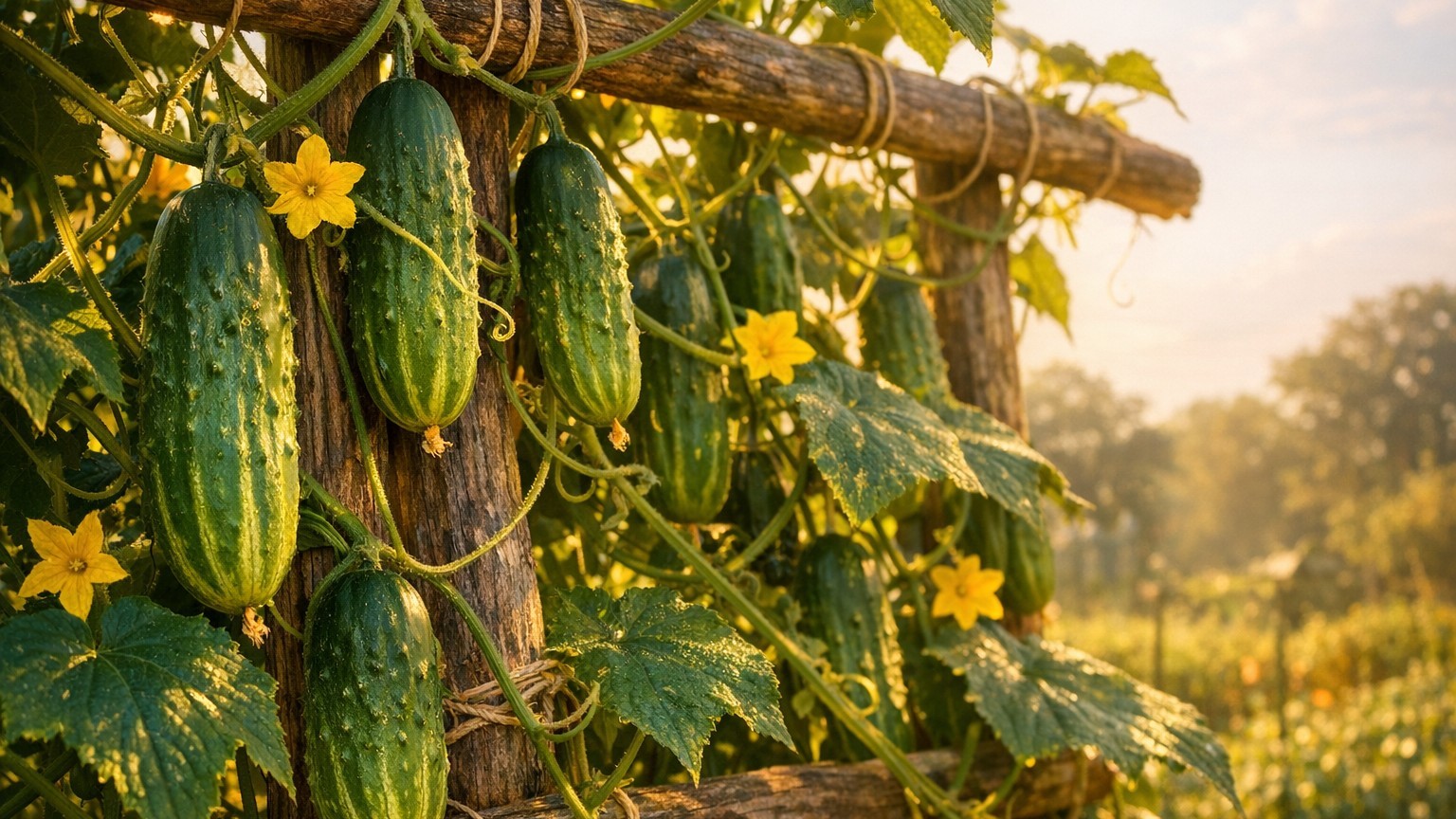

For most of Florida, the right cucumber choice isn’t a brand name, it’s a type: fast-maturing pickling and bush varieties for short windows between heat waves, and parthenocarpic or burpless types trained on a trellis where humidity turns any sprawling vine into a fungus magnet. Which type wins depends on where in the state the garden sits.
The short answer for Florida
Florida doesn’t run on one clock. North Florida, tracked here through the Jacksonville reference station, still gets a real frost: the last spring freeze falls between February 16 and March 7, and the first fall freeze arrives November 26 to December 13. That leaves a frost-free stretch of roughly eight and a half months, which sounds generous until you look at what happens inside it. The same station logs 73.2 days a year at 90F or hotter. Cucumbers stop setting fruit reliably once nighttime temperatures stay warm and daytime highs sit in that range for weeks running, so the real cucumber season in north Florida is spring into early summer, and again in early fall, not the whole frost-free window.
Central and south Florida don’t fit that pattern at all. Those regions are effectively frost-free, and the growing calendar flips: the workable cucumber season runs through the cooler months, fall through winter into spring, and summer becomes the season to avoid, not the season to plant into. A north Florida frost date is meaningless there.
Given that heat load, the decision by type looks like this. Bush cucumbers suit small beds and containers and mature fast enough to get a harvest in before a heat spike shuts fruiting down. Pickling types share that speed advantage and reward multiple quick pickings rather than one long vine tended for months. Slicing types can work but need a trellis, not open ground, because vertical growth pulls foliage up into moving air, which matters once humidity turns fungal disease into the bigger threat than heat itself. Parthenocarpic varieties, which set fruit without needing pollinators to visit every flower, are worth asking about specifically because Florida’s cucumber beetle pressure can also carry bacterial wilt, and fewer open flowers relying on beetle visits means somewhat less exposure.
None of that points to a single cultivar name, because variety performance shifts by county, seed lot, and even by season. What the state-level numbers do settle is the type: short-cycle, trellis-trained, and chosen with disease pressure in mind rather than chosen for size or novelty. The county-level names come later, from a source built for that job.
What will not work here

Long-season cucumber types built for cooler climates are the first casualty. Anything bred to mature slowly over a long, mild summer runs straight into north Florida’s 73.2 days above 90F. Fruit set falters, vines stall, and by the time a slow variety would normally be hitting its stride the plant is fighting heat stress instead of producing. In central and south Florida the same types fail for a different reason: there is no long mild summer to grow into, only a hot wet season that punishes anything still in the ground come June.
Weekly watering schedules are the second failure point, and the rainfall numbers explain why. Summer rain across June, July, and August averages about 21.2 inches at the Jacksonville reference station, with July, the driest of the three months, still delivering 6.77 inches. That sounds like plenty of water arriving on its own, but Florida’s sandy soils drain fast, and heat above 90F pulls moisture out of that top layer within a day. A single big rain event doesn’t average out into steady soil moisture; it’s a soak followed by a quick dry-down. A cucumber bed watered on a fixed weekly schedule will sit either waterlogged right after a thunderstorm or bone dry three days later, and both extremes stress the plant into dropping blossoms.
Close spacing on bare ground is the third problem, and it’s a humidity issue specifically. With that much summer rainfall landing on soil that’s also holding heat, foliage that stays wet and shaded near the ground turns into a breeding ground for powdery mildew and downy mildew almost immediately. Vines sprawled tight together compound it by blocking airflow between plants. The fix isn’t less water, it’s more space and more height: raised beds, trellising, and spacing generous enough that leaves dry out between rain events instead of staying damp for days.
Finally, planting by a generic “frost-free means grow” assumption fails outside north Florida specifically. In the frost-free south and central regions, treating summer as prime growing time, because there’s technically no freeze risk, ignores that summer there is the hardest season for cucumbers, not the easiest.
What changes across Florida
The USDA Plant Hardiness Zone Map puts Florida somewhere between zone 8b and zone 11b, which is one of the widest spans of any state in the country. That range is built on a single measurement, the average annual extreme minimum temperature, and the gap between 8b and 11b is enormous: it’s the difference between a garden that sees a hard freeze most winters and one that essentially never does.
That spread means there’s no single planting answer for “Florida.” A garden tracking closer to the 8b-9a end, in the north, works on the frost calendar described above: real winter dormancy, a spring planting push after the last freeze window closes, and a second short window in early fall before the first freeze. A garden near the 10b-11b end, further south, skips that structure almost entirely. Winter there is the mild season and often the best cucumber-growing stretch of the year, while summer brings the heat and rain load that shuts things down.
Elevation and distance from the coast add another layer inside those zone bands, since a few miles inland or a slightly higher piece of ground can shift frost risk and drainage even within the same county. None of that can be resolved from a state-level page, and it shouldn’t be guessed at from here either. The zone map itself, not a paragraph describing it, is the tool for pinning down where a specific piece of ground falls, and a gardener reading this should check the map directly rather than assume their county matches either end of the 8b-11b range described above.
Where to check this for your own county
UF/IFAS Extension runs the county-level guidance for Florida, and it’s reached through sfyl.ifas.ufl.edu. That site routes to the local county extension office, and the county office is where the state-level picture in this article gets replaced with something specific to one piece of ground.
Two things are worth pulling from that county office directly. The first is the local planting calendar. Because Florida spans that 8b-11b range and because the frost dates cited earlier only apply cleanly to the north Florida station they were measured at, a county calendar built for, say, a Panhandle county or a Miami-Dade county will diverge sharply from each other and from this page. The county calendar accounts for local frost risk, local rainfall patterns, and the length of the actual growing window in a way a statewide article can’t.
The second is the list of varieties trialled in that county specifically. Extension offices run or track variety trials suited to local disease pressure, particularly the fungal and bacterial issues that Florida’s rainfall and heat combination tends to favor, and those trial results are where an actual cultivar name should come from, not from a general state-level guide. A variety that performs well in a drier, cooler part of the state can underperform badly somewhere with heavier summer rain, and the reverse is just as true.
A county recommendation beats a state recommendation every time, because the county office is working from soil, rainfall, and pest data specific to that ground. This page is the state-level starting point, useful for understanding the type of cucumber and the general seasonal logic, but the county extension office is the next and more accurate step.
Checking this against your own garden
Dates and averages describe a typical year, not this year, and a garden’s own signals settle the question faster than any calendar can. Three things are worth watching directly.
Soil warmth by feel comes first. Cucumbers germinate poorly in cold soil regardless of what the calendar says, so pressing a hand into the top few inches of bed before planting tells more than a date on a page. Soil that still feels cool and damp deep into what should be the planting window is a sign that a particular spot, maybe a shaded corner or low-lying ground, is running behind the rest of the yard.
The first flush of male flowers is the second signal. Cucumbers typically produce male blooms before female ones, and a steady run of male flowers with no females following within a week or two usually points to heat stress or uneven watering rather than a timing problem. That’s a cue to check the watering pattern against the rainfall reality described earlier, not to assume the plant is simply slow.
The first true leaves, the ones that follow the initial pair of seed leaves and actually look like miniature cucumber foliage, mark the point where the plant has moved past the most fragile stage. Slow, pale, or stalled true-leaf growth in a bed that’s otherwise been watered and warmed correctly usually means the local microclimate, wind exposure, drainage, or shade pattern, is different from what a state-level average assumes. That’s the garden telling the gardener something a frost date never could.