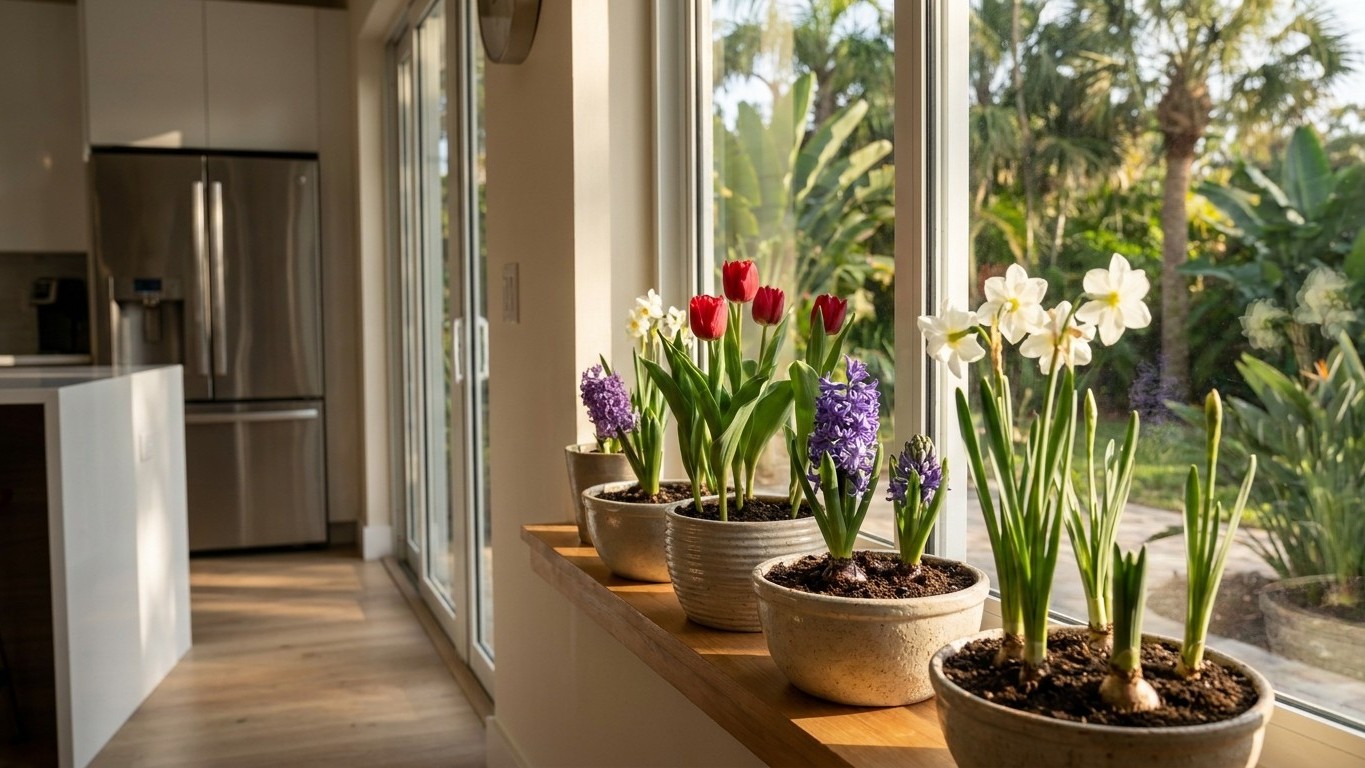

Forcing spring bulbs indoors works in Florida, but not the way it works in Vermont or Minnesota. The state’s mild winters rarely deliver the sustained chill that tulips, hyacinths, and daffodils need to set a flower bud, so gardeners here substitute a refrigerator or an unheated garage for the cold snap nature skips. Done right, forcing turns a bag of imported bulbs into a windowsill bloom in a matter of weeks, no ground planting required.
Why this matters in Florida

The number that decides everything here is 42.9°F. That’s the mean daily minimum temperature for the coldest month, measured at the Jacksonville reference station and reported in the NOAA NCEI Climate Normals for 1991-2020. It’s not a record low and it’s not a monthly average temperature; it’s what the thermometer reads, on average, in the coldest hours of the coldest month. A spring bulb like a tulip or a hyacinth needs roughly twelve to fourteen weeks of temperatures under 45°F to complete the internal chemistry that turns a green shoot into a flower. At 42.9°F for a single monthly minimum, and warmer than that most other months, Florida simply doesn’t stack up enough cold hours in the ground or in open air to get most spring bulbs to bloom on their own.
That puts this territory squarely in the forcing camp, not the container-freeze camp. In colder states, the risk with a potted bulb is the opposite problem: a pot sitting above ground has no insulating soil mass around it, so it freezes solid, roots and all, at a temperature the same bulb would shrug off in a garden bed. That’s why a container often needs a hardiness zone two steps milder than what the tag recommends for in-ground planting. Florida’s USDA hardiness zone range runs from 8b up to 11b, using the USDA Plant Hardiness Zone Map’s 1991-2020 normals, which is one of the widest single-state ranges in the country. That range matters for exactly one reason here: the northern edge of it, around Jacksonville’s 8b designation, can still see a hard freeze in an unusually cold winter, which means a container left outside on a porch in that part of the state needs to come indoors or get mulched during a freeze warning. Everywhere else in the range, the practical problem isn’t protecting a pot from freezing. It’s supplying cold that the calendar won’t provide.
So the forcing question in Florida isn’t really about surviving winter. It’s about manufacturing a winter the bulb never gets outside.
How to do it here
The sequence below assumes you’re starting with dormant, dry bulbs, either fresh from a supplier that ships already-chilled stock or bulbs you’re chilling yourself at home. Follow it in order.
- Choose a cold source you can monitor. An unheated garage works if it stays reliably above freezing but below 45°F through the winter months; check it with a thermometer rather than guessing, since an attached garage near a heated wall can run warmer than expected.
- Or use a refrigerator drawer, kept separate from fruit. Apples, pears, and other ripening produce release ethylene gas, and ethylene will damage or kill the flower bud forming inside a chilling bulb. Dedicate a drawer, or at minimum a sealed paper bag, away from the produce bin.
- Pot the bulbs before chilling, not after. Set them in a container with drainage holes, tips up, in ordinary potting mix, watered once at planting. Chilling them loose in a bag and potting afterward works for some species but adds a step most home growers skip without harm.
- Hold the cold for twelve to fourteen weeks. Mark a calendar. This is the step gardeners in mild climates most often shortchange, because nothing outside is telling them winter is over.
- Check the container’s exposure if it ever sits outside during that window. In the northern part of the state, where an occasional freeze does occur, a pot left outdoors overnight during a freeze warning needs to move to a garage or get wrapped, since the small soil volume in a container offers little insulation compared to a garden bed.
- Move the pot to a bright, cool room once shoots appear. Around 60°F is a reasonable target. Rushing straight to a warm, sunny window at this stage is the single most common mistake.
- Shift to full light and warmer room temperature once buds show color. Bloom typically follows within one to two weeks from there.
Which bulbs are worth it
Not every bulb pays back the effort of chilling it artificially. Species with a short cold requirement force faster and tolerate Florida’s warm ambient temperatures once bloom starts. Species bred for tall garden display often produce a stem that can’t support itself in a lightweight pot, flopping over just as the flower opens. And for any bulb that was never going to survive Florida’s ground and come back next year anyway, forcing it once and composting it afterward costs nothing extra. It was a one-season purchase either way.
Bulbs that force reliably here
- Paperwhite narcissus: needs no cold period at all, making it the easiest starting point.
- Amaryllis: also skips the chilling requirement entirely and blooms on a compact, sturdy stem.
- Grape hyacinth (muscari): short chill requirement and a low, stable habit that suits small pots.
- Crocus: chills relatively fast and stays low enough not to topple.
- Hyacinth: needs the full twelve to fourteen weeks but rewards the wait with a dense, fragrant bloom on a manageable stem.
Bulbs that sulk
- Tall single-late and Darwin hybrid tulips: long chill requirement and a stem that leans in anything less than a heavy, wide pot.
- Large trumpet daffodils: same combination of extended chill time and top-heavy growth that a lightweight container can’t support.
- Fritillaria: demanding chill window and finicky about disturbance, more trouble than the payoff justifies for a first attempt.
What goes wrong, and when you can still fix it
Leaves but no flower
The plant put up green growth and stopped there. This means the cold period ran short, usually because the chilling window was interrupted or cut before the full twelve to fourteen weeks. There’s no fixing this season’s bulb; the bud never formed. The bulb itself may still be usable next winter if you give it a complete, uninterrupted chill cycle from the start.
A flower buried in the leaves, on a stem too short to see
This is a warming problem, not a cold problem. The pot moved from the cold source to a bright, warm window too fast, before the stem had a chance to elongate at cool temperatures. This season’s bloom will open low and stay short; there’s no way to stretch a stem after the fact. Next time, hold the cool, low-light stage longer once shoots appear, before moving to full sun and room warmth.
Soft, rotted bulb tissue in the pot
Rot means water never drained away from the bulb. This is unrecoverable for that bulb; discard it rather than trying to dry it out and replant. The pot itself is usually fine to reuse once cleaned, but check that its drainage holes are clear and consider a coarser potting mix for the next batch.
Related guides
- Growing Spring Bulbs in Containers in Florida
- Forcing Spring Bulbs Indoors in Georgia