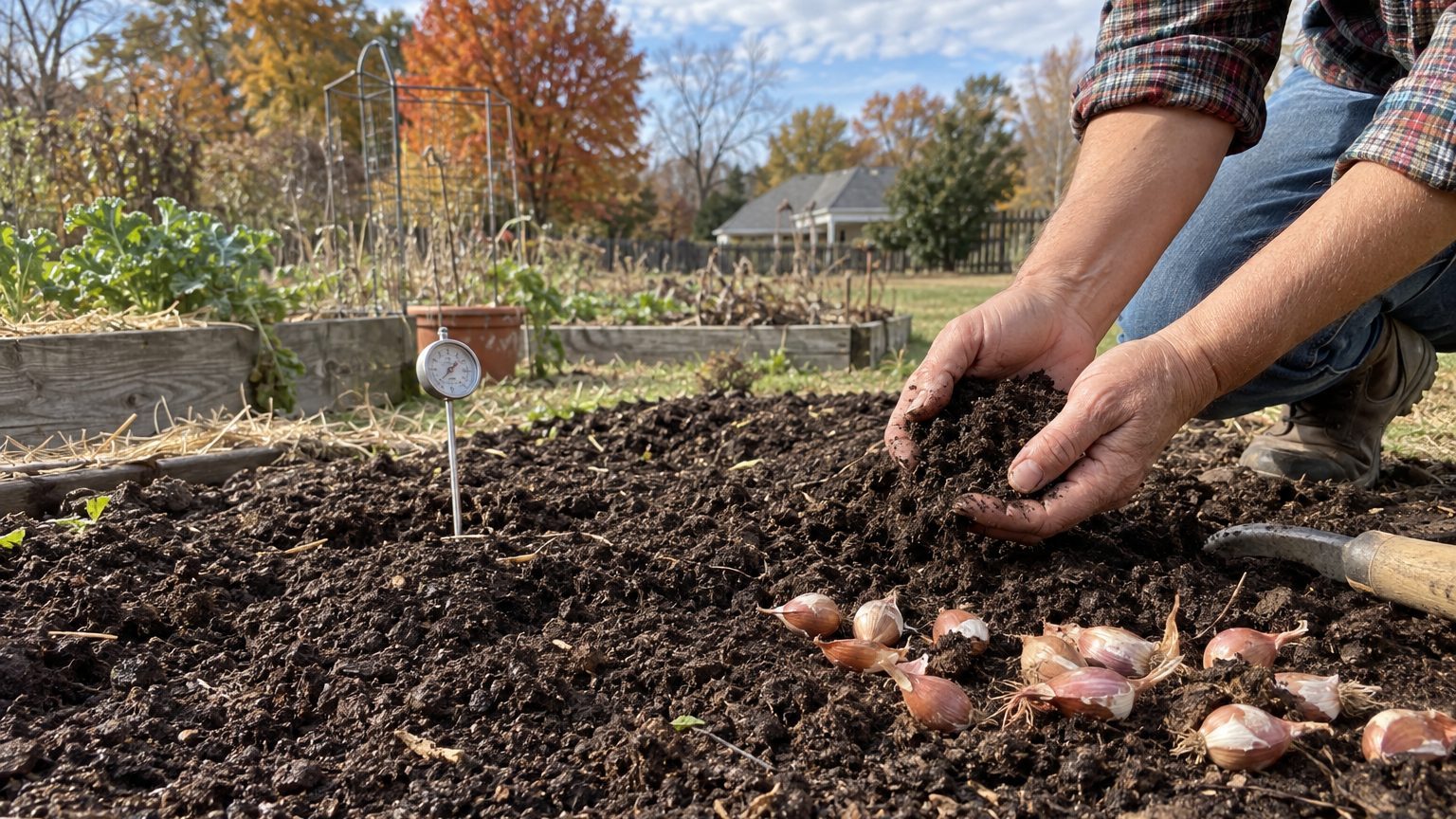

North Florida gardeners can plant shallots in autumn or in late winter. The first date is set by when the heat eases, and the second by when the last freeze passes. The frost figures here come from one Jacksonville station, so they describe north Florida only. Central and south Florida run on a different calendar.
When the soil is warm enough in Florida
The last spring frost at Jacksonville falls between February 16 and March 7. That range comes from the NOAA NCEI 1991-2020 Climate Normals, the 30-70% band of 32°F freeze probabilities at station USW00013889. It is a probability band, not a promise, and a late cold snap can still land outside it.
Frost is only a stand-in for what shallots care about, which is the soil. Ground warms more slowly than air, so soil temperature trails the end of frost risk by a couple of weeks. A bed that survived a February freeze can still be sluggish in early March. For shallots in northern states that lag is the whole planning question: you wait for workable, warming ground, then plant.
Florida flips that logic. Soil here warms early and keeps warming, and heat is what ends the shallot’s growth, not cold. A set planted in March has a short runway before summer pushes the plant to bulb and then to decline. So the useful question in north Florida is less “is the soil warm enough?” and more “how much cool weather is left?” That is why the autumn planting window matters so much, and the next sections work through it.
Frost data do not travel south
The Jacksonville airport is an inland site in north Florida, and even there three of thirty autumns saw no freeze at all. Central and south Florida are effectively frost-free. If you garden around Orlando or Miami, do not apply the February-to-March window above. There the main season runs through the cooler winter months, and summer is the stretch you plan around. For your county, the University of Florida IFAS Extension office is the right source for dates.
What carries over from garlic
Shallots and garlic share autumn planting, curing, storing and allium rotation. This site’s garlic section covers those practices in depth, so they are not repeated here. Three things differ for shallots. Each set multiplies into a cluster rather than a single head. The tops fall over and yellow when the clump is ready, and you lift the whole cluster. And you should keep shallots out of beds that held onions, garlic or leeks recently, because the diseases are shared.
At curing time, inspect before you store. A neck that is still soft or green, or a base that shows mold, ends the question for that bulb. Looking sound is not proof that it is sound, and no keeping time can be promised from the garden.
How long the season lasts here
Take the two dates at the same Jacksonville station. The last spring frost falls between February 16 and March 7. The first fall frost falls between November 26 and December 13. Subtract and you get a frost-free window of roughly 264 to 300 days. That is the span between the latest spring date and earliest fall date at the short end, and the earliest spring and latest fall at the long end.
Roughly 264 to 300 days is a long window by national standards. For comparison, many northern gardens count in the low hundreds at best. The number alone does not tell you how many shallot days you have, because the window includes a Florida summer that shallots will not enjoy. What the length does tell you is that you are not squeezed at either end. A cold snap in November will not catch an unfinished crop, and a late February freeze will not kill your plan.
A long window allows two things a short one does not. First, a second sowing. If a first planting goes in during autumn and a second in late winter, the harvests are staggered and one weather problem will not take the whole bed. The site’s succession sowing guide explains how to space those plantings. Second, transplanting becomes worth the extra care. Starting sets in containers and moving them out lets you plant into a bed that is already cleared of the previous crop. Before you transplant, check the roots. Sets with white, fresh roots move well, while sets with brown or mushy roots should go in the compost pile.
In a short northern season the first sowing is often the only one, and transplanting rarely pays back the effort. Compare it with Growing Shallots in Nunavut, where the whole conversation is about squeezing a crop into a few weeks. Florida’s problem is the opposite: too much calendar, and a hot stretch in the middle of it.
Heat and water in Florida
The facts verified for this page do not include a count of days above 90°F or a figure for summer rainfall, so no numbers appear here. Florida summers are hot and wet, and any local weather service or extension office can supply the counts for your area. What can be said with data is the winter side. The mean daily minimum of the coldest month at Jacksonville is 42.9°F (NOAA NCEI Climate Normals 1991-2020). That is cool, not freezing, and it means a winter shallot bed here rarely sees the hard, wet freeze that wrecks plantings farther north.
Hardiness zones tell a similar story. The USDA Plant Hardiness Zone Map 2023 puts Florida at 8b to 11b. That is a territory-wide range built on one variable, the average annual extreme minimum, so use your own city rather than the whole range. Jacksonville is the reference here, and the southern peninsula sits in much warmer zones.
Here is how that connects to the autumn-versus-spring choice. Where the ground freezes hard and stays wet, autumn-planted sets can rot or heave out of the soil, and spring planting is the safer call. A mild winter reverses that. Autumn planting gives roots a long cool stretch to establish, which is the reason gardeners grow shallots this way, and it tends to produce larger bulbs earlier. North Florida’s winter sits on the mild side of that line, so autumn planting is the natural fit. Rot is still a risk, but from a different cause: warm, soggy soil. Plant in raised or well-drained beds, and skip heavy clay unless you amend it.
Spring planting works as a hedge, though it is a tighter bet. The crop must size up before summer heat and rain arrive, because wet heat favors fungal disease, and bulbs that ripen into a rainy June are the ones that fail in storage. Water is the other lever. Shallots need steady moisture while the tops grow, then dry conditions as they finish. In a state where summer rain can arrive daily, the finishing stage is the hard part. Pull mulch back from the bulbs as the tops begin to fall, and lift clusters during a dry spell if you can.
Neighbors in the Gulf South face a similar mix. Growing Shallots in Louisiana covers a humid state where the same trade-off between autumn rot and spring heat plays out.
Which shallots suit Florida
This page names no varieties, and that is deliberate. A cultivar recommendation only means something if it was trialled where you garden, and no trial results are available to this page. Naming a variety without them would be guessing. The University of Florida IFAS Extension office serving your county can tell you what has been grown locally, and that answer outweighs any general list.
What can be done is to reason by type, from the facts above. Florida’s season is long, so you are not forced into the very earliest types. Its summer is hot and wet, though, so earlier-finishing types that size up and ripen before the worst of the heat have a real advantage. A type that matures in the cool months can be cured before the rain arrives, and that protects storage quality.
Humidity makes disease resistance the first criterion. Ask the extension office which types hold up against the fungal problems common in humid conditions. Then give every type airflow and shade at the root. Space clusters so leaves dry quickly after rain, keep weeds down, and mulch lightly to cool the soil without trapping moisture against the bulb.
A few other choices matter too:
- Divided sets versus seed-grown types. Sets are quicker and more familiar. Seed-grown types can be started in cooler months and are worth asking about.
- Day-length response. Bulbing is triggered by the length of day, so ask which types perform at Florida’s latitude.
- Storage reputation. Heavy humidity makes storability a real question, so ask local growers what has kept for them.
For central and south Florida, the same reasoning applies, but start from the winter season rather than the Jacksonville dates. Planting calendars there are best taken from your county extension agent. For the general method, Growing Shallots: One Bulb In, a Handful Out covers planting depth, spacing and harvest in one place.
Common questions
Can I grow shallots in Orlando or Miami?
Yes, but not on the Jacksonville calendar. Central and south Florida are effectively frost-free, so the main season runs through winter and summer is the hard part. Ask your county extension office for planting dates.
Should I plant in autumn or spring in north Florida?
Autumn suits the mild winter, with a minimum of 42.9°F in the coldest month at Jacksonville. Spring planting is a tighter bet because the crop must finish before summer heat and rain.
What is the last frost date in Jacksonville?
Between February 16 and March 7 (30-70% band of 32°F freeze probabilities, NOAA NCEI 1991-2020 Climate Normals, station USW00013889). It is a probability, and soil warms after frost risk ends.
How do I know cured shallots are safe to store?
Inspect each bulb. A soft neck or a moldy base ends the question for that bulb, and a sound look is not a guarantee. Curing and storage practice is covered in this site’s garlic section, and the method is the same for shallots.