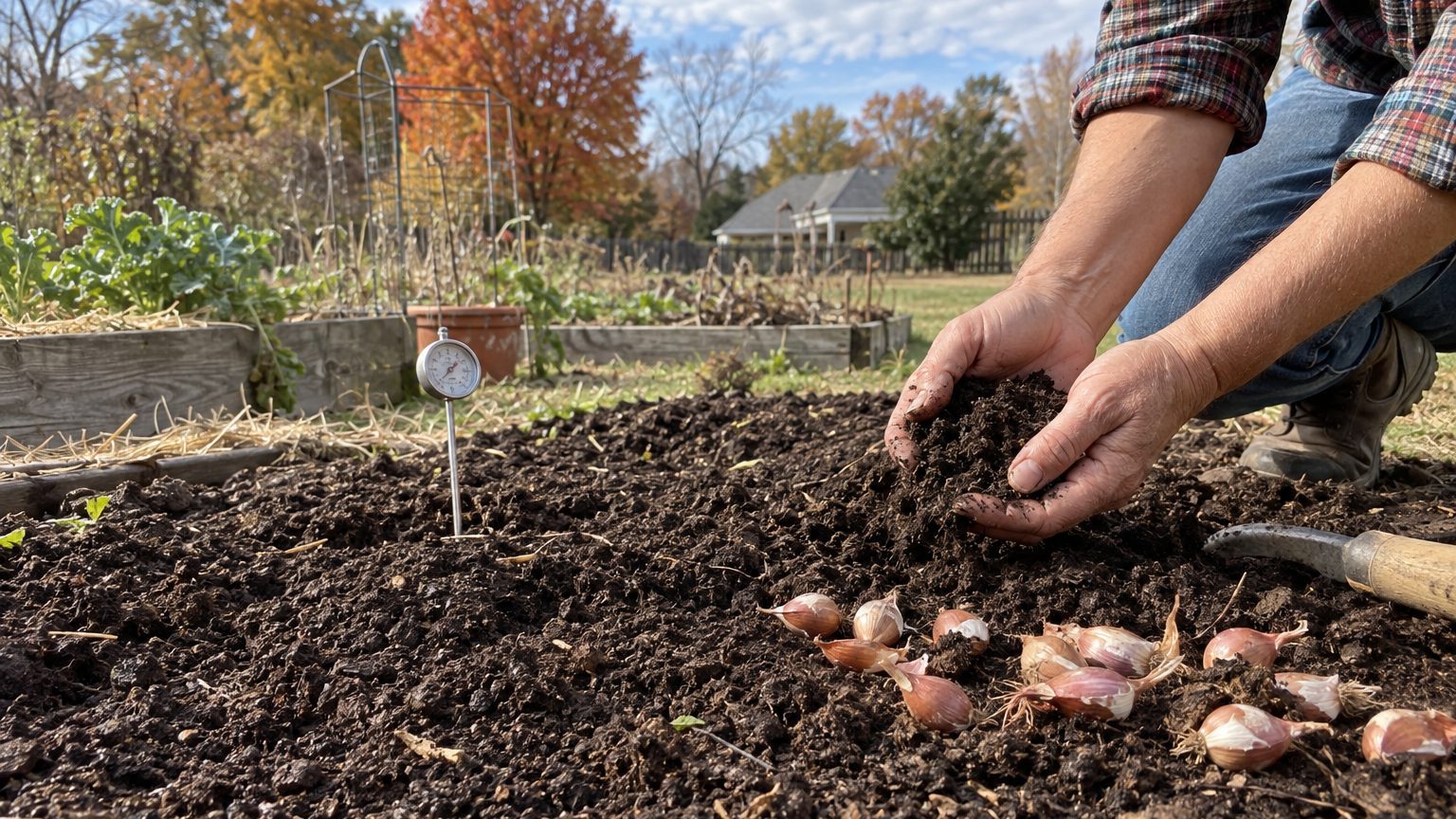

Shallots can be grown in Nunavut, but only on a short clock and mostly in raised beds. Plant in spring, never in autumn, and start with the earliest-maturing types. The mean last frost at Rankin Inlet falls on June 19. Bulbs have to size up and cure before the first fall frost arrives in mid-September.
When the soil is warm enough in Nunavut
At the Rankin Inlet A station, Environment and Climate Change Canada’s 1981-2010 normals put the last spring frost on June 19 on average. That is a midpoint. In one year out of two the last frost comes later. Treat June 19 as the middle of a window and not as a safe planting date. The station sits on Hudson Bay in the Kivalliq region, and districts farther north run weeks behind it.
Frost is only a stand-in for what shallots need, which is thawed, drained, workable soil. Soil warms after the frost risk ends. In much of Nunavut the ground is still frozen below the surface, and meltwater can sit on top of it. A bulb set into cold, soggy ground sits there and rots instead of rooting.
Shallots do tolerate cool soil once they are in it. So skip any numeric rule and go by the bed itself:
- The soil has thawed through the full planting depth, about the length of your finger.
- It crumbles in your hand instead of smearing, and no water pools in a hole you dig.
- The bed has held this condition for a few days and not just one sunny afternoon.
A raised bed filled with imported soil meets that test sooner than native ground, because it drains and warms from the sides as well as the top. A sheet of clear or dark plastic laid over the bed before planting speeds the thaw further. Take it off once the sets are in, or let air under it, so the bed does not overheat on a still sunny day.
Should shallots go in during autumn or spring in Nunavut?
Spring. Garlic growers in milder places plant in autumn and let the cloves root before winter. Shallots can follow the same habit in a place like Delaware, where the ground rarely locks up. In Nunavut the soil freezes hard and stays wet around the bulbs through thaw. Autumn-planted sets rot or heave out of the ground. Neighboring Northwest Territories has the same problem in its northern districts.
For the general method, the main guide Growing Shallots: One Bulb In, a Handful Out covers spacing, depth and how one planted bulb becomes a cluster. The Nunavut change is the calendar. Everything waits on the thaw, and everything after that is compressed.
For variety trials and what has worked in northern gardens, Agriculture and Agri-Food Canada is the federal source to start from.
How long the season lasts here
The reference station has about 86 frost-free days between the mean last spring frost (June 19) and the mean first fall frost (September 13). Both dates are 1981-2010 averages from Rankin Inlet A. In one year out of two the first frost comes earlier than September 13, so the real window is often shorter. Canadian normals cover 1981-2010, while US figures cover 1991-2020, so the two are not strictly comparable.
A short window decides how you grow the crop. A long one allows a second sowing, and shallots in the south can be planted in two rounds. Here, the first planting is the only planting. A bulb sown in July has no time to size up, and fall frost ends the run before the tops die back on their own.
What does an 86-day window allow?
- Bulbs get one planting. Set them as soon as the bed is workable. Waiting for warmer weather costs growing days you do not have.
- Green shallots can be sown in succession. Young tops are harvested for the kitchen well before the bulb matures, so a staggered sowing through early summer is possible.
- Transplanting becomes worthwhile. Starting seed or sets indoors gains weeks that the outdoor season cannot give.
Transplanting comes with a catch. Shallots grown from seed in cells have fine roots, and you should check them before moving the plants out. A healthy root mass holds the plug together and shows white at the cell edge. Pot-bound, circling or sparse roots mean the plant will sulk after the move, and in a short season there is no time to lose to that.
Harden transplants before they go out, since June can still bring a cold snap. Shallots shrug off light frost better than most garden crops, but a hard freeze on a tender transplant sets it back for weeks.
Any frost date for a specific community will differ from Rankin Inlet’s. A garden near open water or in a sheltered hollow can run days ahead of the station, and an exposed, windy site can run behind. Keep a plain thermometer in the bed and write the thaw and first frost down each year. After a few seasons your own record is a better guide than any regional average.
Heat and water in Nunavut
Heat is not the limit here. Summers on the Hudson Bay coast are cool, and a day above 90°F is not part of the planning. The questions are cold and damp. The coldest month at Rankin Inlet has a mean daily minimum of -34.3 °C (-29.8 °F), and Natural Resources Canada rates the reference city at hardiness zone 0a in the Canadian system. That is not a USDA zone and does not convert to one, because the two systems measure different things.
That winter cold is what settles the autumn-versus-spring question. Where the ground freezes hard and stays wet, autumn-planted sets rot or heave, and spring is the safer call. A milder winter gives the larger, earlier bulbs that autumn planting is grown for. Nunavut does not have that winter, so the early-bulb advantage is out of reach.
Cool, damp summers bring their own problems. Mildew becomes a disease risk, ripening runs slow, and tops stay green late into the season. A shallot that is still green when frost comes has not finished sizing up. Neck rot also follows wet harvests, because moisture sits in the neck while the bulb dries.
Plant for airflow and drainage:
- Use raised beds with loose, well-drained soil.
- Leave more space between clusters than the packet suggests, so leaves dry after fog or rain.
- Keep weeds out, since they hold moisture around the base of the plants.
- Rotate alliums away from any bed where onions, garlic or leeks grew recently.
Water by feel. Push a finger into the bed. If the soil feels dry, water at the base and not over the leaves. Stop watering once the tops begin to yellow and fall, which tells you the bulbs have finished growing and are ready to cure.
Cure in a place with moving air and cover from rain, such as a porch, a shed with the door open or a room with a fan. Cool damp weather can stall outdoor drying. Before you store anything, handle each bulb. Squeeze the neck. A soft neck or a moldy base ends the question, whatever the outer skin looks like, so compost that bulb. Bulbs that pass still need regular checks in storage, and a keeping time is never guaranteed. Curing and storage follow the same rules as garlic, with the same signs of trouble.
Which shallots suit Nunavut
The choice comes down to type. A short season favors the earliest-maturing shallots, and damp summers make disease resistance the first criterion. A hot climate would favor types that tolerate heat, but that does not apply here. Garden centers rarely stock for Arctic conditions, so you may order sets or seed by mail. Read each description for how early the plant matures and how it handles damp.
| Type | Why it can fit | What to watch |
|---|---|---|
| Earliest-maturing sets (small bulbs planted in spring) | Fastest route to a mature bulb in a short season | Plant the day the bed thaws and drains |
| Seed-grown shallots started indoors | Gains weeks before the outdoor season opens | Check the root mass before transplanting |
| Types described as resistant to mildew and neck rot | Handles cool, damp summers | Resistance lowers the risk but does not remove it |
| Late, large-bulb types | Suits long, mild seasons | Likely to be caught green by fall frost |
A name that does well in Ontario or Alaska says little about a garden on Hudson Bay. The only recommendation that means something is a variety that has been trialled where you live, and a name taken from another climate is likely to fail the first season. Agriculture and Agri-Food Canada is the place to ask for northern trial results.
If you have a choice, buy small quantities of two or three early types and compare them over a couple of seasons. Mark the rows. Record the thaw date, planting date and the day tops fell. By the third year the bed will tell you more than any catalogue.
Common questions
Can you grow shallots in Nunavut?
Yes, in a raised bed with imported soil, planted in spring as soon as the soil thaws and drains. The window is short, so choose early types and consider starting seed indoors.
When is the last frost in Nunavut?
At Rankin Inlet A, the 1981-2010 average last spring frost is June 19. Half of all years run later than that, and northern communities run weeks behind. Wait for workable soil instead of the date.
Is hardiness zone 0a a USDA zone?
No. Zone 0a is from Natural Resources Canada’s system, which uses seven climate variables. It does not convert to a USDA zone, so do not compare it with US figures.
How do I know if cured shallots are safe to store?
Squeeze each neck and check the base. A soft neck or a moldy base means the bulb goes in the compost. Even sound-looking bulbs need regular checks in storage.