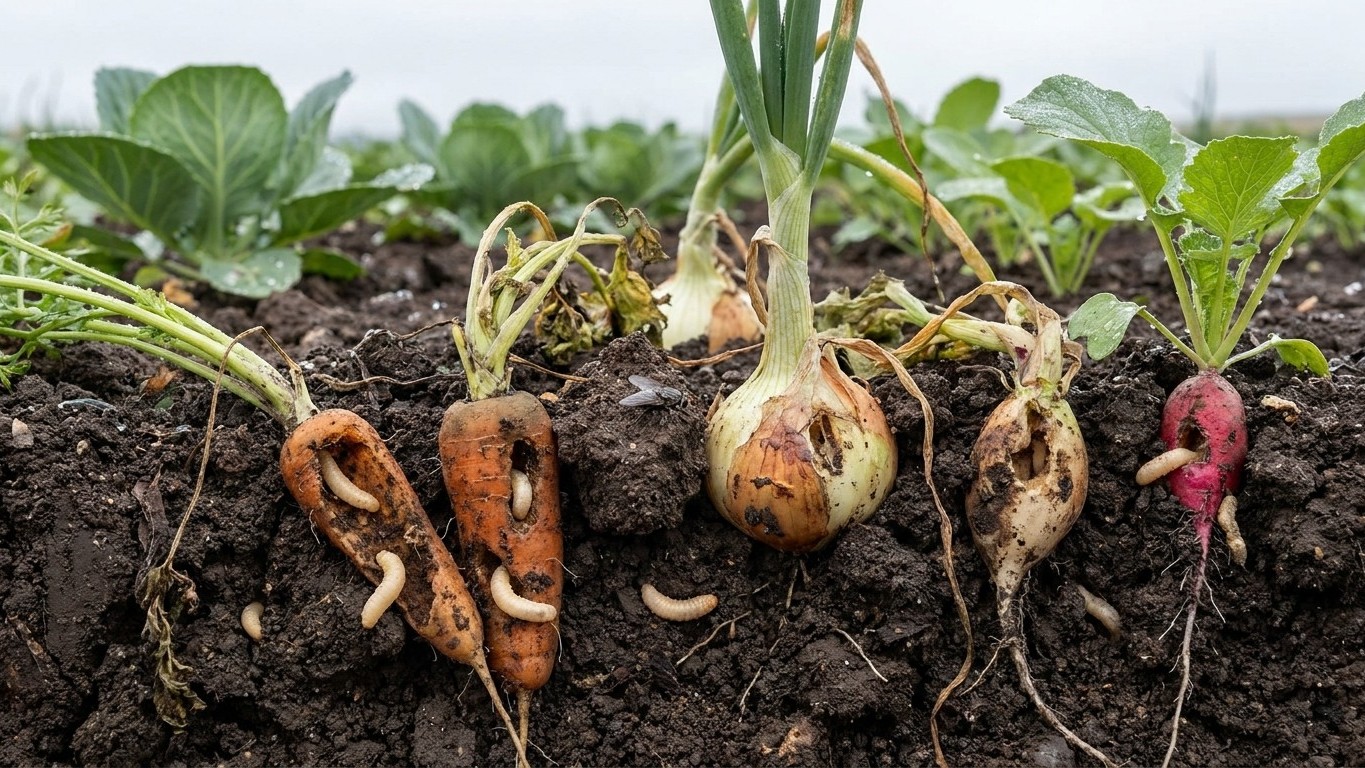

In north Florida, plant warm-season unusual roots after the last-freeze window closes on March 7, and sow cool-season ones so they are established before the first-freeze window opens on November 26. In central and south Florida, that math does not apply. Those regions are effectively frost-free, so the main season runs through winter and summer is the hard part. The dates here come from one north Florida station.
The short answer for Florida
For north Florida, the sowing window runs from the end of the last-frost band to the start of the first-frost band. NOAA’s 1991-2020 Climate Normals put the last spring frost between February 16 and March 7. The first fall frost falls between November 26 and December 13. Warm-season roots wait until the March 7 end of the spring band has passed. Cool-season roots go in early enough to be established before November 26.
These dates are not calendar promises. They are a probability of a 32°F freeze, taken from the 30 to 70 percent band at the Jacksonville airport station (USW00013889). The early date in each range is the point where the odds of a freeze are around 30 percent. The late date is where they reach 70 percent. February 16 is therefore a gamble, and March 7 is the safer bet. Planting tender roots on the early date means accepting roughly a one-in-three risk of a freeze afterward.
The station itself adds two caveats. It sits at an inland airport, and inland sites run colder than coastal gardens a few miles away. Across the thirty fall seasons in the record, three saw no freeze at all. A calendar built on frost is shaky even in Jacksonville, because the frost sometimes never comes.
The coldest-month number helps explain why. The mean daily minimum of the coldest month at the reference station is 42.9°F, nearly 11 degrees above freezing on an average night. Averages hide cold snaps, which is why the frost bands still matter. But the figure shows the winter here is mild enough for many cool-season crops to keep growing.
For the full picture of what grows here and why, start with Growing Unusual Root Crops in Florida. This page covers only the timing.
What will not work here
The most common failure is borrowing a northern calendar. Advice that says “plant after the last frost in May” assumes a frost date that, in Florida, passes in February or early March. Follow it and you lose two to three months of usable spring. Plants that need a long, slow season never get enough of it, and they hit summer heat before they have sized up.
Applying the Jacksonville window farther south is the opposite mistake. The frost dates on this page do not describe Orlando or Miami. There, sowing “after the last frost” has no meaning, because there is effectively no frost to wait for. A gardener in central or south Florida who waits until March to start cool-season roots is starting them just as the heat arrives.
Summer is the other wall. Cool-season roots sown in spring in central or south Florida tend to stall or bolt as temperatures climb, and they do not recover. Fall planting is the working answer there. Gardeners who treat the calendar as inverted, planting in autumn and harvesting through winter, tend to get results that spring planting never delivers.
Wet summers punish close spacing. Florida’s rainy season brings heavy afternoon downpours and long stretches of humidity. Roots crowded at the tight spacing printed on a seed packet hold moisture around the crown and foliage, and rot follows. Wider spacing and raised, well-drained beds are cheap insurance. Many Florida soils are sandy and drain fast, so a bed can swing from waterlogged to dry within days, and a once-a-week soaking will not keep up in that stretch.
Last, there is the idea that a mild winter means anything survives. A coldest-month minimum of 42.9°F is gentle on average, yet one hard freeze can still kill tender tops. In a year when a freeze arrives in the fall band, tropical roots left in the ground can be damaged. For picks that suit these conditions, see The Best Unusual Roots to Grow in Florida.
What changes across Florida
Florida does not have one garden. The USDA Plant Hardiness Zone Map (2023 edition, built on 1991-2020 normals) puts the state at 8b to 11b. That spans seven half-zone steps, each 5°F apart, and it measures a single variable: the average annual extreme minimum temperature. With a spread like that, there is no single answer for the state, and any one-size date is wrong for most of it.
The Jacksonville reference sits at the cold end of the range. Gardeners in north Florida, and those inland, should treat the frost bands on this page as live. They should hold tender roots until after March 7 and keep an eye on forecasts through the fall band. A gardener far from the coast or at a higher spot should lean toward the later date in each window, since such sites tend to run colder than the airport reading.
| Part of Florida | Does the frost window apply? | Main growing season | Hard part of the year |
|---|---|---|---|
| North Florida (Jacksonville is the reference) | Yes: February 16 to March 7 and November 26 to December 13 | Warm-season roots after the spring band; cool-season roots through fall and mild winter | Freeze nights, mostly in the frost bands |
| Central and south Florida | No, effectively frost-free | Winter | Summer heat and rain |
Look up your own zone on the USDA map rather than guessing from the state range. Nothing on this page can tell you where your yard falls, and the map can, down to a few miles. Treat the zone as a guide to cold risk only. It does not capture summer heat or humidity, which matter just as much here.
Where to check this for your own county
Your county’s extension office is the next stop. In Florida, that is UF/IFAS Extension, which has a local office serving each county. Staff there know the soil, the rainfall pattern, and the cold snaps that actually hit your area, none of which a statewide page can capture.
Two things are worth looking for. The first is the local vegetable planting calendar, which will name sowing months for your county and usually separates the cool season from the warm one. The second is the list of varieties trialed or recommended locally. A root that performs well in one county can fail in another, and trial results show which ones have actually been grown nearby.
If your county has no calendar for the crop you want, call or visit the office and ask. Extension staff and Master Gardener volunteers field these questions routinely, and they can tell you how close your site is to the reference conditions used here.
A county recommendation beats a state one. This page is the state one, and its dates come from a single north Florida station. The extension service holds the county-level answer, so when the two disagree, go with the county.
Checking this against your own garden
Your own observations outrank every date above. Three signs are worth watching, and none needs an instrument.
Soil warmth by feel. Push your hand a few inches into the bed in the morning. If it feels cool or clammy, warm-season roots will sulk. If it feels comfortably warm, they will establish. A bed against a south-facing wall will warm days ahead of a shaded one, and the difference shows you how much your site differs from the airport reading.
The first male flowers. Squash and cucumber vines open male blooms before female ones, and they open them once warmth has settled in. If yours appear early, your garden is running ahead of the regional average. If they come late, your spot is cooler, so keep your root planting later too.
The first true leaves. Seedlings put out rounded seed leaves first, then the true leaves that look like the mature plant. If those true leaves arrive slowly, the bed is too cool or too shaded, and a low corner where cold air pools is a common cause. If they arrive fast, the spot is warm and sheltered.
Common questions
When is the last frost in Florida?
In north Florida, the NOAA 1991-2020 normals put the last spring frost between February 16 and March 7, based on the 32°F freeze probability band at the Jacksonville station. Central and south Florida are effectively frost-free, so no such date applies there.
Can I use the Jacksonville dates in Orlando or Miami?
No. The window describes north Florida. In central and south Florida, the calendar inverts: the main growing season runs through winter, and summer is the hard part.
What hardiness zone is Florida?
The USDA Plant Hardiness Zone Map (2023) ranges from 8b to 11b across the state, which is too wide for one answer. Check the map for your location instead of relying on the state range.
Is the frost window a guarantee?
No. It reflects the 30 to 70 percent probability band of a 32°F freeze, so a freeze can still arrive after the late spring date. In the thirty falls of the Jacksonville record, three had no freeze at all, so the dates mark odds and not certainties.