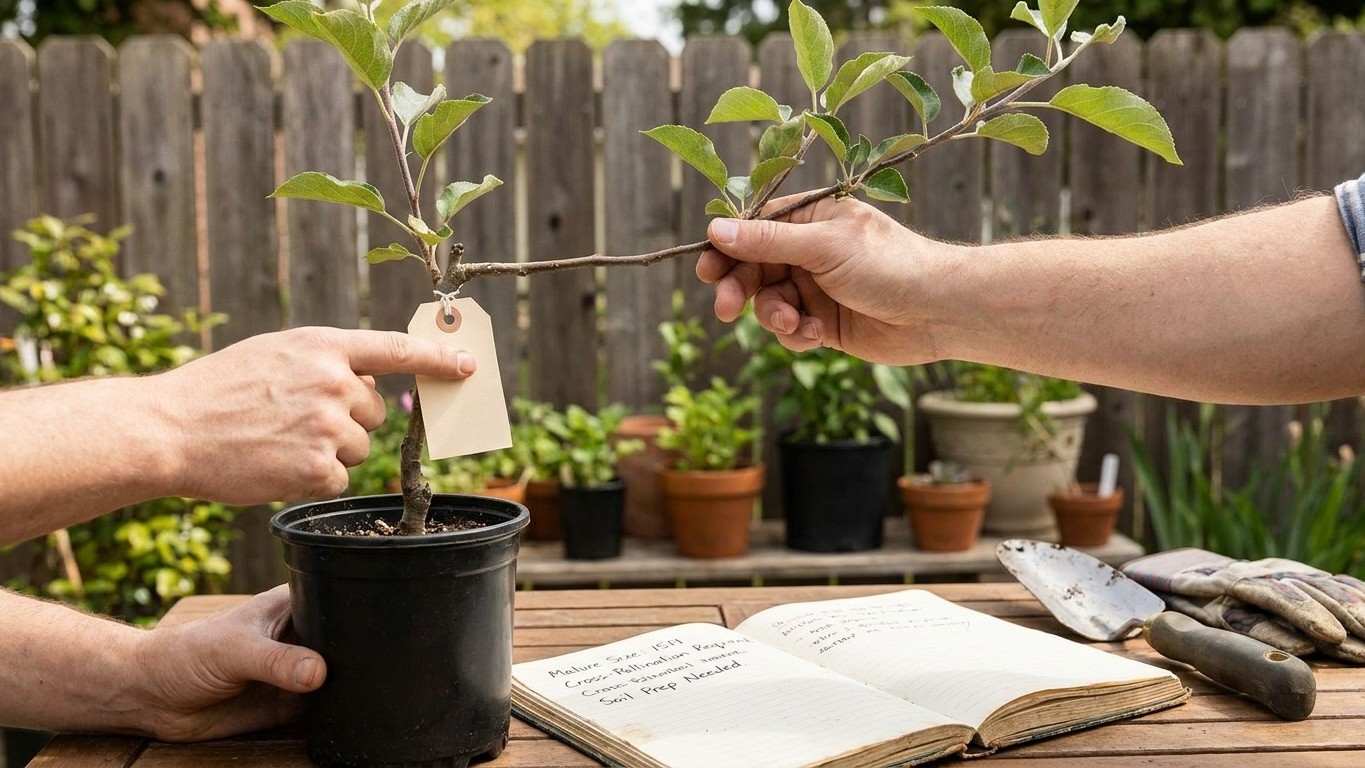

A blank tag can cost you a decade, and here’s why: the rootstock decides how big your tree will actually get, and the variety decides whether it bears any fruit at all. A dwarf on M.9 tops out around 8 to 12 feet; the same variety on seedling rootstock can push past 35. Before you hand over money, find the rootstock code printed on the tag, walk your planting site with a tape measure, and confirm the variety has a compatible pollinator blooming nearby — because once this tree is in the ground, both decisions are already made for good.
Why it matters
The tree you carry out of the nursery already carries decisions that took a grower years to make and that you cannot undo once it is in the ground. The rootstock grafted below the graft union fixes how tall and wide the tree will grow for the rest of its life, and the variety’s pollen supply decides whether the tree sets fruit at all. Both facts sit on the tag if you know where to look, and neither shows up in the photo on the label.
This decision belongs at the buying stage, before the tree goes in the ground. Once a bare-root tree breaks dormancy and pushes green tip in spring, the rootstock is already grafted and the variety already fixed. Buy on looks alone and you can end up wanting a tree that tops out at 12 feet and getting one that reaches 30 feet or more, or a variety that blooms alone in the yard and drops no fruit because nothing nearby sheds compatible pollen at the same time.
Getting this right at purchase saves a decade of correction. A tree planted too large for its rootstock means climbing a ladder for every harvest and fighting the size with pruning cuts that never quite catch up, a problem summer pruning deals with once the tree is already established but cannot fully undo. A tree bought without checking pollen compatibility can bloom on schedule every spring and still hang no apples, a much harder problem to fix after the fact than before you paid for the tree.
When to do it
Nurseries sell apple trees two ways: bare-root, dug and shipped while the tree sits in full dormancy, and containerized, potted and sold through most of the growing season. The buying window that matters most is the dormant one. Bare-root stock ships and plants before the buds swell into green tip, and that is also the point at which the rootstock is easiest to check, since the tree has no leaves yet to distract from the graft union near the base of the trunk.
What moves this window is not a date on a calendar but the tree’s own stage. A nursery in a cold winter region ships bare-root stock later than one in a mild one, and the safe planting stage runs from dormancy through green tip, never after the buds have opened into pink or bloom. A potted tree already in bloom at a garden center tells you almost nothing useful about its real bloom timing, since a tree’s flowering in a container says more about the greenhouse it sat in than about when it will flower once it is planted in your yard.
Pollination compatibility is worth working out before you buy, not after the first bloomless spring. Clemson Cooperative Extension’s HGIC 1350 sorts common varieties into bloom groups that flower at roughly the same relative time. Group A varieties such as Anna and Dorsett Golden bloom earliest, group B varieties including Fuji, Gala, Ginger Gold, Granny Smith, Jerseymac, Mollie’s Delicious, Mutsu, Red Delicious, and Yates bloom through the middle stretch, and group C varieties including Arkansas Black, Golden Delicious, Jonagold, Ozark Gold, Priscilla, Rome Beauty, and Stayman bloom last. The actual calendar date each group flowers shifts with climate, but the order between groups holds everywhere, so pick a second tree from the same group or an adjacent one, never from opposite ends of the list.
How to do it

Start with the tag, not the tree. Every reputable nursery tag names the variety and, somewhere in smaller print, the rootstock it is grafted onto. If the rootstock is not printed, ask before you buy. It is the single piece of information that predicts the tree’s adult size more reliably than anything else on the label.
Match the rootstock to your space
USU Extension’s guidance for the home garden gives the mature height range to plan around:
| Rootstock | Mature height (USU Extension) |
|---|---|
| M.9 | 8-12 feet |
| M.26 | 12-15 feet |
| G.11 | 12-15 feet |
| G.30 | 18-20 feet |
| M.7 | 18-20 feet |
| M.106 | 25-30 feet |
| MM.111 | 30-35 feet |
| Seedling (ungrafted) | 35-40 feet |
Walk the planting site with a tape measure before you buy, not after. A dwarfing rootstock like M.9 or M.26 fits a small yard and a ladder-free harvest. MM.111 or a seedling rootstock wants the room a full-size shade tree would take, and that space has to already exist on your property. The variety grafted on top, whether it is a Fuji or a Golden Delicious, has no bearing on this figure at all. The rootstock decides it, not the variety name printed above it on the tag.
Check pollen compatibility before you pay
Ask what variety is planned as the pollinator, or is already growing nearby, and cross-check it against the bloom groups above. Then check the variety itself against one more list: Jonagold, Mutsu, Stayman, and Winesap all carry sterile pollen, according to Clemson HGIC 1350, the University of Georgia’s Circular 740, and USU Extension. Any of these four can be pollinated by another variety, but none of them can pollinate anything else. A yard holding only two of these four sets no fruit on either tree, however well both bloom.
- Confirm the rootstock code is printed on the tag, or ask nursery staff directly.
- Measure the planting site and match it against the rootstock’s mature height range.
- Identify what pollinator variety will bloom nearby at the same relative time.
- Rule out pairing two sterile-pollen varieties as each other’s only pollinator.
If no compatible apple variety already grows within range, a flowering crabapple can fill that role for many apple varieties instead of a second full-size tree, a workaround covered in using a crabapple as a pollinator. That is often the more practical fix for a small yard than planting two full apple trees just for the sake of pollination.
What goes wrong
The most common mistake is buying on variety name alone and letting the nursery pick the rootstock, or not asking at all. A tree grafted onto MM.111 or a seedling rootstock looks identical to a dwarf tree in its first year in a pot. The size difference does not show up until years four through six, by which point the tree is already far too large for the space it was planted in and the only real fixes are heavy corrective pruning or removal.
The second mistake is pairing two sterile-pollen varieties and assuming any two apple trees will cross-pollinate each other. Jonagold, Mutsu, Stayman, and Winesap can each receive pollen and set fruit, but none of them produce pollen that works on another tree. Plant two of these four together with nothing else nearby and both trees can bloom heavily every spring and still hang no fruit, a failure that does not show up until the first bloom season, often two or three years after planting.
Timing mistakes at the nursery
Buying a containerized tree already in bloom tells you little about when it will actually flower once it is in the ground, since a potted tree’s bloom reflects greenhouse conditions more than garden conditions. Relying on that in-store bloom to judge bloom-group compatibility is a common error. Check the tag or ask staff for the named variety and look up its bloom group instead of trusting what you see in the pot that day.
A third, quieter mistake is skipping the rootstock question because the salesperson does not volunteer it. Not every tag prints the rootstock code clearly, and a nursery that cannot tell you what rootstock a tree is grafted on cannot tell you how big it will get either. Walk away from that sale rather than guess, since the mature size gap between an M.9 tree and an MM.111 tree is the difference between an 8 to 12 foot tree and one reaching 30 to 35 feet, per USU Extension, on the exact same piece of ground.
What changes where you are
The bloom order Clemson HGIC 1350 lays out for groups A, B, and C holds true everywhere apples are grown, but the calendar date each group actually flowers moves with climate. A group A variety like Anna blooms weeks earlier in a warm winter climate than the same variety does somewhere with a longer, colder dormancy. What stays fixed is the order between groups, so a group A and a group C variety make a poor pollinator pair almost anywhere, even though the exact dates differ from one region to the next.
Rootstock size ranges from USU Extension are national figures and do not shift with climate the way bloom dates do, but how well a given rootstock actually performs still depends on local soil and winter conditions that your own state extension service tracks better than a national fact sheet can. Some rootstocks handle wet soil or hard winters better than others, and that is worth asking a local nursery or extension office rather than assuming one rootstock performs the same everywhere it is sold.
Local frost dates, chill-hour requirements, and any spray guidance for pest and disease control are all county-level or state-level questions, not ones a national fact sheet can answer. Check with your own state extension service, the same kind of office that publishes HGIC 1350, Circular 740, and the USU guidance, before finalizing a variety choice for your own climate. If you are still deciding whether apples make sense in your yard at all, the groundwork that comes before any purchase, including site and soil questions, is covered in growing apples.
Common questions
Does the rootstock change how the apples taste?
No. The rootstock controls the tree’s size, vigor, and how early it starts bearing, but the fruit itself, its flavor, color, and texture, comes from the variety grafted on top. A Honeycrisp on M.9 and a Honeycrisp on MM.111 produce the same apple, just on a much smaller or much larger tree.
Do I need two full apple trees, or will a crabapple work?
Many apple varieties can be pollinated by a nearby flowering crabapple instead of a second full-size apple tree, which is useful if your yard only has room for one apple. Check that the crabapple’s bloom time overlaps with your apple variety’s bloom group before relying on it.
How do I find the rootstock if the tag doesn’t list it?
Ask the nursery staff directly and expect a specific answer, not a general one like “dwarf” or “standard.” A reputable nursery selling grafted trees should be able to name the rootstock code, since it is part of their own ordering records for that batch of trees.
Can a bare-root tree and a potted tree from a garden center pollinate each other?
Yes, as long as their varieties fall in the same or an adjacent bloom group. How the tree was sold, bare-root or containerized, has no effect on when it blooms. What matters is the variety itself and the bloom group Clemson HGIC 1350 assigns it.