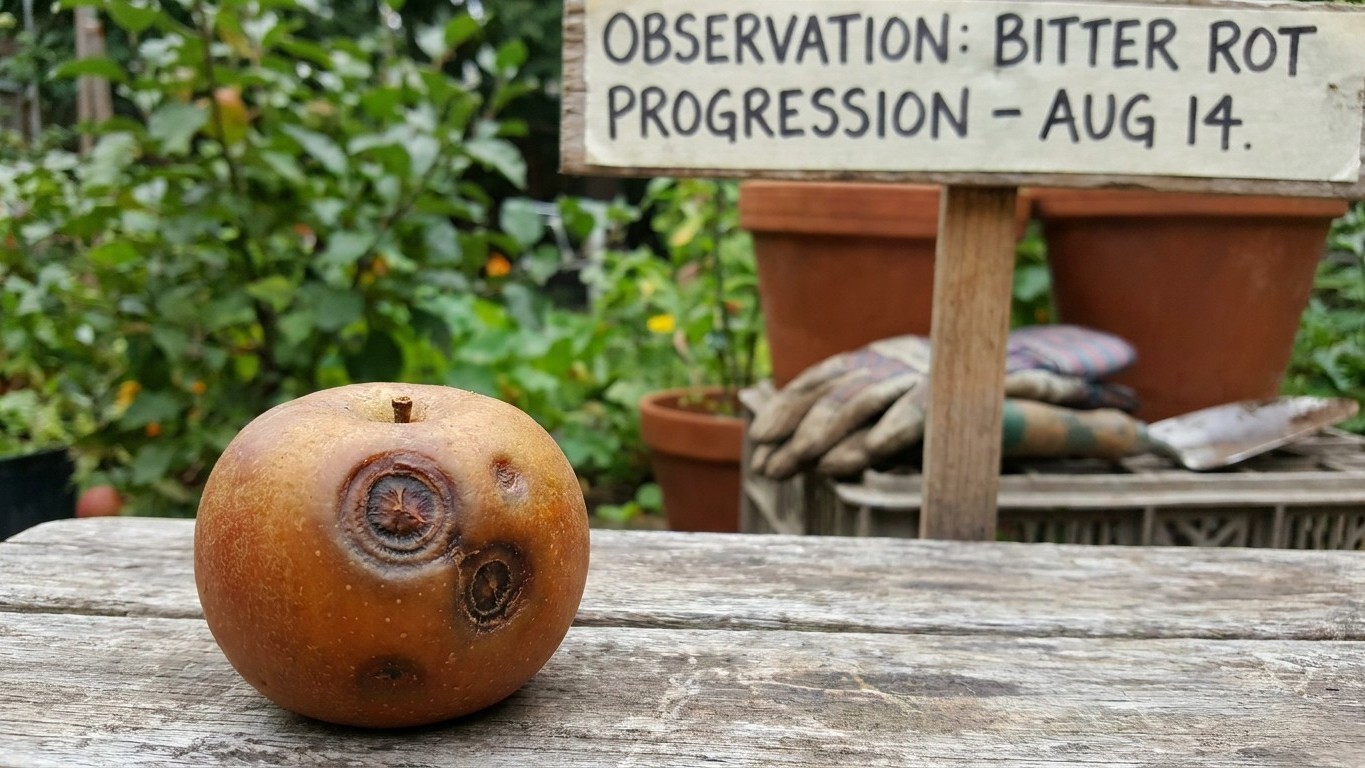

Bitter rot shows up as a small brown spot on the fruit skin that sinks into a tight, circular depression, often with a cone-shaped rot running down into the flesh, and it spreads fast once warm, humid weather sets in. The fungi behind it, in the genus Colletotrichum, ride rain splash off dead wood and old fruit mummies onto the crop below. Walk the orchard after every warm rain from midsummer through harvest and pull off any fruit showing that sunken spot before it has a chance to sporulate.
What you are looking at

The first sign shows up on the fruit itself: a small tan-to-brown spot on the skin, no bigger than a pinhead at first, usually on the side of the apple that faces the sun. Within a few days it widens into a perfectly circular, sunken lesion with a slightly raised, darker rim around the edge. Cut the apple open under that spot and the rot runs into the flesh in a narrow cone, firm and brown rather than watery, tapering toward the core.
On the fruit
As the lesion ages, its center often shifts from tan to brick red and then to black, and in warm, wet weather small pimple-like fruiting bodies push up through the skin in rings that follow the shape of the spot. Press one on a humid morning and it can ooze a cream-to-orange mass of spores. Left on the tree through the season, an infected apple shrivels down into a hard, black mummy that clings to the spur and carries live fungus straight through winter.
On the wood
Check the limbs and you often find the other half of the picture: a sunken, elongated canker on a branch, frequently starting at an old pruning cut, a hail scar, or a spot where a limb was broken or rubbed. These cankers are where the fungus overwinters, and they are the source of the spores that rain splashes onto fruit the following summer. Bitter rot tends to appear from midsummer into harvest, worse in stretches of warm nights and repeated rain, and a lesion the size of a fingernail can turn a whole apple to rot in under a week once conditions favor it.
What it is not
Fruit rots that get confused with it
Apple growers lump every fruit rot together, but the differences matter because the fungi involved overwinter in different places and call for different sanitation. Black rot produces a similar-looking fruit decay, but the rot is firmer and spreads inward from the calyx end or a wound rather than sinking as a discrete circle, and the same fungus causes frogeye leaf spot, a ring of small brown-and-tan spots on leaves that bitter rot never produces. That disease’s full pattern is covered on the page about Black Rot and Frogeye Leaf Spot: One Fungus, Two Symptoms.
White rot, from a different fungus, tends to produce a softer, watery lesion that bleaches the skin pale rather than darkening it, and it shows up in the same warm weeks as bitter rot, which is exactly why the two get mixed up in the field. Sooty blotch and flyspeck stay on the surface only, smudging the skin gray-green or dotting it with tiny black specks, and never sink into the flesh or rot the fruit. Apple scab shows up earliest in the season as olive-green to black blotches on leaves and young fruit, and while a scab lesion can crack the skin, it never produces the cone-shaped internal rot that marks bitter rot. That pattern is described on Apple Scab: The Olive Blotches That Come With Wet Springs.
The cut test
The single detail that separates bitter rot from all of these is a knife: cut the fruit in half. A dry, firm, cone- or V-shaped rot pointing at the core is bitter rot. A soft, water-soaked, expanding rot with no defined cone points to something else, and treating the wrong disease means pruning out cankers that were never there while the real infection keeps spreading.
| Disease | Fruit lesion | Wood or leaf sign |
|---|---|---|
| Bitter rot | Sunken circle, firm cone-shaped rot inward | Elongated canker at wounds |
| Black rot | Firm rot spreading from calyx or a wound | Frogeye leaf spot |
| White rot | Soft, watery, skin bleached pale | Poorly defined limb cankers |
| Sooty blotch / flyspeck | Surface smudge or black specks, no rot | None on wood |
| Apple scab | Olive-black blotch, cracked skin, no internal cone | Olive blotches on leaves |
The conditions that bring it on
Warm, wet, and windy enough to splash
Bitter rot needs three things to build into a bad year: standing moisture on the fruit surface, warm temperatures, and a source of spores nearby. Rain, dew that doesn’t dry off by midmorning, and overhead irrigation that wets the canopy all give the fungus the film of water it needs to germinate on the skin. The spores travel only a short distance and only in water, splashed by raindrops off a canker or a mummified fruit onto the apples below or beside it, so a single warm, wet stretch after a dry spell can trigger an outbreak that looks like it appeared overnight.
Wounds and reservoirs
The fungus is opportunistic and infects most readily through a break in the skin: hail damage, insect stings, sunscald cracks, or a bruise where one apple rubs another. It also builds up wherever dead wood sits in or near the orchard. Standing dead limbs, unpruned old cankers, a pile of prunings left in a corner, or a dead hardwood tree at the fence line all hold live fungus over winter and reseed the orchard every spring. An orchard that had bitter rot last year and did nothing about the dead wood is starting this season with a bigger reservoir than the year before, not a smaller one, so a run of warm rain now can produce a worse outbreak than the one that first got noticed.
What to do now
Remove the infected fruit
Once an apple shows the sunken circular lesion, that fruit is not coming back, and no product available to a home gardener will reverse it. Pick every visibly infected fruit off the tree and off the ground as soon as you find it, and carry it out of the orchard entirely rather than leaving it at the base of the tree or tossing it in a compost pile close by, since either spot still lets the fungus finish sporulating. Do the same with any mummified fruit still hanging from last season. They are loaded with viable spores the moment the weather warms.
Cut out the cankers you can reach
Any branch canker you can see should come out now. Cut a few inches into clean wood below the visible margin rather than trimming right to the edge of the lesion, since the fungus runs ahead of the dead bark that marks it. Wipe or dip pruning tools between cuts so a cankered limb doesn’t hand the fungus to a healthy one on the same pass through the tree.
- Pick and remove infected fruit every time you walk the orchard after warm rain
- Cut cankers well below the visible margin, not right at its edge
- Sanitize pruning tools between cuts on infected wood
- Call your extension office before applying anything, since labeled options differ by state
Know the limit of a midseason fix
There is no rescue for fruit that has already started to rot, and no single midseason step reliably stops an outbreak already underway in warm, wet weather. Because fungicide registration and label rates differ by state, and using an unregistered material or the wrong rate can be both illegal and ineffective, the useful move this week is to call your county or state extension service and ask what is currently labeled for bitter rot on apple where you garden. They can also tell you whether the outbreak you’re seeing is worth a spray this late in the season or whether sanitation alone will carry you to harvest.
Preventing it next season
Clean up what carries it through winter
Bitter rot survives the winter in cankers, mummified fruit, and dead wood, so the single most effective step for next year happens during dormancy, not during the growing season. Walk the orchard while the trees are bare and remove every mummy still hanging, every dead spur, and every canker missed during the growing season, cutting well into clean wood each time. Haul brush and prunings out of the orchard the same week you cut them rather than letting a pile sit through spring, since a pile of dead wood is exactly the reservoir the fungus needs.
Prune for airflow, and size the tree to match
A tight, shaded canopy holds humidity longer after rain, which is exactly what the fungus wants, so opening the canopy with dormant pruning cuts real infection risk, not just light. How much pruning that takes depends on the rootstock the tree is on. USU Extension lists mature heights of 8 to 12 feet for M.9, 12 to 15 feet for both M.26 and G.11, 18 to 20 feet for G.30 and M.7, 25 to 30 feet for M.106, 30 to 35 feet for MM.111, and 35 to 40 feet for a seedling rootstock. A tree on M.9 or M.26 is easy to keep open with hand pruners from the ground. A seedling or MM.111 tree pushes a much larger, denser canopy that needs more aggressive annual pruning, often from a ladder, to hold the same airflow through the fruiting wood.
Watch for related problems while you’re in there
Dormant season is also the time to check for the other rots and blotches that show up in the same warm, wet stretches, since an orchard already dealing with one of the apple diseases tends to be carrying more than one at a time. Bitter rot, black rot, and apple scab all overwinter in wood or leaf litter, so the sanitation pass that controls one goes a long way toward controlling the others.
Common questions
Can I still eat an apple that has a small bitter rot spot if I cut around it?
You can cut out the visible lesion and eat the rest, but the fungus has usually spread further into the flesh than the sunken circle shows, and the flesh right next to the rot often tastes genuinely bitter, which is where the disease gets its name. If more than a small fraction of the apple is affected, or the flesh tastes off past your cut line, it isn’t worth saving.
Does bitter rot ever show up on the leaves, or just the fruit?
Mostly the fruit and the wood. Unlike apple scab or black rot, bitter rot does not produce a distinctive leaf spot, so a tree can carry cankers and lose fruit to bitter rot while the leaves look normal all season.
I had a bad bitter rot year. Does that mean next year is automatically bad too?
Not automatically, but the odds go up if the source material stays in the orchard. The fungus overwinters in cankers, mummified fruit, and dead wood, so a thorough dormant-season cleanup can cut the spore load going into next spring even after a rough season, while leaving the same dead wood in place makes a repeat far more likely.
My stored apples looked perfect at picking and then developed rotten spots weeks later. Is that bitter rot?
It’s possible. Bitter rot can infect fruit in the orchard while it’s still small and stay invisible until the apple is well into storage, so a spot appearing weeks after harvest doesn’t rule the disease out. Sort stored fruit periodically and pull any apple that develops a sunken spot before it touches its neighbors, since the rot spreads fruit to fruit in storage too.