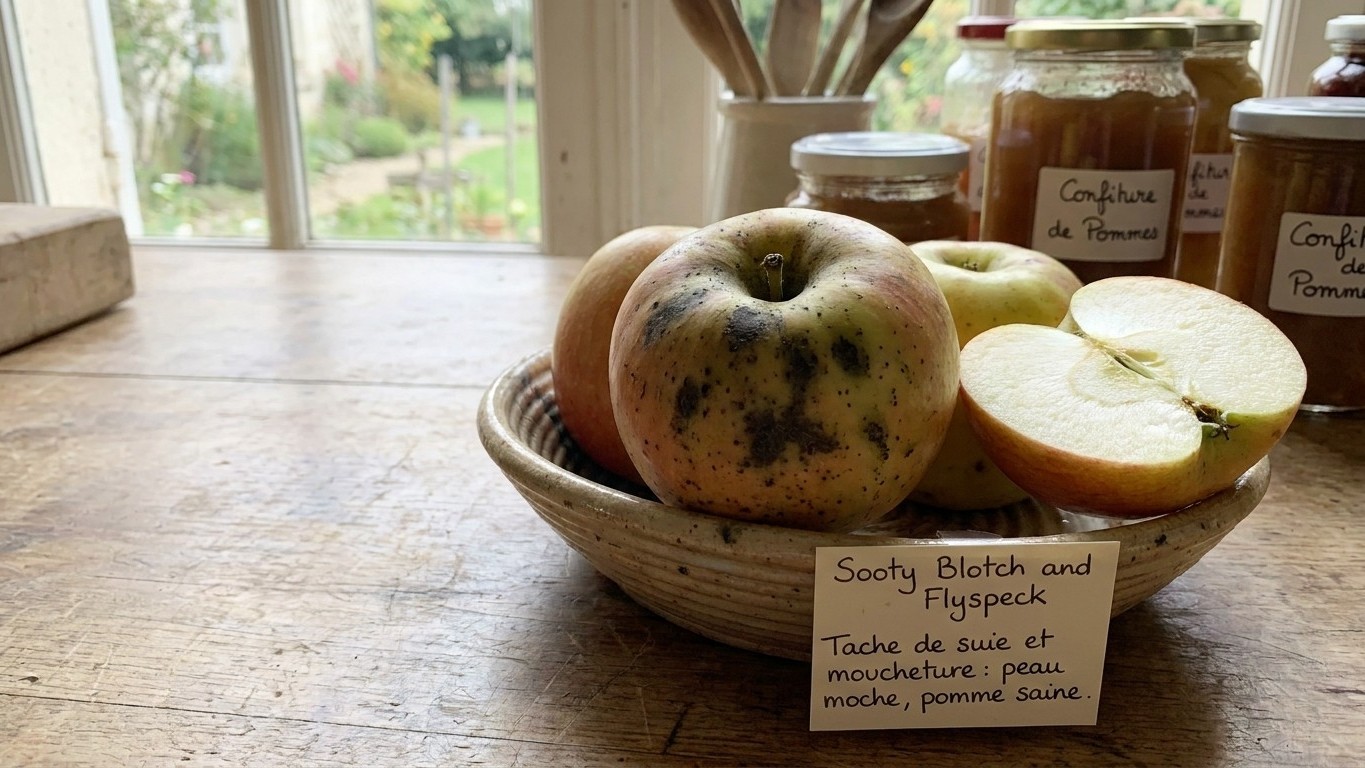

Sooty blotch and flyspeck are cosmetic. The fungi that cause the dark smudges and pinpoint black dots on apple skin sit on the surface of the fruit and do not rot, soften, or spoil the flesh underneath. An apple covered in it is still sound to eat once you get past how it looks. If you are trying to decide whether to salvage a crop already showing symptoms, rub a small patch with a thumb and a little rubbing alcohol: if it lightens or smears, that confirms sooty blotch and flyspeck (SBFS) rather than something that has actually damaged the fruit.
What you are looking at

Two patterns on the same fruit
Sooty blotch and flyspeck are usually discussed together because they show up on the same apples, at the same time of year, and for the same reasons, even though they are caused by different fungi living side by side on the skin. You will not see either one on young, small fruit. Both develop as the apple sizes up through summer and become obvious in the weeks before harvest, often seeming to appear overnight on fruit that looked clean a few weeks earlier.
Sooty blotch shows as fuzzy, olive-gray to black smudges with ragged, indistinct edges. Individual smudges can be smaller than a dime or can merge into a blotch covering half the fruit. Under a hand lens the smudge looks like a smear of soot rubbed onto the skin, which is exactly where the name comes from.
Flyspeck looks completely different and often sits right next to sooty blotch on the same apple: tiny, shiny, near-black dots, each one pinhead-sized, clustered in loose groups or rings. From a step or two back the cluster really does resemble a scatter of fly droppings on the skin.
Both problems favor the shaded, inner and lower parts of the canopy, where fruit stays out of direct sun and dries slowly after rain or dew. Fruit hanging in full sun on the outer canopy often escapes with little or no symptoms even on a tree where inner fruit is heavily marked. Cut one of the affected apples open: the flesh is unmarked, unbruised, and normal in texture and flavor, because both fungi stay on the cuticle and never get past the skin.
What it is not
The look-alikes worth ruling out
The detail that separates SBFS from almost everything else that marks an apple’s skin is depth: sooty blotch and flyspeck sit on top of the cuticle and can be partly rubbed or scrubbed off, while the diseases that actually damage the tree and the crop leave lesions that are sunken, corky, or cracked into the fruit itself.
Apple scab is the most common mix-up. Scab lesions are olive-brown, turn corky and dark with age, and often crack the skin or dimple the fruit’s shape rather than sitting flush on the surface. A tree can carry both problems in the same wet spring, since the weather that sets up scab overlaps with the weather that sets up SBFS. If you’re also seeing leaf lesions and premature leaf drop, read Apple Scab: The Olive Blotches That Come With Wet Springs for that piece of the picture.
Cedar apple rust is the other common confusion, but it is easy to separate once you know what to look for: rust lesions are bright orange to yellow-orange, not black or gray, and they show up on leaves as well as fruit, often with a raised, spotted texture. Details are in Cedar Apple Rust: Orange Spots and the Tree Next Door.
Sooty mold, which grows on the sticky honeydew left by aphids or scale insects, can also look like a black smear at a glance. The giveaway is location: sooty mold tracks wherever the honeydew dripped, often down leaves and onto fruit below an infested branch, and it wipes off cleanly with a damp cloth in a way that true sooty blotch resists. A tree that has been generally struggling with several skin and leaf problems at once is worth reading up on more broadly at Apple Diseases before you decide which one you are actually managing.
The conditions that bring it on
What a bad year looks like
SBFS is a warm, wet-season problem. The fungi need extended periods of leaf and fruit wetness to establish and spread, so a spring and early summer with frequent rain, heavy dew, and warm humid nights sets up the worst outbreaks. A dry spell in the same window can hold both fungi back almost completely, which is why the disease is often much worse in some years than others on the exact same tree.
Air movement matters as much as rainfall. Fruit and wood that stay wet for long stretches after rain, because the canopy is dense and shaded, give the fungi the continuous moisture they need. Fruit on the same tree that dries quickly in sun and breeze often stays clean. This is why symptoms cluster on the shaded, inner side of the canopy rather than spreading evenly over the whole tree.
SBFS fungi also survive on woody hosts other than apple, particularly wild brambles like blackberry, and on other rough-barked shrubs and vines growing in hedgerows, fence lines, and the edge of the woods near an orchard. A stand of wild bramble upwind of the tree acts as a year-round reservoir that reinfects the apples every summer, even if the tree itself was clean the previous fall.
A single bad year does not mean the site is a lost cause. It usually means the combination of a wet season and a crowded, shaded canopy lined up at the same time, and that combination is worth changing for next year even if this year’s crop is already marked.
What to do now
This season’s fruit is not coming back clean
Once sooty blotch and flyspeck are visible on hanging fruit, nothing you do this season removes the marking from the tree. The fungi are already established on the cuticle, and there is no rescue treatment that clears symptomatic fruit while it is still on the branch. What you can control at this point is what happens to the fruit after picking, and what you set up for next year.
- Harvest at the normal time for the variety. Delaying harvest to “wait it out” only gives the fungi more time to spread to unaffected fruit nearby.
- Scrub marked apples under warm water with a soft brush or a mild abrasive pad. Sooty blotch usually lightens noticeably; flyspeck dots are more stubborn but the fruit is unaffected either way.
- Use heavily marked fruit for cider, sauce, or baking rather than fresh eating or gift baskets, where appearance matters more than flavor.
- Do not bother spraying a fungicide on fruit that already shows symptoms. By the time the marking is visible, the infection period that caused it is long past.
If you have not sprayed at all this season and are wondering whether it is too late to start, the honest answer is that a program aimed at SBFS works by protecting fruit during the wet infection periods earlier in the season, at stages like petal fall and the weeks after, not by treating visible symptoms in late summer. Registered fungicides and timing vary by state, so check with your own state extension service for a product and schedule you can actually use where you live rather than guessing at a rate from a label meant for a different region.
What you can start on immediately, regardless of the calendar, is cutting back the parts of the canopy holding fruit in constant shade. Even done in late summer, opening up a few crowded interior branches improves airflow around the remaining fruit for the rest of this season and sets the tree up better for next year at the same time.
Preventing it next season
Airflow does more than any spray
Because SBFS thrives on prolonged wetness in a shaded canopy, the single most useful long-term fix is pruning that opens the tree to sun and moving air, done during the dormant season rather than as an emergency in summer. Remove crossing branches, thin crowded interior wood, and aim for a canopy fruit can dry out of quickly after rain or dew, rather than one so dense that the center never sees direct sun.
How much canopy you are managing depends on the rootstock the tree is grafted onto, since rootstock, not variety, sets the mature size of the tree according to USU Extension’s guidance for home orchards:
| Rootstock | Mature height (USU Extension) |
|---|---|
| M.9 | 8-12 feet |
| M.26 | 12-15 feet |
| G.11 | 12-15 feet |
| G.30 | 18-20 feet |
| M.7 | 18-20 feet |
| M.106 | 25-30 feet |
| MM.111 | 30-35 feet |
| Seedling | 35-40 feet |
A tree on a large rootstock like MM.111 or a seedling rootstock produces a lot more interior wood and shaded canopy to manage every winter than a tree on M.9 or G.11, which stays small enough to keep open with light annual pruning. If SBFS has been a recurring problem on a large, older tree, the underlying issue is often simply that the canopy has outgrown what a home gardener can keep pruned open by hand each year.
Sanitation around the tree matters too. Since wild bramble and similarly rough-barked wild hosts carry the fungi between seasons, clearing or cutting back bramble and neglected brush growing close to the trees removes a reservoir that reinfects the orchard every summer regardless of how well the tree itself is pruned. Good general orchard sanitation, covered on the main Apple Diseases page, also reduces the humid, cluttered conditions that several skin and leaf diseases share, not just this one.
Common questions
Can I still eat apples covered in sooty blotch and flyspeck?
Yes. The fungi stay on the skin and do not affect the flesh, so a scrub under warm water and a soft brush is usually enough to make the fruit presentable, and it is safe to eat either way, marked skin and all.
Will sooty blotch and flyspeck spread to my other fruit trees?
SBFS is specific to apple and pear skin surfaces and the fungi involved do not attack peach, cherry, or other stone fruit the way they attack apple. The bigger spread risk is from wild bramble or brush near the orchard acting as a year-round source that reinfects the apple trees themselves each summer.
Does washing or peeling remove all of it?
Washing lightens sooty blotch noticeably and often removes it almost completely, but flyspeck’s tiny black dots are more stubborn and can survive a scrub. Peeling removes all of it, since both fungi stay on the cuticle and never penetrate into the flesh.
Is there an apple variety that just doesn’t get this?
No published resistance rating for sooty blotch and flyspeck by variety is available from the sources behind this page, and skin texture, canopy density, and local humidity affect how visible the marking is more than the variety itself does. A better lever than variety choice is keeping the canopy open and pruned, which matters on any cultivar.