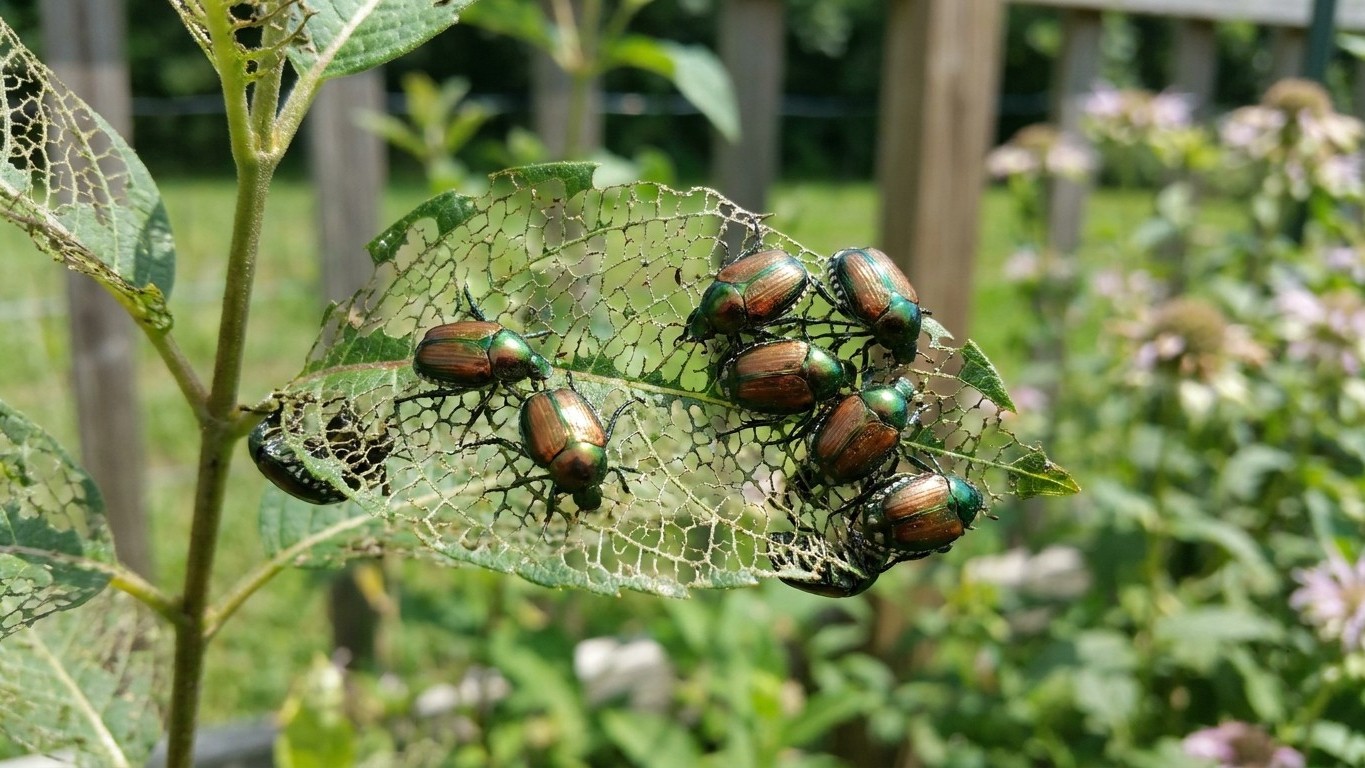

Japanese beetles skeletonize apple leaves, stripping out the soft tissue between the veins until the leaf looks like a scrap of green lace held together by its own ribs. They work the top of the canopy hardest and will also chew shallow pits into ripening fruit on the sunny side of the tree. Check the upper third of the canopy first, since that is where beetles land and feed before they spread downward, and knock a few into a jar of soapy water to confirm the pest before you decide on a response.
The damage it leaves

The first sign most growers notice is a leaf gone see-through in patches, the green tissue chewed away between the veins while the veins themselves stay intact. Left alone, a heavily fed leaf turns brown and curls at the edges within days, and a tree under a bad attack can carry dozens of these skeletonized leaves in the upper canopy at once. Beetles feed in the open, in full sun, and they cluster: find one leaf that looks lacy and you will usually find several more on the same branch, sometimes with a knot of beetles still on it.
Fruit damage shows up differently. Adult beetles rasp shallow, ragged pits into the skin, almost always on the side of the apple that faces the sun, since that is where they gather to feed and to mate. The marks stay shallow on a young, hard apple but widen and scar as the fruit grows, giving a rough, corky patch that does not heal smooth. This is a surface wound, not a tunnel, which matters when you are trying to tell it apart from other pests working the same tree. A single afternoon of heavy feeding will not defoliate a mature tree, but repeated waves through the summer can strip enough leaf area to set back the following year’s bud development.
Bark and twig damage is rare and usually secondary. Beetles occasionally skeletonize the tender green growth at a shoot tip the same way they do a leaf, leaving a bare, brown stub. If you are managing a young tree, this kind of tip feeding is worth watching, since it slows the shoot growth that a newly planted tree needs to fill out its frame. For everything else going after an apple tree at the same time of year, the general roundup at Apple Pests is worth a look before you settle on a single culprit.
Making sure it is this one
What the beetle itself looks like
The adult is small, about the size of a fingernail, with a metallic green head and thorax and copper-brown wing covers that catch the light. Along each side of the abdomen, look for a short row of small white hair tufts. That combination, the green head with the copper back and the white side tufts, is what separates it from the various brown and black beetles that also turn up on fruit trees in summer and get blamed for the same holes.
The leaf pattern helps confirm it too. Skeletonization that leaves the veins standing like a skeleton, hence the name, is a fairly distinctive feeding style. Compare that to the kind of damage other apple pests leave: codling moth tunnels into the fruit itself and leaves frass at the core rather than surface pitting, while plum curculio leaves a crescent-shaped scar on young fruit rather than the rounder, shallower pit a beetle leaves. If the wound has a tunnel behind it, you are not looking at a beetle.
A hung trap settles any doubt fast. Japanese beetle traps use a floral lure and a sex pheromone together, and a trap hung near the affected tree for a day or two will usually catch several beetles if they are present in numbers worth worrying about. Traps are a diagnostic tool here, not a control method, and the difference matters, which is covered in the next section.
When it attacks
Reading the tree’s stage instead of the calendar
Japanese beetle adults do not appear on a fixed date. They emerge from the soil as the tree moves past bloom and into petal fall and early fruit set, when the new leaves are expanding and the young apples are still small and green. That timing lines up with when the beetle’s underground larval stage finishes feeding on nearby turf roots and pupates, so the adults are already active by the time your tree has fruit worth protecting.
Once above ground, the adults feed through the run of summer, working the canopy in waves rather than a single steady push. Females lay eggs back in nearby lawn and turf through this same stretch, and the resulting grubs spend the rest of the season feeding underground on grass roots before overwintering as larvae in the soil. Most regions see one generation a year, so a bad beetle summer on the tree traces back to a healthy grub population in the lawn the year before, and this year’s grubs are already setting up the next round before the adults on your tree have finished feeding.
Feeding tends to taper off as the season moves toward fruit maturity, partly because the beetles disperse and partly because the foliage toughens. That does not mean the damage stops mattering. A tree that lost a meaningful share of its leaf area during petal fall and early fruit set has less foliage left to feed the fruit sizing up and the buds forming for next spring, so a summer beetle problem can echo into a smaller crop the following year even after the beetles themselves are gone.
What to do about it
Traps, hand-picking, and timing around bloom
Hand-picking is the most reliable low-tech control on a small planting. Beetles are sluggish in the cool of early morning, and knocking them off the leaf into a jar of soapy water kills them without any spray. Do this every morning through the worst of the feeding stretch and you will keep the population on that particular tree from snowballing, since beetles are drawn to leaves already showing feeding damage.
Pheromone traps are a poor fit for control despite being sold for exactly that purpose. The lure draws beetles in from a wide radius, and studies behind the traps’ design have found they often attract more beetles to a yard than they actually catch, meaning a trap hung near your tree can leave you worse off. If you use one at all, hang it well away from the tree you are trying to protect, on the far edge of the property, so it pulls beetles off rather than toward the fruit.
Netting is the most dependable physical barrier for a tree small enough to cover, and fine insect netting or floating row cover fabric draped over the canopy during the heaviest feeding weeks keeps beetles off the fruit and leaves entirely. This is worth the effort on a young, low tree and impractical once a tree has grown past reach.
Do not spray anything while the tree is in bloom, regardless of which pest you are treating, since bees and other pollinators are working the flowers at exactly that stage and any material that harms beetles will harm them too. Beetle feeding starts after petal fall, past the point where bloom-stage spray restrictions apply, but check with your own state’s cooperative extension service before choosing a product, since registration and legal use rates differ by state and are not something to guess at. Removing already-skeletonized leaves and any beetle-damaged fruit from the tree and the ground below it also cuts down on the visual and scent cues that draw more beetles in.
Keeping it out next year
Breaking the cycle between lawn and tree
Because the grub stage lives in turf, not in the orchard soil right around the tree, next year’s beetle pressure has a lot to do with how attractive your lawn is to egg-laying females this summer. Well-watered, well-fertilized turf right under and near a fruit tree is exactly the kind of soil a female beetle prefers for laying eggs, so a strip of less lush ground cover, mulch, or bare cultivated soil around the trunk removes some of that appeal.
Fallen, beetle-damaged fruit left on the ground does double duty as a problem. It draws in more adult beetles to feed on the softening flesh, and it also attracts other pests and disease organisms that thrive on rotting fruit. Clean up dropped apples regularly through the feeding season rather than leaving them to accumulate, and do the same with fruit mummies left hanging on the tree over winter, since those carry over problems of their own into spring.
- Pick up dropped and beetle-scarred fruit at least once a week through summer
- Keep pheromone traps, if used at all, well away from any fruit tree
- Hand-pick beetles into soapy water during the cool morning hours
- Reduce lush, well-watered turf directly under and around the tree
- Net young, reachable trees during the heaviest feeding weeks
None of these steps eliminate Japanese beetles from a landscape on their own, since the adults can fly in from neighboring yards no matter what you do on your own property. Combined and repeated year after year, they keep the population working your tree low enough that the damage stays cosmetic rather than something that costs you fruit or next year’s bud set.
Common questions
Will Japanese beetles kill my apple tree?
Not on their own, in a single season. The damage is real but it is leaf and surface fruit feeding, not the kind of trunk or root injury that kills a tree outright. A tree that gets hit hard year after year without any cleanup can lose enough vigor to weaken it, but that takes repeated, unmanaged seasons rather than one bad summer.
Are the grubs in my lawn the same beetle that’s on my apple tree?
Yes, if they are Japanese beetle grubs. The adults you see chewing leaves in summer came out of the soil as grubs that fed on turf roots, and the eggs laid this summer become next year’s grubs in that same soil. Treating the lawn stage is a separate project from managing the adults on the tree, and both matter.
Can I spray to get rid of them while the tree is blooming?
No. Bloom is when bees and other pollinators are working the flowers, and Japanese beetle adults generally do not show up in numbers until after petal fall anyway, so there is no reason to spray during bloom for this pest. Whatever product you eventually choose, check your own state extension service first, since registration and legal application differ by state.
Why do the beetles all show up on one tree and not another?
Aggregation. Japanese beetles are drawn to leaves and fruit that already show feeding damage and to the scent other beetles give off while feeding, so one tree in a row can end up carrying most of the population while its neighbor stays nearly clean. Removing the first damaged leaves promptly can keep a tree from becoming that magnet in the first place.