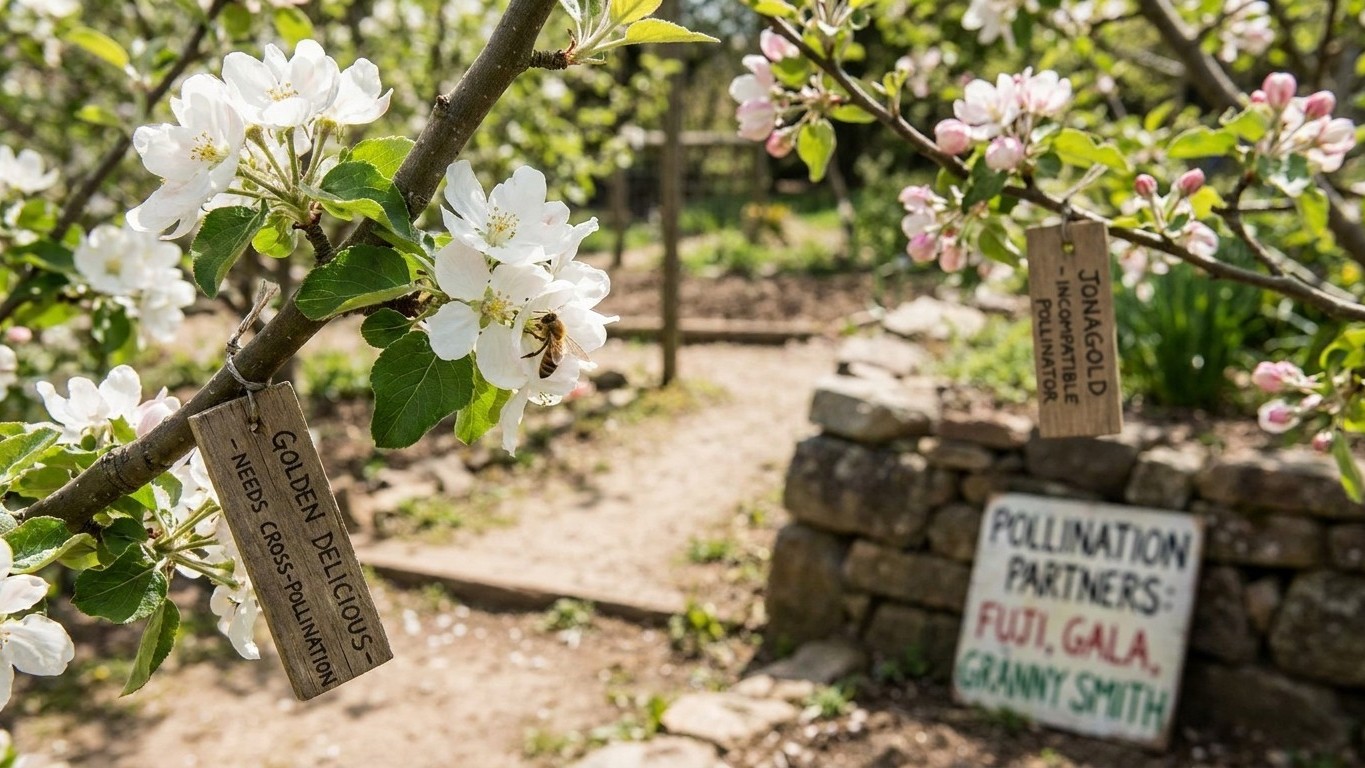

Golden Delicious sets a full crop when pollinated by Arkansas Black, Ozark Gold, Priscilla or Rome Beauty, the four varieties USU Extension and Clemson Cooperative Extension recognize as flowering in the same mid-season window as Golden Delicious, a window Clemson and the University of Georgia class as bloom group C. Plant one of those four within bee-working distance of your Golden Delicious, ideally the same yard rather than the same block, and that single step covers the pollination requirement.
The short answer
If you want fruit from a Golden Delicious tree, plant a second tree from this list: Arkansas Black, Ozark Gold, Priscilla or Rome Beauty. Any one of the four will do the job, and you don’t need all four. What matters is that at least one of them is close enough for bees to move pollen between the two trees during bloom.
Two trees are enough here. Golden Delicious itself is not listed among the varieties with sterile pollen, so it can return the favor to whichever partner you plant beside it. That is not true of every apple. Some varieties produce pollen that cannot fertilize anything, which forces a grower to plant a third tree just to keep both of the first two fed. Golden Delicious does not carry that complication, so a straightforward pair, this variety plus one compatible partner, is the whole shopping list.
| Variety | Bloom timing relative to Golden Delicious | Pollen for Golden Delicious |
|---|---|---|
| Arkansas Black | Same mid-season window, bloom group C | Fertile, compatible |
| Ozark Gold | Same mid-season window, bloom group C | Fertile, compatible |
| Priscilla | Same mid-season window, bloom group C | Fertile, compatible |
| Rome Beauty | Same mid-season window, bloom group C | Fertile, compatible |
If you already have apple pollination basics sorted out from another tree in the yard, this list is the only new information you need for Golden Delicious specifically.
Why these varieties and not others

Pollination only works when two trees are shedding and receiving pollen at the same time. Apple breeders and extension services sort varieties into bloom groups for exactly this reason, and Clemson Cooperative Extension places Golden Delicious in bloom group C, a mid-season slot shared by Arkansas Black, Ozark Gold, Priscilla and Rome Beauty. A variety in an early group has usually finished flowering before a mid-season variety opens its first blossom, and a late variety hasn’t started. Group C is a relative label, not a calendar date. In a warm climate, group C trees might bloom in March. In a cold one, they might not open until May. What stays fixed is the order: whatever is blooming alongside Golden Delicious in your area is the group C window for that year, in that place.
What the bloom group does not tell you
Matching bloom timing gets two trees flowering in the same two or three weeks. It does not tell you whether the pollen is fertile, and it does not tell you whether one variety is a seedling of the other. Both of those questions sit outside the bloom group entirely, and both can quietly ruin a pairing that looks correct on paper. A grower who picks a partner purely because the bloom group matches is only halfway to a working orchard.
This is also why the compatible list above matters more than the bloom group by itself. Arkansas Black, Ozark Gold, Priscilla and Rome Beauty are not just group C apples that happen to flower near Golden Delicious. They are varieties known to produce pollen that actually fertilizes Golden Delicious blossoms, which is a separate fact from timing. Two trees can bloom together for years and never set a full crop between them if the pollen itself is the problem, and that is exactly the situation with the next section.
What cannot pollinate it
Jonagold and Stayman flower at the same mid-season time as Golden Delicious, but neither can pollinate it. Both produce pollen that is functionally sterile, meaning the flowers open on schedule, bees visit them, and nothing useful gets carried to a neighboring tree. A grower who plants only Golden Delicious and Jonagold, or only Golden Delicious and Stayman, gets no fruit from either tree, even though the bloom dates line up perfectly and everything looks correct at flowering time.
This is the trap with bloom group thinking. It’s tempting to assume that two trees flowering together must be able to pollinate each other, but timing and fertility are two different facts about a variety, and only one of them shows up when you’re standing in the orchard watching blossoms open. Sterile pollen only fails in one direction: a sterile variety can still be pollinated by something else, it just cannot return the service.
- Jonagold: same mid-season bloom as Golden Delicious, sterile pollen, cannot pollinate it
- Stayman: same mid-season bloom as Golden Delicious, sterile pollen, cannot pollinate it
- Arkansas Black, Ozark Gold, Priscilla, Rome Beauty: fertile pollen, confirmed compatible
Parentage is the other trap, though it doesn’t apply to Golden Delicious and either of these two. A variety bred as a seedling of another cannot fertilize its own parent, no matter how closely the bloom times match, because the pollen carries the same genetic material the parent tree already has. Beyond the varieties named here, published compatibility data for Golden Delicious runs out. If you’re considering a variety not on either list, the honest answer is that its compatibility with Golden Delicious has not been documented, and guessing from bloom group alone is exactly the mistake this section is warning against.
How close the second tree has to be

Apple pollen moves on bees, not on wind, so distance is a practical question rather than a fixed number. The closer the two trees, the more reliably bees carry pollen between them, and a partner tree in the same yard works far better than one three properties away. Honeybees and orchard mason bees do range further than a single yard, but every extra hundred feet is a chance for a bee to visit other flowers along the way and never make the crossing at all.
What else can carry the job
The second tree does not have to be one you planted for this purpose. A neighbor’s apple tree, if it happens to be one of the four compatible varieties and blooms close enough in time, does the same work as a tree in your own garden. A flowering crabapple blooming at the same point in the season can also stand in as a pollen source, since crabapples are apples in the same genus and many overlap nicely with mid-season varieties. A single grafted branch of a compatible variety, added onto an existing tree, is another route, and it solves the space problem without a second trunk in the ground.
None of that helps if bees simply aren’t flying. Cold or wet weather during the bloom window keeps bees inside, and no amount of pollinator variety fixes a week of rain when the blossoms are open. This is the one part of the pollination question that a second tree can’t solve on its own, and it’s worth watching your local bloom period for a stretch of decent weather rather than assuming compatibility alone guarantees a crop.
If there is no room for a second tree
A small garden doesn’t rule out pollination, it just narrows the options. A multi-grafted tree, one trunk carrying two or three varieties grafted onto it, gives you a compatible partner without a second planting hole. It takes more pruning attention than a single-variety tree, since each grafted variety grows at its own rate and can shade out the others if left unchecked, but it solves the space problem completely.
Grafting a single pollinator branch onto your existing Golden Delicious is a lighter version of the same idea. It costs an afternoon with a grafting knife and a scion of Arkansas Black, Ozark Gold, Priscilla or Rome Beauty, and it doesn’t require a second tree at all. The tradeoff is that a graft takes a year or two to establish and flower reliably, so it’s not an instant fix the first spring.
A columnar apple variety, bred to grow as a narrow upright tree instead of a spreading one, fits into a bed or a large container and can serve as the second tree in a genuinely tight space. It still needs to be one of the compatible varieties, or one confirmed to overlap in bloom and fertility, so checking the same list applies before buying one. A flowering crabapple, planted purely for pollen rather than fruit, is often the cheapest fix of all, since ornamental crabapples are widely sold and many nurseries can tell you their bloom timing.
None of these options changes the weather problem from the section above. A columnar tree, a graft, or a crabapple all still depend on bees flying during bloom, and a compatible variety with the wrong weather window sets no more fruit than an incompatible one. If you’re weighing the same decision for a different variety, the pollination requirements for Golden Supreme and for Topaz both work through the same bloom group and pollen fertility questions, though the compatible lists themselves are different.
Common questions
Can I just plant two Golden Delicious trees together?
No. Two trees of the same variety share the same pollen, and a variety generally cannot fertilize its own flowers. You need a genuinely different variety, ideally one from the compatible list, for either tree to set a full crop.
My Golden Delicious already has some apples on it with no other tree nearby. How?
A wild crabapple, a neighbor’s tree further away than expected, or even an ornamental in a nearby yard can be doing the pollinating without your knowledge. Bees range further than most gardeners assume, so a light crop with no obvious partner tree usually means one exists somewhere within flying distance.
Does a crabapple work as well as a full-size pollinator variety?
It can, as long as it’s flowering at the same time as your Golden Delicious. Crabapples are in the same genus as apples and many bloom in the mid-season range, but check the specific crabapple’s bloom timing before relying on it as your only pollen source.
What happens if I plant Jonagold and Stayman together thinking they’ll pollinate my Golden Delicious?
You’ll likely get little or no fruit from any of the three trees. Jonagold and Stayman both carry sterile pollen, so neither can fertilize Golden Delicious or each other, regardless of how well their bloom times overlap.
How do I know if a variety I’m considering is actually bloom group C?
Check the variety’s entry with a state extension service or a reputable nursery catalog, since bloom group is usually listed alongside disease resistance and harvest window. Remember that the group tells you relative timing only, not fertility, so confirm pollen compatibility separately before counting on it.