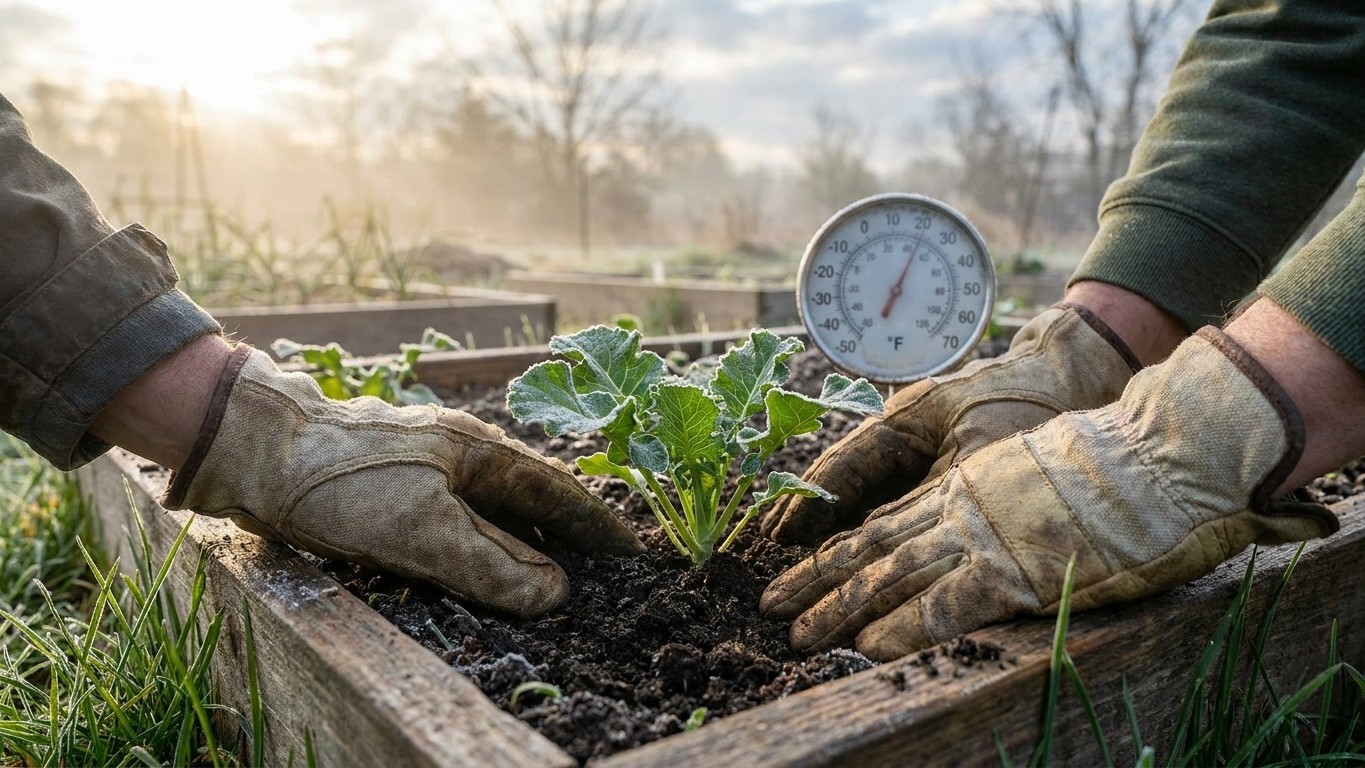

Broccoli transplants go into the ground two to three weeks before the last frost date in your area, according to Utah State University Extension’s guide, Broccoli in the Garden (Drost & Johnson, 2020). That’s the reverse of what most gardeners learn with tomatoes and peppers, which wait until frost danger has fully passed. Broccoli handles cold fine and struggles with heat, so planting it early rather than late is what actually protects the crop.
The short answer
Utah State University Extension states it plainly: transplants may be planted two to three weeks before the last frost-free date for the growing area, and seeded broccoli can go into the ground at that same time. There’s no waiting for a calendar date after frost risk ends. The plant is set out while a light frost is still a realistic possibility, because a young broccoli transplant simply isn’t bothered by it the way a pepper seedling would be.
The cold tolerance behind that recommendation is specific. Broccoli is not seriously damaged by temperatures down to 28 F, according to the same USU Extension source. That’s a real frost, not a chilly morning. What broccoli can’t tolerate is heat: the plant grows best and produces its highest yields when temperatures stay at or below 75 F. Push past that ceiling during the heading period and quality drops fast, so every week gained in early spring is a week of cool weather banked before the heat of summer arrives.
This is why the transplant date sits before the last frost instead of after it. A gardener who waits, out of habit, for the same “safe” date used for warm-season vegetables is giving up productive cool weeks for no benefit, since the frost itself was never the threat. The real deadline broccoli is racing against is the arrival of hot weather, not the departure of cold weather.
USU Extension also specifies what a transplant should look like before it goes out: four to six mature leaves and a well-developed root system. Younger, smaller transplants handle that early, still-cool ground better and are less prone to the stress reactions covered in the next section. A transplant that’s been held too long indoors and has outgrown that four-to-six-leaf stage is more likely to react badly to the very conditions it’s being planted into.
What actually decides it
Three separate mechanisms determine whether an early-planted broccoli crop turns into full, tight heads or a disappointing patch of loose, bitter florets. They don’t overlap, and treating them as one problem is how gardeners misdiagnose what went wrong.
Heat, not cold, is the real enemy
Broccoli’s growth ceiling sits at 75 F. High summer temperatures reduce growth, decrease quality, and cause loose heads to form, according to USU Extension, and those loose heads taste bitter. Heat also pushes heads to open and flower prematurely, a problem made worse by water stress on top of the heat. The practical takeaway: the goal of early planting and fall planting alike is keeping the heading period inside cool weather, not just avoiding frost at the start.
Buttoning has three separate causes
Buttoning is the development of premature, undersized flower heads, and USU Extension identifies three distinct triggers rather than one. Plants that button have been exposed to cold weather, or stressed for water, or stressed for nutrients, either before or after transplanting. Any one of those three, alone, can cause it. On top of that, larger transplants are more prone to buttoning, which is exactly why selecting transplants with four to six leaves (not more) matters at planting time. Cold exposure, water stress, and nutrient stress each demand a different fix, so a gardener troubleshooting buttoned heads needs to rule out all three rather than assuming it’s simply “the cold.”
Boron deficiency mimics other stress
A separate issue, boron deficiency, shows up as brown spotting on the head and a hollow, discolored stem underneath it. USU Extension links this to excess fertilizer, high pH soils, or water-stressed plants, not to cold at all. Because the symptoms can look like general stress damage, it’s worth ruling boron deficiency out separately rather than folding it into a buttoning diagnosis.
How to do it
- Work backward from the last frost date. USU Extension advises sowing seed for transplants six to seven weeks before the expected planting date, and planting transplants two to three weeks before the last frost. Add those two figures together in words: two to three weeks before frost for planting, plus another six to seven weeks before that for sowing, lands the indoor seed-starting date at roughly nine weeks ahead of the last frost date.
- Sow seed indoors one-quarter to one-half inch deep.
- Thin seedlings once they reach three to four true leaves.
- Hold transplants until they have four to six mature leaves and a well-developed root system, no further, since oversized transplants are more prone to buttoning.
- Set plants out two to three weeks before the last frost-free date, spacing 12 to 18 inches apart within the row and leaving two to three feet between rows. Closer spacing of one foot by one foot is possible but reduces head size and inhibits side-shoot development.
- Water one to two inches per week, applied deep and infrequent rather than light and frequent; drip irrigation is preferred where available. Keep plants well-watered through the heading period specifically, since water stress at that stage worsens premature flowering.
- Feed with nitrogen (21-0-0) at one-half cup per 10 feet of row, four weeks after transplanting or thinning. Add another one-quarter cup once the head reaches the size of a quarter.
- Apply organic mulch once temperatures climb above 80 F.
- For a fall crop, plant 50 to 75 days before the anticipated maturity date; the maturity date itself can land several weeks after the first fall frost.
- Harvest when heads are compact and before flower buds open, at 6 to 12 inches in diameter, cutting with about six inches of stem attached.
- After cutting the main head, apply additional water and fertilizer to push side-shoot production, which yields shoots three to six inches long.
What goes wrong
- Heads button early instead of forming full size. This traces to one of three causes: cold exposure, water stress, or nutrient stress, made more likely by an oversized transplant. Fix it by planting transplants at four to six leaves rather than letting them grow larger, and by keeping water and fertilizer consistent from transplanting onward.
- Heads turn loose, open, and bitter. This is a heat response, worsened by water stress during heading. Time the crop so the heading period lands in cool weather, and keep plants well-watered through that stretch.
- Brown spotting on the head with a hollow, discolored stem underneath. This points to boron deficiency, tied to excess fertilizer, high pH soil, or water-stressed plants. Avoid over-fertilizing and keep watering consistent, particularly in alkaline soils.
- Concentric, sooty black spots on leaves. This is Alternaria leaf spot. Avoid overhead irrigation, which spreads it, and rotate broccoli out of the same bed in following seasons.
- Worms found inside the harvested head. Cabbage worms and loopers hide directly inside the developing head rather than staying on outer leaves, so a clean-looking exterior doesn’t rule them out. Check heads carefully before use.
- Seedlings disappear or collapse soon after emergence. Flea beetles target young seedlings and can kill them outright. Protect transplants at the seedling stage rather than waiting for damage to appear on mature plants.
Common questions
Can broccoli be direct-seeded instead of started indoors as transplants?
Yes. USU Extension notes that seeded broccoli may be planted at the same time as transplants, two to three weeks before the last frost-free date, seeded one-quarter to one-half inch deep and thinned at three to four true leaves.
Why does broccoli go in before the last frost while tomatoes and peppers wait?
Because the two crops have opposite vulnerabilities. Broccoli isn’t seriously damaged by temperatures down to 28 F but loses quality above 75 F, so early planting buys cool weeks before summer heat arrives. Warm-season crops face the opposite risk and can’t tolerate frost at all.
How much broccoli should I plant, and what does it yield?
USU Extension recommends three to five plants per person for fresh use, plus another five to ten plants per person if you plan to store extra. Expect roughly 7 to 10 pounds per 10 feet of row. Harvested heads keep one to two weeks in storage at 32 F and 95% relative humidity.
Which broccoli varieties mature fastest?
USU Extension lists three specific cultivars with their days to maturity: Packman at 50 days, Green Comet at 55 days, and Premium Crop at 65 days. That spread matters most for timing a fall crop, since USU Extension advises planting 50 to 75 days before the anticipated maturity date.